Regular Episode
#075 – ZOMBIES, CULTS, AND DEMONS
🧟 Voodoo, Zombies, and the Real Walking Dead
Karen traces Voodoo (also spelled Vodou) from its origins among the Fon and related peoples of West Africa, through the brutal mechanism of the Code Noir — the French colonial slave code that forced rapid conversion to Catholicism — and into its syncretized New World forms: Haitian Vodou, Brazilian Candomblé, and Cuban Santería. Because practitioners were forced to hide their faith, they mapped their spirits — the Loa — onto Catholic saints, creating the syncretic tradition still visible today in New Orleans shops and altars.
Despite Hollywood shorthand, the religion is monotheistic, community-oriented, and largely focused on petitioning spirits (including the crossroads figure Papa Legba) for practical help in everyday life. Voodoo dolls, it turns out, are more talisman than torture device.
On the zombie front, Karen discusses the Haitian legal and cultural reality: zombification — the alleged use of poison to reduce a victim to a near-death, controllable state — is serious enough to be prohibited under the Haitian Penal Code. The most famous alleged case is that of Clairvius Narcisse, who reappeared in 1980 claiming to have been buried alive, enslaved on a sugar plantation, and wandering Haiti for nearly two decades. DNA testing of other alleged zombie returnees has consistently disproved the family connections — most cases appear to involve mistaken identity and mental illness rather than actual pharmacological zombification.
Ethnobiologist Wade Davis investigated the supposed zombie poison for his book 📚 The Serpent and the Rainbow 💵, ultimately identifying a preparation containing tetrodotoxin (from pufferfish) and the hallucinogenic jimsonweed. Laboratory analysis found the doses too small to reliably produce the claimed effect, and Davis’s chemical hypothesis has since been largely discredited — though his broader argument about the social power of the zombie threat as a mechanism of control remains a subject of discussion.
👑 Marie Laveau and the Above-Ground Cemeteries of New Orleans
Blake and Karen pay tribute to Marie Laveau, the 19th-century “Voodoo Queen of New Orleans,” who died around 1881 but whose tomb in St. Louis Cemetery No. 1 is still visited by pilgrims who mark three crosses, knock three times, and leave offerings. A string of women who resembled her — including a daughter and granddaughter — helped sustain the legend of her near-immortality. A self-made entrepreneur, Laveau moved from hairdressing to voodoo practice under a mysterious mentor known as “Dr. John,” and combined genuine charitable work with a brisk trade in curses, charms, and information-brokering.
Blake also debunks the popular claim that New Orleans uses above-ground “oven” burials because coffins would float up in floods. His scale-model experiments suggest a burial deeper than about three feet is sufficient to prevent buoyancy in flooding. The more likely explanation: when Spanish colonial administrators controlled the city, they imported the above-ground entombment style common in Spain, and the practice simply persisted. (Post-hurricane washout — where floodwaters erode the surrounding soil — is a different and real phenomenon.)
😈 Demonic Possession and Exorcism
Possession in voodoo is spiritually desirable — a sign of divine favor. In much of Western Christianity the opposite is assumed, and Karen traces the history of exorcism back well beyond Christianity to Babylonian, Egyptian, Greek, and Roman practices. Its modern American popularity exploded after William Peter Blatty‘s novel 📚 The Exorcist 💵 and the 1973 film adaptation, alongside Rosemary’s Baby and The Omen.
Karen references Michael Cuneo‘s 📚 American Exorcism 💵, which distinguishes between the Hollywood “fireworks” — levitation, xenoglossia, supernatural strength — and what actually shows up in real exorcism cases: mundane struggles with addiction, lust, or mental illness reframed as demonic oppression. Malachi Martin‘s 📚 Hostage to the Devil 💵 is discussed as representative of the lurid, over-the-top end of exorcism literature; Karen regards it as essentially fiction.
The episode plays audio from the real-life exorcism sessions of Anneliese Michel, the German woman who died in 1976 after 67 exorcism sessions spanning roughly ten months — during which she received no medical treatment for what was most likely epilepsy and schizophrenia. Her parents and the officiating priests were convicted of negligent homicide. Blake notes that Anneliese’s case unfolded after The Exorcist had already been released, and the audio bears a striking resemblance to the film’s template — consistent with a pattern of cultural scripting rather than genuine possession. Anneliese herself reportedly believed she was inhabited by the spirits of Nero, Judas Iscariot, and Adolf Hitler, among others.
The conversation also covers Bob Larson, self-styled “The Real Exorcist,” whose touring exorcism events Karen attended firsthand. She describes them as a form of structured group performance: crowds are primed with exorcism videos, cued to identify specific “demons” (Belial, Legion, Jezebel), and led through what skeptical investigator Joe Nickell characterizes as stage-hypnosis-style complicit role-play — with ongoing appeals for donations throughout.
🕯️ LaVeyan Satanism and the Satanic Panic
Karen draws a sharp distinction between LaVeyan Satanism — founded by Anton LaVey in San Francisco in 1966 and characterized by atheism, individualism, and theatrical ritual (“psychodrama”) rather than actual devil worship — and the murderous secret cults conjured by the Satanic Panic of the 1980s and early 1990s. LaVey himself was a serial self-mythologizer: claims of affairs with Jayne Mansfield and Marilyn Monroe, vast real estate holdings, and enormous wealth were largely fabricated. He died nearly penniless.
The Panic was substantially ignited by 📚 Michelle Remembers 💵 (1980), in which Michelle Smith — under hypnosis with her therapist, later husband, Lawrence Pazder — produced recovered “memories” of childhood satanic ritual abuse dating to 1956, more than a decade before LaVey’s Church of Satan even existed. The episode also references the McMartin Preschool trial and the broader role of leading questions, bad therapy, and poorly understood memory science in generating false accusations with devastating real-world consequences. For deeper background on false memory, Blake points listeners to an earlier MonsterTalk special featuring Elizabeth Loftus and Richard Wiseman.
Animal sacrifice associated with cemetery vandalism, Karen notes, is far more likely to be connected to Santería practice than to Satanism — and the persistent urban legend linking corporations like Procter & Gamble to Satanism (via a supposedly 666-encoded logo) was traced back to competing Amway distributors.
📚 Further Reading
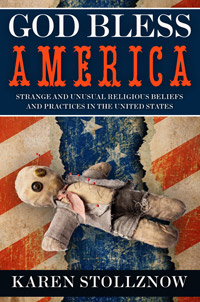
– 📚 God Bless America: Strange and Unusual Religious Beliefs and Practices in the United States 💵 by Karen Stollznow
– 📚 Haunting America 💵 by Karen Stollznow
– 📚 The Serpent and the Rainbow 💵 by Wade Davis
– 📚 American Exorcism 💵 by Michael Cuneo
– 📚 Hostage to the Devil 💵 by Malachi Martin
– 📚 Michelle Remembers 💵 by Michelle Smith and Lawrence Pazder
– 📚 In Pursuit of Satan: The Police and the Occult 💵 by Robert Hicks
🔗 Related Links
– Haitian Vodou (Wikipedia)
– Clairvius Narcisse
– Marie Laveau
– Anneliese Michel
– Anton LaVey
– LaVeyan Satanism
– Satanic Panic
– McMartin Preschool Trial
– Cheesman Park, Denver (and its cemetery history)
Note: ads inserted into the distributed audio alter the timestamps in unpredictable ways, so timing references in these notes are approximate.
A FAMILIAR VOICE returns to MonsterTalk as Dr. Karen Stollznow joins us to discuss her new book, God Bless America.
Items of Interest
- Haunting America on Amazon
- More information on the case of Anneliese Michel
- Wade Davis’s book on Haitian zombies — The Serpent and the Rainbow
- More reading on the Satanic Panic — In Pursuit of Satan: The Police and the Occult
Music
- Monstertalk Theme: Monster by Peach Stealing Monkeys
MTArchivist
0