#076 – NATURE’S RICH BOUNTY
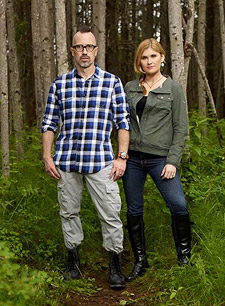
Dr. Todd Disotell is a professor of anthropology at New York University and a veteran MonsterTalk guest going back to the very first episode of the show. He has previously appeared on MonsterQuest and Is It Real? and is one of the more recognizable scientific skeptics in the cryptozoology media ecosystem. Natalia Reagan is a primatologist, comedian, writer, and actress whose academic work centers on spider monkeys, primate conservation, and evolutionary biology. She has appeared in My Name Is Earl and Better Off Ted, and consulted for The Today Show and Fox Edge News. This is her first appearance on MonsterTalk.
🔬 How Two Scientists Ended Up on a Reality Show
Dr. Disotell was originally brought in to consult with Lloyd’s of London — the underwriters backing the titular bounty — to establish the scientific criteria that would actually qualify for the $10 million prize. That meant defining the required standard of DNA evidence, as well as physical or visual corroboration. From there, he was incrementally drawn deeper into the production: designing the challenge structure, building and manning a field laboratory, and finally, only about ten days before filming began, being asked to serve as a full co-host.
Reagan’s path was similarly last-minute. Disotell had introduced her to the executive producers as a potential guest host for individual episodes. When the format shifted to two permanent co-hosts, she got the call — roughly 16 hours before her flight. She had already committed to teaching a primate field school in Costa Rica, and somehow managed to do both.
🧫 A Real Lab in the Real Woods
The most striking element of the conversation is just how much genuine fieldwork infrastructure Disotell brought to the production. He designed a portable laboratory that fit into five shipping crates and included an automated DNA extraction system capable of processing 96 samples in approximately 90 minutes, two high-speed PCR machines, and two high-speed gel electrophoresis units. Working roughly from 6 a.m. to 4 p.m. each day, he processed hundreds of biological samples, identifying them down to family or genus level — distinguishing ursids, canids, cervids, non-human primates, and humans — without full sequencing.
One technique that particularly excited both hosts was environmental DNA extraction from biting insects. By capturing mosquitoes and other blood-feeding insects and analyzing their blood meals (provided the meal was less than 24–36 hours old), the team could reconstruct a snapshot of the local fauna without ever directly observing the animals themselves. Disotell noted that this approach — now being adopted by primatologists and wildlife biologists using high-throughput sequencing — is genuinely applicable to his ongoing academic research, and that the experience of running a portable field lab may change how he and his graduate students approach future primate studies.
📋 The Show’s Format and the Scientific Method as a Competitive Sport
The show featured nine teams of two — five self-described professional “squatchers” and four professional hunters or wildlife photographers — competing across eight episodes set up as expeditions. Each episode had three components: a skills challenge, an overnight evidence-gathering hunt, and an elimination round in which teams had to present and defend their collected evidence before the hosts.
The challenges were explicitly designed to mirror real fieldwork: teams used biopsy dart guns, deployed camera traps, practiced GPS mapping, identified animal trackways, and collected insects. Evidence collection was subject to strict protocol — gloves, sterile implements, photographs taken before and during collection, GPS coordinates on every sample. Disotell was clear: if a sample arrived without documented sterile collection, it didn’t go in the lab.
The team that survived all eight episodes won a $100,000 “research grant” (the standard reality show prize, rebranded for the squatching context). The $10 million bounty, underwritten by Lloyd’s, remained available to any team that could produce evidence meeting the scientific criteria — which no team did.
🦶 What Bigfoot Would Actually Have to Be
The episode gets into some genuinely interesting primate biology when Reagan and Disotell discuss the contradictions in the squatchers’ theories. Across nine teams, Bigfoot was variously described as an apex predator, a strict vegetarian, purely nocturnal, only active during the day, solitary, and living in multi-male/female groups. The creature was simultaneously described as so cryptic as to be nearly undetectable — and yet apparently fond of elaborate tree-knocking and tree-structure building as territorial communication.
Reagan noted several specific anatomical problems with common Bigfoot claims: the near-total absence of anatomically plausible secondary sexual characteristics on Bigfoot statues and depictions; the question of what primate grouping structure would be consistent with the reported behavior; and the biomechanical implausibility of a large ape being both a habitual biped and a brachiator. She also revisited the Patterson–Gimlin film through a primatologist’s eye, remarking on the lack of realistic movement in the subject’s chest anatomy for a full-grown individual moving at that gait. Disotell added that the DNA criteria they established for the bounty required a sample to represent a non-human primate falling outside the known range of variation of any recognized species — specifically to rule out, for instance, a feral chimpanzee.
Disotell also mentioned that his lab has been involved in the description of multiple new primate species and subspecies, including two subspecies each of chimpanzees and gorillas, as well as several new monkey species — making clear that the techniques needed to confirm Bigfoot’s existence are entirely standard, and that the absence of positive results to date is meaningful.
🎬 Science Advocacy and the Reality TV Gamble
Both guests were candid about their uncertainty over how much of the scientific content would survive the editing process, having seen only clips rather than full episodes before the interview. Reagan, who came to the show from a background in science-comedy videos, expressed hope that the show might serve as an entry point for younger viewers — particularly young women — into field primatology. She and Disotell were planning a series of independent online videos to ensure the science got out regardless of what made final cut.
The show maintained a strict no-weapons policy — something Reagan said was a condition of her participation, and which addressed early online concern from parts of the Bigfoot community that armed hunters might attempt to kill a Sasquatch. The largest implement any contestant carried was a Leatherman.
Blake summed up the episode’s central tension neatly: he went in expecting television spectacle and came out genuinely impressed — if still cautious — about whether the science would make it to air. As he put it, the show was aiming for that rarest of tricks: balancing entertainment with education.
📚 Further Reading
– 📚 Hunting Monsters: Cryptozoology and the Reality Behind the Myths 💵 by Darren Naish
– 📚 Abominable Science!: Origins of the Yeti, Nessie, and Other Famous Cryptids 💵 by Daniel Loxton and Donald R. Prothero
🔗 Related Links
– Gigantopithecus — the extinct great ape sometimes proposed as a Bigfoot candidate
– Denisovans — another proposed archaic hominin candidate discussed by the guests
– Environmental DNA (eDNA) — the wildlife survey technique used in the field lab
– Patterson–Gimlin Film — the 1967 footage discussed through a primatological lens
– Primate locomotion — background on bipedalism and brachiation in apes
– Chupacabra — mentioned by Disotell, whose lab has tested numerous alleged samples (invariably mange-affected canids)
Note: ads inserted into the distributed audio alter the timestamps in unpredictable ways, so timing references in these notes are approximate.
IF BIGFOOT IS REAL, would a $10,000,000 bounty be enough to bring the beast down? That’s the premise of a new show on Spike TV. In this episode, MonsterTalk interviews two of the scientists who are working on the show to find out if this is a serious search for Bigfoot, or just folks out in the woods raising cane.
Natalia Reagan is an anthropologist, comedian, writer, actress and a co-host of the Ten Million Dollar Bigfoot Bounty. Her academic work has focused on spider monkeys, primate conservation, and evolutionary biology. She combines her wit and creativity with her passion for science advocacy to help make educational videos. As an actress, she’s appeared on shows such as My Name is Earl and Better Off Ted—and as a science consultant on The Today Show and Fox Edge News. This is her first appearance on MonsterTalk.
Dr. Todd Disotell is a professor of anthropology at NYU, and a co-host of the new Spike TV show the Ten Million Dollar Bigfoot Bounty. MonsterTalk listeners will remember Todd from previous visits going back to the very first episode of our show, as well as his appearances on MonsterQuest and Is It Real? He has been a prominent voice for science advocacy and skepticism in cryptozoology.
Music
- Monstertalk Theme: Monster by Peach Stealing Monkeys