Regular Episode
#068 – RETURN OF THE REVENGE OF THE SON OF THE BRIDE OF MONSTERTALK
The conversation is part book celebration, part methodological reckoning: how should we actually investigate cryptids, what does the historical record really show, and why does it matter that millions of people believe in creatures like Bigfoot?
📖 The Book Itself
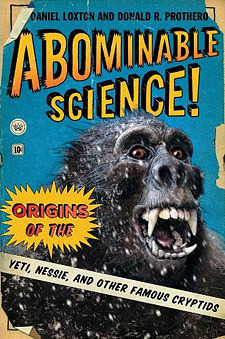
Columbia University Press produced Abominable Science! as a full-color hardcover on high-quality glossy stock — unusual for an academic press and a genuine surprise to both authors. The cover deliberately mimics a pulp tabloid or 1940s–50s comic book, complete with a faux-tattered jacket. At $30 for an academic hardcover with color printing throughout, Blake calls it one of the most beautiful books in his paranormal collection.
The volume covers five major case studies — Bigfoot, the Loch Ness Monster, sea serpents, the Yeti, and Mokele-mbembe — and opens with a methodological chapter on how science works and how to rank evidence. Finished chapters on Chupacabra and other lake monsters were cut for length but may appear in a second edition or on Columbia’s website. The book still ran to roughly twice its contracted length.
🔍 What the Research Actually Turned Up
Both authors emphasize that, despite the enormous existing literature on these creatures, genuinely basic historical work had never been done. A few standout discoveries from their research:
– The Mokele-mbembe legend emerges, in the historical record, almost immediately after the first sauropod dinosaur skeletons were mounted in the world’s museums — a connection never previously discussed in the literature. Ironically, those century-old museum mounts were scientifically wrong (tail-dragging swamp dwellers), and it is precisely that outdated image that informs the legend, suggesting cultural rather than biological origin.
– The William Roe sighting — arguably the most important account in the Bigfoot literature and a likely template for the Patterson-Gimlin film creature — was submitted to researcher John Green by letter. Roe subsequently died, and no one in cryptozoology ever interviewed him in person. Nobody in the literature had even noted this absence.
– The George Spicer sighting — the report that gave Nessie its long neck and transformed it into something plesiosaur-like — occurred shortly after Spicer had seen the 1933 film 🎬 King Kong 💵. Researcher Rupert T. Gould noticed the similarity and asked Spicer about it, but the connection then dropped out of serious discussion for roughly 80 years. Abominable Science! revives it with a direct visual comparison between the Spicer sketch and relevant film frames.
🌊 Boom-and-Bust: The Cultural Pattern of Cryptid Sightings
Across multiple cryptids, the authors identify a recurring pattern: a single highly publicized sighting triggers a wave of copycat reports, interest peaks, then subsides — only to be reignited by the next big sighting. This is a cultural cycle, not a biological one. The Chupacabra is a particularly clean example: the creature had no prior existence before a woman in Puerto Rico — who had just seen the 1995 film 🎬 Species 💵 — reported a similar creature. The legend spread across Latin America after a television appearance on El Show de Cristina, a Spanish-language talk show, and notably stopped spreading wherever Spanish-language cultural influence faded.
Similarly, the Yeti was originally described in Himalayan sources as a dark brownish creature (consistent with the Himalayan brown bear). Western culture has since canonized it as snow-white — as seen in stop-motion holiday specials and cartoon depictions — a transformation driven entirely by cultural drift.
🦕 Ecological and Geological Constraints: What Biology Actually Requires
Don brings his background in paleontology and field biology to bear on a question cryptozoology typically sidesteps: what would the real-world biology of these animals actually demand? Population densities, home-range sizes, fossilization rates, and dietary requirements all generate testable predictions — and none of the cryptid evidence comes close to satisfying them. Lake monsters face an additional geological constraint: most of the lakes where they are reported (including Loch Ness) were under glacial ice as recently as 12,000 years ago, making a relict population of large reptiles or plesiosaurs essentially impossible.
The Loch Ness Monster and Mokele-mbembe receive the firmest verdicts in the book. Sea serpents are treated more cautiously: the ocean remains genuinely underexplored, and the chapter acknowledges that novel deep-water organisms remain plausible — just not the specific cultural creature the legend describes.
⛪ Cryptozoology, Creationism, and the Stakes of Bad Thinking
One of the book’s most pointed arguments concerns the overlap between cryptozoology and creationism. Don notes that the most active field investigators currently searching for Mokele-mbembe and the Loch Ness Monster are often creationist groups who believe that finding a living sauropod or plesiosaur would somehow falsify evolution — a claim that reflects a fundamental misunderstanding of how evolutionary theory works. He highlights a Louisiana voucher-school curriculum that was, at the time of recording, teaching the Loch Ness Monster as scientific evidence against evolution.
Don and Daniel differ somewhat in their assessment of cryptozoology’s overall harm potential. Don sees uncritical belief as a gateway to broader scientific creationism and argues that anything reinforcing credulous thinking has social costs in a country where roughly 40% of the population holds creationist views. Daniel, who traces his own career as a science writer directly to a childhood love of monsters, is more sympathetic to the field’s power to ignite curiosity — though he acknowledges Don’s concern may be more apt in the American context than in the comparatively secular environment of British Columbia.
👥 Who Believes, and Why It Matters
The final chapter of Abominable Science! draws on demographic survey data to sketch a portrait of the cryptid-believing public. The findings are, as Daniel puts it, “boringly normal”: believers are largely indistinguishable from the general population in education, income, and relationship status — and are, if anything, slightly more likely to be married than average. One surprising finding: women are at least as likely as men, and by some surveys more likely, to believe in cryptids generally. Yet the deeper one goes into active cryptozoology — convention attendance, content generation, field research — the more male-dominated the community becomes, mirroring patterns seen in skepticism, atheism, and geek subcultures more broadly.
Blake and Daniel push back on skeptics who regard monster research as a waste of time. Roughly 20% of the American public thinks Bigfoot is probably real, with 2–3% being certain — that’s millions of people whose beliefs deserve serious scholarly attention. As Daniel puts it: “The largeness of your topic is not diminished by the smallness of mine.”
📚 Further Reading
– 📚 Abominable Science!: Origins of the Yeti, Nessie, and Other Famous Cryptids 💵 by Donald Prothero and Daniel Loxton
– 📚 Haunting America 💵 by Karen Stollznow
– 📚 The Loch Ness Monster 💵 by Rupert T. Gould (a key primary source cited throughout the book)
🔗 Related Links
– Patterson-Gimlin Film
– Mokele-mbembe
– Aquatic Ape Hypothesis (and Elaine Morgan, its chief proponent, who passed away shortly before this episode was recorded)
– Loren Coleman (prominent cryptozoologist; given a review copy of the book)
– Sharon Hill, whose work on cryptozoology as a proto-field informs the book’s final chapter
– SkepticBlog, where Don discussed the “where there’s smoke, there’s fire” fallacy in paranormal reasoning
Note: ads inserted into the distributed audio alter the timestamps in unpredictable ways, so timing references in these notes are approximate.
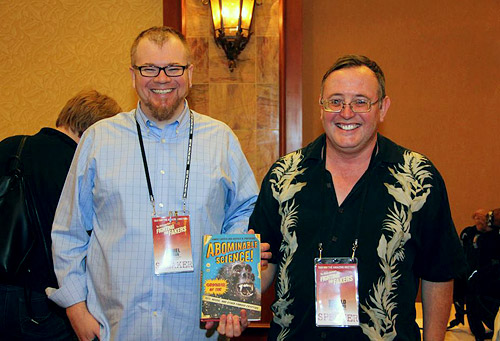
Daniel Loxton (left) and Donald Prothero (right) at The Amazing Meeting 2013. (Photo by David Patton)
MonsterTalk returns from its break with guests Donald Prothero and Daniel Loxton who introduce their long-awaited book Abominable Science!: Origins of the Yeti, Nessie, and Other Famous Cryptids.
Music
- Monstertalk Theme: Monster by Peach Stealing Monkeys
MTArchivist
0