Regular Episode
063 – HOP SPRINGS ETERNAL
Before the main interview, Karen discusses her recent investigation for Swift, the newsletter of the James Randi Educational Foundation, into the so-called “dancing lights” of Silver Cliff Cemetery in Colorado — one of many cemeteries claimed to be “the most haunted in America.” The lights, traceable to a 1969 National Geographic travel piece, have grown in the retelling from a dim blue glow to bright, multicolored orbs spread across the grounds. Karen’s candidate explanations include reflections from nearby traffic on polished marble headstones, phosphenes (the light-like sensations produced by the eye in low-stimulus conditions), and a recently identified blue-sensitive photoreceptor pathway — a good reminder that a dark cemetery plus expectant eyes is practically a hit-generation machine.
👹 The Shape-Shifting Bogeyman of Victorian London
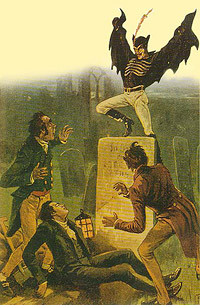
Mike traces the canonical Spring-Heeled Jack story to the winter of 1837–38, when reports of a terrifying, cloaked figure began circulating in villages on the outskirts of London. What makes the original legend so strange is that Jack was not one consistent monster: early sightings described him as a ghost, a bear, a devil, a giant baboon, and a figure clad in armour — only slowly coalescing, over several weeks, into the tall, thin, red-eyed, fire-breathing demon familiar from secondary Fortean literature. His signature traits — blazing eyes, iron claws, and the ability to vomit blue and white balls of fire — appear in only a handful of the primary sources, yet have become the defining image in popular retellings.
Mike notes that Victorian newspapers and middle-class commentators did not actually treat Jack as a supernatural entity; they regarded the stories as servants’ gossip. Among the working class, the dominant theory was that he was a wealthy, well-connected aristocrat — someone with the money for elaborate costumes, spring-assisted boots, and a gang of accomplices — which neatly explained how he could move across London unimpeded. The prime suspect of the day was the Marquess of Waterford, a notorious aristocratic thug known for beating up watchmen and elaborate pranks.
🔍 The Alsop and Scales Assaults — and the Police Investigation
Two specific incidents gave Spring-Heeled Jack his most durable newspaper coverage. On 22 February 1838, Jane Alsop of Bearbinder Lane, Bow, answered a knocking at her gate from a figure claiming to have caught Spring-Heeled Jack in the lane. When she brought a candle, the figure held it under his chin, revealing (she said) glowing red eyes, then breathed blue and white fire into her face and raked her with iron claws before her sister dragged her inside. Days later, Lucy Scales, a butcher’s sister from Limehouse, was similarly blasted with blue flame in a narrow alley off the Thames, collapsing in hysterics.
Both cases triggered a real police inquiry. Detective James Lee — effectively the most celebrated detective in Britain at the time, famous for solving the Red Barn Murder — ran parallel investigations alongside the Metropolitan Police K Division. Key findings: witnesses in Bearbinder Lane (including a wheelwright carrying a large wheel on his shoulder, standing roughly 100 yards away) stated they saw no dramatic assault and no balls of fire — consistent, Mike argues, with the fire effect being a short-range parlor trick visible only at arm’s length. The cloak Jack left behind vanished, suggesting an accomplice. Lee also arranged experiments at a local teaching hospital demonstrating that a small alcohol-soaked sponge held in the mouth, breathed out near a candle flame, could produce a startling close-range fireball — exactly the kind of technique described in contemporary conjuring literature and consistent with the detail that both Jane Alsop and Lucy Scales encountered an open flame (candle and lantern, respectively) immediately before Jack “breathed fire.”
📰 Penny Aligners, Stamp Tax, and the Mechanics of a Legend
One of the episode’s most illuminating stretches concerns how Victorian journalism actually worked. Newspapers were subject to a stamp tax that kept cover prices prohibitively high; when it was abolished in the mid-1800s, circulation exploded and so did Spring-Heeled Jack reports. Sensational “filler” stories were supplied by freelancers called penny aligners who earned only from published pieces and had every incentive to recycle and embellish older material during parliamentary recesses when hard news was scarce. Mike discovered a direct statistical correlation between periods when Parliament was not sitting and the appearance of Spring-Heeled Jack stories in the press.
Digitization of historical newspapers transformed Mike’s research: starting with 45,000 words from 80 newspapers (pre-digitization, published 1996), his source file has since grown to roughly 240,000 words. This allowed him to trace precursor figures stretching back much further: a leaping devil in a Suffolk pamphlet from 1677; the Hammersmith Ghost scare of 1804 (whose “cow’s hide” costume echoes early Jack descriptions); the Croydon Monster of 1809; a Hampshire/Isle of Wight ghost with claw gloves and armour from 1824–25. His conclusion: the Spring-Heeled Jack of 1838 was almost certainly a recycled newspaper story that gained traction only because a real copycat assault (the Alsop case) accidentally gave it flesh.
🕵️ Peter Haining and the Problem of Fabricated Sources
A substantial portion of the episode is devoted to Peter Haining, author of the only book on Spring-Heeled Jack published before Mike’s own research, and the single most damaging influence on the modern Fortean literature about him. Mike documents multiple fabrications:
– The story of Maria Davis, a teenage prostitute supposedly thrown to her death from a bridge in Jacob’s Island (1844–45) by Spring-Heeled Jack — supported by an illustration Haining sourced from the 1870s part-work Old and New London that actually depicts a resident scooping water from a ditch with a saucepan. No death record for Maria Davis exists in London for those years.
– Haining’s “smoking gun” tying the Marquess of Waterford to the legend: an extract from the supposed Memoirs and Correspondence of Sir Frederick Johnston, depicting Waterford’s companions plotting the Spring-Heeled Jack prank en route home from Norway. In reality, Sir Frederick Johnson died in a riding accident in 1842, aged 35 — decades too early to have written any such retrospective memoirs. The book appears in no library catalog worldwide.
– Alleged German paratroop experiments with spring-heeled boots (yielding a purported 95% rate of broken ankles) — unverifiable in any contemporary source.
Digitization, genealogical records, and union library catalogs have made it straightforward to expose these fabrications now; in the 1970s, Haining’s reputation as a well-read anthologist of Victorian sensationalia meant readers simply assumed he had done the work.
🌍 Migratory Legends: From Springheel Jackson to Perak of Prague
Spring-Heeled Jack analogues appear across the British Empire (Newfoundland’s “Springheel Jackson,” Australia, New Zealand, South Africa) in ways that suggest straightforward cultural diffusion — emigrants carrying the story in their mental luggage. More puzzling are the cases with no clear British connection: a “Tall Man” who appeared at second-floor windows in Mogadishu in the 1980s; a gang of criminals in revolutionary St. Petersburg called “the leapers” who reportedly wore actual springs on their feet to terrorize victims (tracked down and executed by the early Cheka); and most strikingly, Perak, the Spring Man of Prague, a wartime Czech folk hero described in 1944–45 folklore in terms almost identical to Spring-Heeled Jack — iron claws and all — despite no traceable transmission of the penny dreadful literature into Czech.
Folklorists classify these as migratory legends, but Mike notes that the classification describes the phenomenon without explaining the mechanism. He and Blake speculate briefly about memetics and computational folklore indexing as potential frameworks — questions still very much open.
📚 Further Reading
– 📚 Spring Heeled Jack: A History 💵 by Mike Dash (forthcoming at time of recording)
– 📚 The First Family: Terror, Extortion, and the Birth of the American Mafia 💵 by Mike Dash
– 📚 Spring-heeled Jack 💵 by Peter Haining (treat with extreme caution — see episode for details)
🔗 Related Links
– Spring-Heeled Jack — Wikipedia
– The Hammersmith Ghost (1804) — Wikipedia
– Marquess of Waterford — Wikipedia
– The Red Barn Murder — Wikipedia
– Perak, the Spring Man of Prague — Wikipedia
– Migratory Legend (folklore) — Wikipedia
– Phosphenes — Wikipedia
– British Newspaper Stamp Tax — Wikipedia
– Mike Dash’s Past Imperfect column at Smithsonian
– Karen Stollznow’s “The ‘Dancing Lights’ of Silver Cliff Cemetery” at Swift/JREF
Note: ads inserted into the distributed audio alter the timestamps in unpredictable ways, so timing references in these notes are approximate.
LONDON OF THE 1830S was terrorized by an astonishing figure—a caped man with long sharp metallic claws who spouted blue fire from his mouth and leaped over rooftops. Surely such a creature could be no more than myth, right? Or was there a mysterious aristocrat playing tricks on the working class? In this week’s episode of MonsterTalk, we talk with historian Mike Dash about the legendary figure known as Spring Heeled Jack.
Items of Interest
- Karen Stollznow’s Silver Cliff Cemetary article: “The ‘Dancing Lights’ of Silver Cliff Cemetery”
- Mike Dash’s Past Imperfect column
- Mike Dash’s article “About Spring-heeled Jack”
- Mike Dash’s books on Amazon.com
Music
- Monstertalk Theme: Monster by Peach Stealing Monkeys
MTArchivist
0