Regular Episode
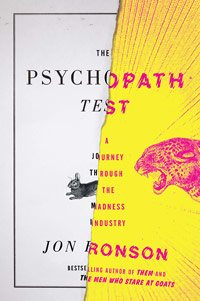
054 – QU’EST QUE C’EST?
The episode title — Qu’est que c’est? — is a nod to the Talking Heads song “Psycho Killer,” and the conversation lives up to the reference: psychopaths, as Ronson notes, look and act like the rest of us — until, quite suddenly, they don’t.
🧠 What Is a Psychopath, Exactly?
In clinical settings the preferred term is Antisocial Personality Disorder (APD), as found in the DSM. But the word psychopath belongs, Ronson says, largely to Robert Hare, the Canadian psychologist who developed the Hare PCL-R — a 20-point checklist that has become the gold standard for diagnosis. Items on the checklist range from “cunning and manipulative” to “criminal versatility” to “early behavior problems” (typically manifesting around age ten).
Crucially, Ronson points out that psychopathy is not a mental illness in the conventional sense — there are no hallucinations, no delusions, and no medication that treats it. If anything, it’s better described as a moral deficiency: the amygdala, the brain region associated with fear, guilt, and remorse, underperforms. As Ronson observes with characteristic wryness, it may be the most subjectively pleasant of all neurological conditions — for the person who has it.
📋 Learning to Spot Them — and the Dangers of Doing So
Ronson trained in the Hare checklist over three days in a marquee in West Wales with Hare himself — and promptly, he admits, began abusing his newfound power. The book frames psychopath-spotting as a cautionary tale: the checklist may be accurate, but the ways it gets applied in the real world are frequently problematic. Diagnoses are typically made from afar, precisely because a psychopath in the room will manipulate any direct assessment.
One of the book’s most vivid illustrations is Ronson’s prison visit to Toto Constant, a Haitian death squad leader serving time in upstate New York for mortgage fraud — itself item 20 on the checklist, “criminal versatility.” When Ronson pointed out that constantly needing people to like you sounded like a weakness, Constant corrected him: if you can get people to like you, you can manipulate them to do whatever you want. Straight out of the checklist.
🎬 Psychopaths in Pop Culture
Hare told Ronson that almost no cinematic portrayal of psychopathy is accurate — too baroque, too theatrical. The one exception he cited: the character of Holly, played by Sissy Spacek, in Terrence Malick’s 1973 film 🎬 Badlands 💵. Holly’s flat, clichéd voiceover — lifted wholesale from movie magazines — is a near-perfect illustration of “shallow affect,” the checklist item describing an inability to experience a genuine range of emotions and a tendency to mimic the emotions of others instead. By contrast, Anthony Hopkins‘s Hannibal Lecter in 🎬 The Silence of the Lambs 💵 is dismissed as far too grandly charismatic. Real psychopathic charm, Ronson notes, is superficial — a film rather than a depth. The more time you spend with them, the more the facade becomes visible.
🏢 Psychopathy, Capitalism, and Corporate Behavior
The conversation takes a structural turn when Blake asks whether corporations — treated legally as persons in the United States — might themselves score high on the PCL-R. Ronson is cautious about polemics, but he can’t resist noting that certain industries, at their worst, look like the physical manifestation of psychopathy: journalism caught up in phone-hacking scandals, subprime lenders deliberately targeting vulnerable borrowers, healthcare systems that prioritize profit extraction over patient welfare. As he puts it, Mitt Romney said corporations are people — and yeah, some of them can be real bastards.
He also raises the observation, attributed to psychologist Martha Stout of Harvard, that psychopathy is so prevalent and so powerful that it has effectively re-shaped society — a theory Ronson notes is structurally identical to David Icke‘s claim that blood-drinking lizard people secretly rule the world. The difference, he observes dryly, is that Stout gets taken seriously.
🔍 Rachel North and the Conspiracy Within the Conspiracy
One of the most striking digressions in the book — and in the conversation — involves Rachel North, a survivor of the 7 July 2005 London bombings who became a public advocate for a survivors’ inquiry. North discovered that a segment of the online conspiracy community had concluded she didn’t exist — that she was in fact a team of MI5 operatives spreading disinformation to cover up the “truth” of 7/7 (variously theorized as an accidental power surge on the Underground, with the bus bombing faked using actors). When North emailed the group to confirm her existence, her correspondence was taken as further evidence of the conspiracy. The ringleader turned out to be David Shayler, a former MI5 officer turned whistleblower turned truther. Ronson notes this story tempered his affection for conspiracy culture, which had felt more playful in the pre-9/11 world of Them.
🤝 On Skepticism and Humanist Journalism
The final stretch of the conversation turns reflective. Ronson identifies as a skeptic but admits his skeptical instincts tend to go quiet when he’s actually sitting across from someone — they re-engage when he’s back at his desk trying to get the facts right. He singles out Sylvia Browne as one of the rare cases where he felt straightforwardly investigative rather than curious and empathetic, describing a psychic cruise he once took with her. More broadly, he worries that skepticism can tip into dehumanizing the people it disagrees with, and advocates for combining rigorous skepticism with genuine humanist curiosity — a pairing Blake and Karen find hard to argue with.
📚 Further Reading
– 📚 The Psychopath Test: A Journey Through the Madness Industry 💵 by Jon Ronson
– 📚 Them: Adventures with Extremists 💵 by Jon Ronson
– 📚 The Men Who Stare at Goats 💵 by Jon Ronson
– 📚 The Sociopath Next Door 💵 by Martha Stout
🔗 Related Links
– Hare Psychopathy Checklist (PCL-R)
– Robert D. Hare – Wikipedia
– Antisocial Personality Disorder – Wikipedia
– Amygdala – Wikipedia
– 7 July 2005 London Bombings – Wikipedia
– David Shayler – Wikipedia
– Toto Constant – Wikipedia
Note: ads inserted into the distributed audio alter the timestamps in unpredictable ways, so timing references in these notes are approximate.
Remorseless killers are the stuff of countless films. Sadly, the real world has even more of them. Jack the Ripper, Ted Bundy, H. H. Holmes, John Wayne Gacy—these remorseless psychopaths filled graveyards with corpses and sleeping minds with nightmares. But these aren’t monsters—they’re real people who have a brain that developed differently than most peoples. Author Jon Ronson joins us on this episode of MonsterTalk to discuss the condition of psychopathy—and to share with us his journey into the world of these dangerous people.
Links of interest
Music
- Monstertalk Theme: Monster by Peach Stealing Monkeys
MTArchivist
0