Regular Episode
046 – SQUATCHING WITH THE KRAMPUS
🎄 Krampus: Santa’s Sinister Shadow
The segment opens with Blake playing a tongue-in-cheek “interview” with the Krampus himself (voiced by Brian Thompson), touching on the creature’s pre-Christian Alpine roots and his professional relationship with a certain more famous winter gift-giver. The Krampus, as tradition holds, accompanies St. Nicholas on his rounds — rewarding good children with toys while dispensing lashes to the naughty and carrying off the very worst in a sack. Festivals known as Krampusnacht — in which men dress in elaborate fur suits and enormous curved horns and parade through Alpine towns — were already spreading in popularity beyond their Central European homeland at the time of recording. The segment is played entirely for laughs, but the underlying folklore is genuine: the Krampus is a figure rooted in pre-Christian winter traditions that long predate the modern Santa Claus mythology.
🎥 Scott Herriott: Squatcher, Comedian, Documentarian
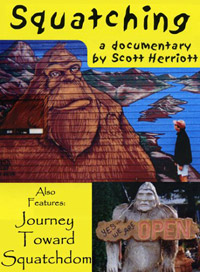
Scott Herriott came to Blake’s attention via TechTV, where Scott appeared to discuss his documentary Squatching. A self-described believer who nonetheless skewers credulous excess — he made the mockumentary Journey Toward Squatchdom specifically to poke fun at claimants who insist Bigfoot “lives in my shed” — Scott occupies a genuinely interesting middle position in the Bigfoot world. His interest began in childhood, sparked by John Green‘s The Year of the Sasquatch, and deepened after discovering Green’s expansive 📚 Sasquatch: The Apes Among Us 💵 in a university science library. He co-hosts The Bigfoot Show podcast alongside Brian, Paul, and Sam Rich, and freely grants that the physical evidence for Bigfoot is, by scientific standards, weak at best.
🌲 The 1992 Willow Creek Encounter
The centerpiece of the interview is Scott’s detailed account of an experience in 1992 near Willow Creek, California — a small Northern California town long associated with Bigfoot lore and home to the Willow Creek–China Flat Museum’s Bigfoot collection. The chain of events began when Scott contacted a local information booth while planning a solo wilderness expedition, only to learn that a father had just called in, distraught, because his son and the son’s friend had allegedly observed a large, whitish, muscular, man-like figure on an embankment roughly 100 feet away.
Scott drove up, interviewed the two boys separately, and found their accounts consistent and, to his mind, credible. He and a skeptical friend then hiked up the steep, densely vegetated hill — documented with Scott’s Hi8 camera and a companion’s shoulder-mounted VHS rig — to investigate. Part-way up, Scott observed what appeared to be large, dark eyes in the shadow beneath a fallen tree, watching them without moving for roughly thirty seconds. The eyes then exhibited a vivid reddish glow — twice, in quick succession. Ben notes for the record that red eyeshine (produced by the tapetum lucidum) is documented in numerous mammal species, including some squirrels and owls, and is a straightforward optical phenomenon rather than bioluminescence.
When the two men moved to flank the animal, Scott’s companion Daryl reportedly filmed something for about thirty seconds before breaking into tears. On reviewing the tape, Scott says he could make out, at roughly thirty feet, what appeared to be a large whitish upper arm protruding from a rhododendron bush — and above it, partially obscured by branches, a dome-shaped head-like object of the same color that appeared to move independently of the surrounding still foliage. This movement was later assessed by a video analyst on the TV show Sightings, who ran edge-detection software and concluded that the object was indeed moving by itself — though Scott is candid that the footage falls well short of scientific proof. The following day, the group located what Scott describes as a large matted-down nest area — approximately 25 by 15 feet — consistent in his view with the sleeping nests of great apes. Hair samples collected at the site were later assessed morphologically by a Bay Area primatologist named Sterling Bunel, who reportedly found the internal structure similar to, yet distinguishable from, chimpanzee and mountain gorilla hair. No genetic analysis was performed.
🧬 Evidence, Epistemology, and the Ketchum DNA Project
Ben and Scott circle a productive tension throughout the interview: Scott leans heavily on the cumulative weight of eyewitness testimony — including his own — while Ben applies a harder evidentiary filter, pointing out that sightings, however sincere, have never yielded a verifiable fact about Bigfoot. Both agree that the physical evidence is weak; where they diverge is on how much the sheer volume and geographic concentration of sightings in the Pacific Northwest should shift one’s priors.
The conversation briefly addresses the then-ongoing Erickson Project and Melba Ketchum‘s DNA study, which Scott treats with cautious skepticism despite being broadly sympathetic to the Bigfoot hypothesis. Both he and Ben flag the pre-announcement hype as a significant red flag. The Bigfoot Field Researchers Organization (BFRO) and its founder Matt Moneymaker come in for pointed criticism from Scott, who finds the near-constant “evidence” produced on every BFRO expedition statistically implausible. Jeff Meldrum of Idaho State University gets a more mixed assessment — Scott credits him with calling out a dubious Siberian Yeti claim but criticizes his continued defense of casts associated with the known hoaxer Paul Freeman. David Daegling‘s 📚 Bigfoot Exposed 💵 is cited approvingly for its analysis of the measurement assumptions underlying the Patterson–Gimlin film.
🔬 The Photograph Problem and the Jane Goodall Question
Ben raises what he considers one of the stronger skeptical arguments: that the quality of photographic and video evidence for Bigfoot has conspicuously failed to improve despite decades of dramatic advances in camera technology and the near-universal presence of high-resolution cameras in pockets worldwide. Scott’s response — that elusive, rare animals in dense terrain are not reliably captured regardless of equipment, and that photographic evidence wouldn’t constitute proof anyway — prompts a spirited but good-natured back-and-forth about what a genuinely compelling photograph would need to show.
The group also discusses Jane Goodall‘s well-known NPR radio remarks in which she initially said she was “sure” Bigfoot exists before walking the claim back to a statement of hope. Ben argues that Goodall’s primate expertise doesn’t straightforwardly extend to the evidentiary questions surrounding Bigfoot — creature identity, eyewitness reliability, hoax detection — just as a ghost researcher shouldn’t assume that a physicist’s knowledge about energy applies to claimed hauntings. Scott finds the gorilla-discovery analogy compelling: reports of large, manlike apes in Central Africa were dismissed for generations before mountain gorillas were verified, and primatologist George Schaller‘s observation of gorillas covering a dead conspecific with vegetation is offered as a speculative parallel for why Bigfoot bodies might not surface.
📚 Further Reading
– 📚 Sasquatch: The Apes Among Us 💵 by John Green
– 📚 Bigfoot Exposed: An Anthropologist Examines America’s Enduring Legend 💵 by David Daegling
– 📚 Tracking the Chupacabra: The Vampire Beast in Fact, Fiction, and Folklore 💵 by Benjamin Radford
🔗 Related Links
– Krampus (Wikipedia)
– Bigfoot / Sasquatch (Wikipedia)
– Patterson–Gimlin Film (Wikipedia)
– Tapetum lucidum (eyeshine) (Wikipedia)
– Bigfoot Field Researchers Organization (BFRO) (Wikipedia)
– Jeff Meldrum (Wikipedia)
– John Green (cryptozoologist) (Wikipedia)
– Mountain gorilla (Wikipedia)
Note: ads inserted into the distributed audio alter the timestamps in unpredictable ways, so timing references in these notes are approximate.
By popular demand, we take a brief aside into fantasy to talk with one the more sinister figures associated with the Winter Holidays: The Krampus. Then we get a bit more serious as we welcome one of the co-hosts of the popular podcast The Bigfoot Show, documentarian and comedian, Scott Herriott. Scott has made several films about walking the Pacific Coast Trail and about his personal quest to find Bigfoot—and the people he’s met in that search. This MonsterTalk interview includes a detailed recounting of his own brush with what he believes may have been a Sasquatch.
Music
- Monstertalk Theme: Monster by Peach Stealing Monkeys
MTArchivist
0