Regular Episode
045 – UNBOTTLING SOME JINN
Blake sets the tone early: in much of the Muslim and Arabic-speaking world, djinn aren’t whimsical wish-granters but a separate species of intelligent being — invisible, shapeshifting, capable of possession, and confirmed as real by the Quran itself. They fill the cultural niche that ghosts and demons occupy in the West, and the parallels to familiar Western paranormal phenomena — hauntings, abductions, changelings, succubi — turn out to run surprisingly deep.
🔥 Origins: Smokeless Fire and Ancient Winds
Lebling traces djinn belief back at least to the ancient Sumerians, where nature spirits and wind deities gradually evolved into what we now call jinn. The orthodox Islamic account holds that God created jinn from smokeless fire, just as humans were created from clay — but an older tradition ties them to the scorching desert wind, the simoom. It’s in this latter tradition that Lebling locates Pazuzu, the Assyrian demon familiar to Western audiences from The Exorcist — here recast as one of the earliest recognizable jinn forms, born of the hot desert wind.
The taxonomy of jinn is more elaborate than pop culture suggests. Lebling outlines a rough hierarchy:
– The Shayatin (literally “satans”) — the lesser demonic class.
– The Ifrit (or Afrit) — larger, more powerful, and more fearsome.
– The Marid — the most powerful category of all.
– The Ghoul — a flesh-eating, shapeshifting subcategory that haunts remote places and is almost universally classified as djinn.
🏚️ What Djinn Do (and Where They Lurk)
In day-to-day belief, nobody in Saudi Arabia expects to find a genie in a lamp on the beach. What they do expect is to encounter djinn in desolate places — ruins, caves, sewers, abandoned buildings. The haunted-house niche that ghosts fill in Western culture is occupied entirely by djinn in the Islamic world; there is no strong parallel tradition of spirits of the dead.
Beyond haunting, jinn are said to possess human beings (requiring specialist religious exorcists — scholars who combine the role of Islamic cleric and ruqyah practitioner), abduct adults and children (the changeling explanation for a child who seems to “not belong” to its family maps almost exactly onto European fairy-lore), and travel in tribal groups — complete with families, clans, and, in some accounts, camel caravans making the hajj to Mecca.
Djinn are also prodigious shapeshifters, capable of appearing as virtually any animal — with one notable exception: the wolf. The only wolf-form djinn Lebling has encountered is the Udrut of Yemen, a lurking presence that appears near violent death but never attacks anyone.
👑 Solomon, Sheba, and the Seal of Power
King Solomon looms large in jinn lore. According to tradition, God granted Solomon a magic ring bearing the Seal of Solomon — essentially the Star of David — that gave him power over evil jinn and compelled them to labor as builders of palaces and fortresses throughout the Middle East. Jinn sealed away in casks by Solomon are said to have burst free centuries later when an expedition from Al-Andalus retrieved them from the sea floor near the legendary City of Brass — and still fled in terror, believing Solomon might yet be alive.
Solomon’s connection to the Queen of Sheba (known in Arabic tradition as Bilqis, and associated with ancient Saba in Yemen) runs through jinn belief as well: she is said to be partly of jinn ancestry, and Solomon reportedly constructed a false glass “pond” in his palace to trick her into lifting her skirts — checking, as the story goes, for the hairy legs or goat feet said to betray jinn heritage. The outcome, Lebling notes wryly, “has been kept secret from all of us.”
🌍 Regional Variations: Ghouls, Lilith, and the North African Twist
Jinn belief is not monolithic. Lebling traces its geographic spread through the Islamic world and highlights some striking regional variants:
– In North Africa (Morocco, Algeria, Tunisia), the Aisha Kandisha figure — a seductive female djinn closely paralleling the ancient Lilith and functioning much like an incubus/succubus — is a powerful and persistent force. (There is even a band named after her.)
– In Tunisia, with its Carthaginian seafaring heritage, djinn of the sea appear as mermen and mermaids — probably the only context where djinn are extensively portrayed as aquatic creatures.
– The ghoul tradition is richest in Yemen and Egypt. Lebling recounts the legend of King Saif of Yemen, trapped in a valley of ghouls and forced to negotiate his escape with their queen — a story with strong echoes of European fairy-captivity tales.
– Lebling also notes a compelling claim in scholarship about George Romero: that the flesh-eating, contagion-spreading zombie of 🎬 Night of the Living Dead 💵 was inspired not by Haitian zonbi tradition but by the Middle Eastern ghoul.
👻 Djinn, Possession, and the Paranormal Parallel
Blake observes — and Lebling agrees — that the phenomenology of djinn encounters maps neatly onto almost every category of Western paranormal experience: hauntings, possession, alien abduction, changeling children, and even claims of inter-species sexual contact (a topic on which Islamic scholars are, apparently, divided). Lebling points to Israeli psychiatric literature as an unexpected research trove: psychologists working with Palestinian patients have documented jinn-possession beliefs extensively, and the political dimensions of djinn accusation — Saddam Hussein reportedly said to have made a pact with jinn, cabinet members of then-Iranian president Mahmoud Ahmadinejad accused of using jinn — show the belief system still operating as a live cultural force.
Ben brings up his own fieldwork: a 2007 investigation in Zanzibar into the Popobawa, a bat-winged entity that blends djinn, ghost, and vampire characteristics. Locals consistently explained it as a djinn that had escaped its master — pointing toward practitioners in Pemba or the Comoros Islands who were said to be capable of controlling such entities through ancient Arabic grimoires.
📖 Lovecraft, Howard, and the Western Inheritance
The episode closes with a brief but satisfying discussion of how djinn lore fed directly into the Western weird fiction tradition. H.P. Lovecraft and Robert E. Howard both drew on Arabic and Middle Eastern sources — Howard in particular weaving djinn mythology together with Celtic fairy-lore to produce something that treated the “little people” not as whimsy but as genuinely menacing. Lebling sees this as one reason he “came into it through the back door”: so much of the source material had already been absorbed into Western literature, it took living in Saudi Arabia to recognize where it originally came from.
A parting note from Lebling: the interview was recorded at the end of Ramadan, during which, per Islamic tradition, all jinn are imprisoned and chained by God. Ramadan was ending. Listeners were advised to be careful.
📚 Further Reading
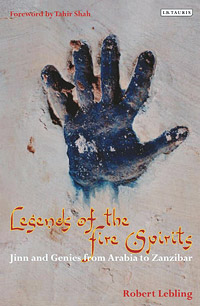
– 📚 Legends of the Fire Spirits: Jinn and Genies from Arabia to Zanzibar 💵 by Robert Lebling
– 📚 One Thousand and One Nights 💵 (the Arabian Nights — the primary literary source for genie-in-a-bottle imagery)
🔗 Related Links
– Jinn — Wikipedia
– Ghoul — Wikipedia
– Pazuzu — Wikipedia
– Lilith — Wikipedia
– Aisha Kandisha — Wikipedia
– Popobawa — Wikipedia
– Solomon in Islam — Wikipedia
– Seal of Solomon — Wikipedia
– Ruqyah (Islamic exorcism) — Wikipedia
– City of Brass — Wikipedia
Note: ads inserted into the distributed audio alter the timestamps in unpredictable ways, so timing references in these notes are approximate.
IF YOU THINK GENIES ARE FUNNY like in Aladdin, or sexy like in I Dream of Jeannie get ready to have your assumptions challenged. In the Middle East, Jinn aren’t whimsical characters of fantasy. They are considered to be frightening, real entities that haunt desolate places and can perform terrible magic. In this episode of MonsterTalk we interview author Robert Lebling about his book Legends of the Fire Spirits: Jinn and Genies from Arabia to Zanzibar. If you miss this episode you’ll wish you hadn’t!
Music
- Arabian Landscape by Guardian Mind Mix
- Monstertalk Theme: Monster
by Peach Stealing Monkeys
MTArchivist
0