Regular Episode
032 – IS THE SKOOKUM FAIR DINKUM?
Daniel Perez is the editor and publisher of the Bigfoot Times newsletter, which he describes, with some justification, as “the Wall Street Journal of Bigfooting.” He’s been researching the subject since seeing 🎬 The Legend of Boggy Creek 💵 at around age ten in 1973, and he brings a skeptical-but-engaged perspective that sets him apart from much of the Bigfoot research community.
🌲 How the Cast Was Found
The expedition took place in Skookum Meadows, Washington, and involved members of the BFRO along with the crew of the Australian television series Animal X. As Perez recounts from his interview with one of the finders, Derek Randles, the group had been having no particular success when researcher Tom Powell (author of 📚 The Locals 💵) suggested baiting a muddy roadside turnout with apples and other fruit. Overnight, the fruit disappeared — and in the morning, the team found a large impression in the mud at the edge of the wallow area.
The BFRO’s own field notes describe the group collectively concluding that the animal had sat at the edge of the mud and leaned forward on its left forearm to retrieve the fruit, deliberately avoiding leaving foot tracks. The notes also mention that the bait site was within earshot of camp, and that the animal may have been “avoiding leaving distinctive tracks.” The hosts note the obvious irony: the creature supposedly famous for its enormous footprints is now being credited with deliberately not leaving any — while simultaneously leaving a 15-square-foot body impression.
🔬 The Scientific Claims
Within weeks of the discovery, Dr. Jeff Meldrum, Associate Professor of Anatomy and Anthropology at Idaho State University, led a team that included retired physical anthropologist Dr. Grover Krantz of Washington State University, Canadian wildlife biologist Dr. John Bindernagel, veteran Bigfoot researcher and author John Green, and exotic animal handler Dr. Ron Brown. Idaho State University issued a press release stating the cast “cannot be attributed to any known Northwest animal and may represent an unknown primate.”
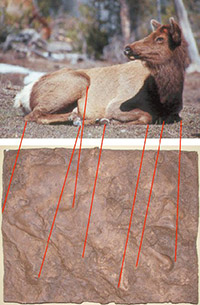
In his book 📚 Sasquatch: Legend Meets Science 💵, Meldrum argued that comparisons with elk imprints at game ranches and zoological parks — combined with consultation with professional gamekeepers — ruled out elk as a candidate. He cited the shape of the heel and forearm impressions, the hair-pattern orientation, and the absence of elk hoof tracks at the center of the impression as compelling evidence. Blake reads the relevant passage directly from the book on air.
Perez, however, points out that Meldrum never published a peer-reviewed technical paper on the cast — only the popular account in his book. Given that Meldrum had previously published a scientific paper on Bigfoot track evidence, the absence of a formal write-up on what was supposedly the best physical evidence since the Patterson-Gimlin film is, to put it charitably, conspicuous.
🦌 The Elk Hypothesis
The most parsimonious explanation — that the impression was left by a reclining elk in a wallow — was the first one most amateur observers reached. Perez notes that there is no dispute that elk were present: substantial amounts of elk hair were cleaned away from the cast before it was examined, and elk tracks are visible within the casting itself.
The most detailed skeptical analysis came from Dr. Anton Robleski, a naturalist with extensive field experience observing elk. Perez interviewed him in 2006 after discovering his commentary on Bigfoot internet forums. Robleski’s conclusion was direct: the impression is consistent with an elk, the initial excitement was premature, and the evidence should have been studied far longer before any press release was issued.
Perez also cites an experiment by researcher Patrick Beaton, who attempted to replicate the posture the BFRO attributed to the Sasquatch — lying at the edge of a muddy area and reaching out to retrieve fruit — without leaving a handprint or footprint. He could not do it. Whatever made the Skookum impression, the “no tracks in or out” feature remains unexplained under any hypothesis.
🧬 The Hair Evidence
Perhaps the most damaging testimony Perez gathered came from Dr. Wolf Henner Fehrenbach, a retired primatologist formerly at the Oregon Regional Primate Research Center. Fehrenbach had been sent hairs recovered from the cast — reportedly by Dr. Meldrum — for analysis. In an August 2010 email to Perez, Fehrenbach wrote that he had no memory of the hairs having “compelling value,” dimly recalled that they did not come out as Sasquatch hair, and confirmed that his personal collection of what he considers authentic Sasquatch hair samples contains nothing from the Skookum cast.
The cast was also reportedly too contaminated for clean analysis — human hairs were among those recovered. Fingerprint specialist Jimmy Chilcutt, whom MonsterTalk had previously interviewed, apparently commented on what he described as dermatoglyphic flow patterns in the heel area, but Perez notes that distinguishing genuine dermal ridges from elk hair-impression artifacts in such a contaminated cast is not straightforward.
🔒 Access Denied: The Politics of the Cast
Ben describes being denied permission to examine the cast by BFRO founder Matt Moneymaker, who told him he was “not qualified.” Perez had the same experience. Both note the obvious problem: if you only allow hand-picked experts who share your prior conclusions to examine the evidence, you are not doing science. Perez goes further, characterizing the BFRO as a “political organization” rather than a scientific one — pointing to the episode in which Moneymaker reportedly endorsed a Penn & Teller-produced man-in-a-suit video as possible Bigfoot footage, then quietly removed those posts once the hoax was revealed.
Physical ownership of the cast itself has also been contentious. The cast is jointly owned by Rick Knoll, Derek Randles, and the estate of the late Dr. Leroy Fish. Randles told Perez that the co-owners had a significant falling out over control of the cast. Randles’s own final assessment, quoted directly in the interview, is sobering: “In all reality, it’s a chunk of plaster and hydrocal… It’s really cool, but it doesn’t prove anything.”
📺 Ten Years On
By 2011 (the recording date of this episode), the Skookum cast had failed to generate the scientific excitement its proponents had hoped for. No mainstream peer-reviewed study had been published. The MonsterQuest television program covered it, but Perez dismisses that coverage as entertainment rather than investigation. Meldrum did not respond to Blake’s request for comment before broadcast.
Blake notes that the BFRO website still carried the original press release at the time of recording, still claiming the imprint “was most likely made by a living Sasquatch.” A visual comparison of the cast with a photograph of an elk in repose — linked in the original show notes — remains one of the more persuasive skeptical exhibits.
📚 Further Reading
– 📚 Sasquatch: Legend Meets Science 💵 by Jeff Meldrum
– 📚 The Locals 💵 by Thom Powell
– 🎬 The Legend of Boggy Creek 💵 (1972 documentary film, the one that started Daniel Perez’s lifelong interest in the subject)
🔗 Related Links
– Skookum Cast — Wikipedia overview
– Bigfoot Field Researchers Organization (BFRO)
– Patterson-Gimlin Film
– Dr. Jeff Meldrum — Idaho State University
– Dr. Grover Krantz — Washington State University physical anthropologist
– Gifford Pinchot National Forest — location of the 2000 BFRO expedition
– Yowie — Australian cryptid discussed by Perez in the context of his 2000 Sydney trip
– Oregon National Primate Research Center — former institution of hair analyst Dr. Fehrenbach
Note: ads inserted into the distributed audio alter the timestamps in unpredictable ways, so timing references in these notes are approximate.
IN TODAY’S EPISODE we learn about what has been called one of the best pieces of evidence for the existence of bigfoot. The Skookum cast, found in Washington state in 2000, is alleged to be the body imprint of a bigfoot lying in the mud to reach some fruit. But skeptics think it is just a big Elk print in the mud. In this episode we learn about the cast from veteran Bigfoot researcher Daniel Perez, editor of The Bigfoot Times. We discuss topics including:
- The background of the expedition that led to the casting
- The role of a TV crew in the research
- The plausibility of a the imprint compared to that of other wildlife of the area
- The players involved in the investigation
- How has the cast held up over the past 10 years as evidence
We’d love to hear your opinion on the Skookum cast. Visit the MonsterTalk page on Facebook.
Music
- Monstertalk Theme: Monster by Peach Stealing Monkeys
MTArchivist
0