Regular Episode
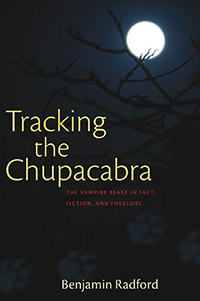
031 – TRACKING THE CHUPACABRA
The Chupacabra (Spanish: goat-sucker) exploded into public consciousness in 1995, riding a wave of tabloid sensationalism, early internet sharing, and a Spanish-language television culture primed for exactly this kind of story. Within months it had crossed international borders; within a year, the writers of The X-Files were already scripting an episode around it.
🧬 One Monster, Two Very Different Creatures
Ben draws a clear distinction between what he calls the two “types” of Chupacabra. Type I — the original — is a bipedal, reptilian or humanoid figure, roughly three to five feet tall, with large wraparound eyes reminiscent of grey aliens, a distinctive row of spines or feathery spikes down its back, long claws, and — in some accounts — wings. This version appeared almost exclusively in Latin America between roughly 1995 and 2000, was never photographed, and left no physical remains.
Type II — what Ben dubs the “Texas Chupacabra” — emerged around 2004 and persists to the present. These are four-legged, nearly hairless canids with prominent teeth, almost certainly animals suffering from severe mange. Unlike their humanoid predecessor, Type II specimens have left behind actual bodies — half a dozen or so — that can be physically examined and DNA-tested.
🩸 Origin of the Original: Madelyne Tolentino and the Puerto Rico Reports
Before August 1995, the Puerto Rico livestock deaths were tabloid fodder but shapeless — just rumors of a vampire creature attacking goats and chickens. The two dominant Puerto Rican tabloids of the era, El Vocero and El Nuevo Día, dispatched reporters and ran dramatic photographs of dead animals, feeding the hysteria without any coherent description of a perpetrator.
The creature gained its iconic face in August 1995 through the eyewitness account of Madelyne Tolentino, whose description became the basis for the most widely reproduced Chupacabra image on the internet. Tolentino herself did not coin the name “Chupacabra” — others applied that label to her account. Crucially, Ben notes, the early investigations of her report and the surrounding cases were conducted almost entirely by UFO enthusiasts and tabloid journalists, not scientists or skeptical investigators.
The story then went supernova in early 1996 when Cristina — the Spanish-language talk show often described as a Latinx equivalent of Oprah — dedicated a segment to it, followed by rapid spread across the early internet.
👽 Origin Theories: Aliens, Government Labs, and the Apocalypse
Ben catalogues the competing folk explanations that accumulated around the creature:
– Extraterrestrial pet: aliens visiting El Yunque rainforest accidentally released their companion animal, which has since haunted the jungle.
– Secret government genetics: a top-secret U.S. bioweapons or genetics program based near El Yunque created the creature.
– AIDS vector: the Chupacabra was created by extraterrestrials as a depopulation mechanism and is linked to the AIDS epidemic.
– End-times portent: one James Lloyd of the Christian Media Network argued that Revelation 9 describes the Chupacabra as a militarized weapon to be unleashed at Armageddon.
🦴 Dead Bodies and DNA: The Type II Cases
Ben investigated several physical “Chupacabra” carcasses in person. Two cases get particular attention:
– Mapsoe, Nicaragua (August 2000): Farmer Jorge Talavera shot at creatures attacking his livestock; a carcass was later found and submitted to a local university, which identified it as a dog. Talavera disputed the finding, alleging the bones had been switched — a response Ben notes became a recurring pattern.
– Cuero, Texas (2008): Phyllis Canion found a hairless carcass near her ranch and had it DNA-tested by researcher Todd Disotell, among others. Results: coyote, possibly with some red wolf admixture. Canion disputed the results and requested retesting; the second analysis reached essentially the same conclusion.
Ben observes that the word “Chupacabra” has effectively become a generic vernacular term in Texas and elsewhere for any strange dead animal — entirely detached from its original vampiric connotation.
🌎 Vampires in Context: A Global Tradition
Rather than treating the Chupacabra in isolation, Ben situates it within a broader global history of vampiric folklore. The book’s second chapter surveys European vampire traditions, African vampiric entities, and other Latin American blood- (or substance-)draining creatures — including the Llichiri (also spelled Lik’ichiri), a Bolivian and Peruvian folkloric figure said to suck the fat from living people. Ben also notes that xenophobia is a recurring undercurrent in vampire legends worldwide, and that the Chupacabra is no exception.
🔍 Solving the Mystery — and Keeping It Solved
Ben states plainly that he believes he has solved the origin of the Chupacabra — a claim he does not make lightly as a skeptical investigator. The solution is presented in the book’s final section, with a version also appearing in his companion volume 📚 Scientific Paranormal Investigation 💵.
Recognizing that no debunking book fully stops a legend, Ben included an appendix titled “How to Identify a Chupacabra” — a ten-point checklist of criteria any genuine specimen would need to satisfy. It’s his attempt to keep the book useful to future investigators for decades to come, regardless of whether the public legend persists.
📚 Further Reading
– 📚 Tracking the Chupacabra: The Vampire Beast in Fact, Fiction, and Folklore 💵 by Benjamin Radford
– 📚 Scientific Paranormal Investigation: How to Solve Unexplained Mysteries 💵 by Benjamin Radford
🔗 Related Links
– Chupacabra — Wikipedia overview
– El Yunque National Forest, Puerto Rico
– Kharisiri (Lik’ichiri) — Andean fat-sucking vampire folklore
– Mange — the skin condition behind most “Texas Chupacabra” sightings
– Skeptic Magazine — MonsterTalk’s production partner
Note: ads inserted into the distributed audio alter the timestamps in unpredictable ways, so timing references in these notes are approximate.
IN THIS EPISODE, Ben Radford takes a seat in the interview-chair as we discuss his latest book Tracking the Chupacabra.. It is the culmination of five years of research on the mysterious Latin American goat-sucker—a vampiric creature which has been troubling ranchers since 1995. In this episode we discuss:
- the origins of the chupacbra legend
- the nature of the beast
- why there are now two different “types” of chupacabras
- how Ben tracked down the solution to they mystery
Music
- Monstertalk Theme: Monster by Peach Stealing Monkeys
MTArchivist
0