Regular Episode
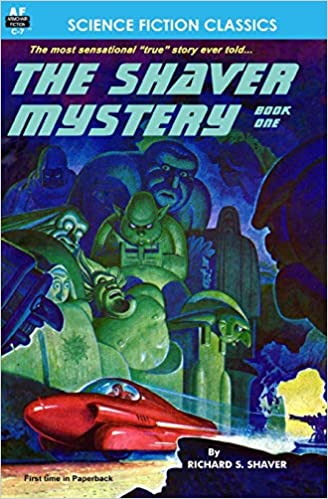
#193 – The Shaver Mysteries (Part 2)
Fair warning — this conversation goes to genuinely dark places. Palmer’s later associations with anti-Semitic writers and far-right politics are discussed plainly, and the guests make a compelling (if uncomfortable) case that the Shaver Mystery isn’t a quaint historical footnote but a foundational text for the conspiratorial anti-intellectualism still very much with us today.
📬 Fandom, Letter Columns, and the Original Social Network
The Shaver stories landed in Amazing Stories in 1945 and immediately exploded the letters-to-the-editor count from roughly 50 to around 2,500. Jeb and Jerry draw a direct line from the letters pages of Weird Tales and Amazing Stories — where editors began printing correspondents’ home addresses so fans could write each other directly — to modern Reddit threads, Creepypasta, and NoSleep forums. The letter columns were, quite literally, the internet on paper. Palmer understood this ecosystem and appears to have deliberately seeded it: the Lemurian and Theosophical keywords in Shaver’s stories weren’t accidents, but hashtags calculated to pull in an adjacent audience already primed for hollow-earth lore.
Not everyone writing in was a true believer. Jerry confesses to having called in to The Art Bell Show‘s famous Mel’s Hole episodes as a bored college student spinning a yarn — a reminder that hoaxers, roleplayers, and sincere believers have always shared the same letter column.
🛸 Palmer Invents the Flying Saucer
The guests walk through a brisk chronology: the Shaver controversy gets Palmer squeezed out of Amazing Stories (then owned by Ziff Davis), so he co-founds Fate magazine with Curtis Fuller in 1948. The inaugural issue leads with Kenneth Arnold‘s first-person account of the 1947 flying-disc sighting — a sighting Palmer had already tried to leverage by hiring Arnold to investigate the Maury Island incident, a hoax Palmer must have had strong reasons to suspect was a hoax.
The term “Palmer invented the flying saucer” comes from John Keel, and the guests think he’s largely right. Between 1947 and roughly 1950–51, public interest in flying saucers had actually cooled — the government’s Project Sign and Project Grudge notwithstanding. It was Palmer’s publishing activity during those three years, the guests argue, that built the conceptual framework — discs from underground civilizations, piloted by ancient precursors to humanity — that UFO culture later inherited. As Jerry notes, the government was not entirely passive in this: a public fixated on little green men is less likely to correctly identify exotic military aircraft.
The Maury Island incident itself — claims of a UFO dropping burning slag on a boat, killing a dog, with the evidence-laden materials later killing two Air Force officers when their plane crashed — gets a proper postmortem. Its staying power comes from two additional anchors: the appearance of Fred Crisman in Jim Garrison‘s JFK investigation, and its mention in Gray Barker‘s early Men-in-Black book. Maury Island is less a case than a narrative hook everything else can hang off of.
🪐 Contactees, Reification, and the Theosophical Handoff
By the early 1950s, a network of people with deep histories in Theosophical lodges, occult groups, and the Shaver letter-writing community made a conceptual pivot: the Ascended Masters they’d been channeling turned out to be from Venus. The contactee movement was born.
The guests trace a specific genealogy: Maurice Doreal (who ran a magical lodge in Colorado, directly plagiarized Lovecraft-circle authors, and participated in Shaver correspondence) introduced reptilian beings into UFO lore. George Adamski was trained in Theosophy before he started taking photos of Venusians. George Hunt Williamson, published by Palmer, was a Nazi sympathizer — and the tall-blonde-Nordic contactee trope, the guests note, traces directly to Nazi-sympathizer writers within years of the war’s end.
A telling contrast: H.P. Lovecraft mined Theosophical material for fiction but actively dismissed readers who asked where to find a real Necronomicon. Palmer did the opposite — taking material he knew to be fictional and presenting it as revealed truth. The reification machine ran in reverse: believers read Lovecraft, assumed he must be channeling the ancient masters, and added his mythology to their cosmology without his consent or endorsement.
🛗 The Dulce Thread: From Shaver to Conspiracy Bedrock
The conversation traces a direct line from the Shaver stories to Dulce Base mythology — the claim that a vast underground alien facility exists beneath Dulce, New Mexico, complete with a “hell level” where human-alien hybrid experiments are conducted. The key connective tissue: a letter-writer in the Shaver correspondence introduced the idea of elevators in world capitals that, operated correctly, take you down into Dero territory. This expands, via the Paul Benowitz affair and Art Bell’s radio show, into Dulce’s seven levels, the Griacom Treaty (President Eisenhower’s alleged agreement to allow alien abductions in exchange for technology), and the Dracos, Tall Whites, and Grey aliens sharing underground facilities originally built by Shaver’s Deros.
Jerry recounts fielding a two-hour phone call — in his professional capacity as a U.S. treaty archivist — from a caller demanding a copy of the Griacom Treaty. His last name being Drake did not help matters.
The guests also connect this lineage to the Montauk Project and the Philadelphia Experiment — cases where, as with Shaver himself, people experiencing genuine psychological distress had their accounts adopted, amplified, and monetized by others. Jeb identifies a recurring dyad across paranormal history: a person in mental health crisis whose experiences get “rewritten and repurposed” by someone better positioned to profit from the narrative. Carlos Allende (Philadelphia Experiment), Phil Schneider (Dulce), and Shaver himself all fit the pattern.
📺 Palmer, Harlan Ellison, and the Elevator Confession
One of the episode’s highlights is an audio clip from Long John Nebel‘s radio program The Party Line — a precursor to Coast to Coast AM — in which Palmer addresses the famous story of Harlan Ellison cornering him in an elevator at a science fiction convention and demanding the truth about the Shaver Mysteries. Palmer’s on-air explanation is, as the guests note, possibly the most honest thing he ever said publicly: he confirms that the stories tripled Amazing Stories’ circulation (from ~50,000 to ~185,000) and that his “confession” to Ellison was sarcasm delivered under duress. He stops well short of saying the Deros aren’t real.
A link to the Long John Nebel archive recordings (via Archive.org) is in the existing show notes.
🌀 The Real Monster: Anti-Intellectualism as Inheritance
The episode closes on its most serious note. Asked who the monster in the Shaver Mystery actually is, the guests land on something like “the attitude that none of this really matters.” Palmer’s gleeful indifference to the difference between fact and fiction — his foundational “does it really matter?” — is the thing that made the mythology so durable and so dangerous. As Jeb argues, the Shaver Mystery isn’t a quirky sidebar; it’s the origin point of a feedback loop connecting pulp Theosophy → contactee movements → UFO conspiracy culture → QAnon-adjacent narratives, all structured around the same medieval-rooted myth of a secret, malevolent urban elite.
Palmer’s later career — promoting writers with openly anti-Semitic views, supporting George Wallace — is discussed without excusing it. The guests trace the persistence of that specific conspiratorial target through history: from medieval European pogroms, to accusations against the Knights Templar, to witch-trial sabbats, to the Illuminati panics, to The Protocols of the Elders of Zion appearing in Behold a Pale Horse, to Pizzagate. The myth is the same myth, retooled for each generation’s anxieties.
On a more humane note: Shaver and Palmer appear to have maintained a genuine friendship to the end, dying in the same year. Shaver’s later life — finding hidden images in rocks and making art from them — may represent a kind of self-directed therapy, channeling paranoid pattern-recognition into something aesthetic rather than something that got people hurt.
📚 Further Reading
– 📚 The Man from Mars: Ray Palmer’s Amazing Pulp Journey 💵 by Fred Nadis
– 📚 War Over Lemuria: Richard Shaver, Ray Palmer and the Strangest Chapter of 1940s Science Fiction 💵 by Richard Toronto
– 📚 I Remember Lemuria 💵 by Richard Shaver (first volume of the Shaver Mystery series)
– 📚 Shaverology 💵 by Richard Toronto
– 📖 The Story of Atlantis and the Lost Lemuria by William Scott-Elliott (the book Lovecraft read before writing Cthulhu)
– 📚 The Interrupted Journey 💵 by John G. Fuller (the Barney and Betty Hill case)
– 📚 Passport to Magonia 💵 by Jacques Vallée
– 📚 A Culture of Conspiracy: Apocalyptic Visions in Contemporary America 💵 by Michael Barkun
– 📚 Behold a Pale Horse 💵 by William Cooper
🔗 Related Links
– Ray Palmer (editor) — Wikipedia
– Richard Sharpe Shaver — Wikipedia
– Fate magazine — Wikipedia
– Kenneth Arnold UFO sighting (1947) — Wikipedia
– Maury Island incident — Wikipedia
– Dulce Base — Wikipedia
– Philadelphia Experiment — Wikipedia
– Skeptoid: The Philadelphia Experiment — Brian Dunning’s skeptical summary
– Montauk Project — Wikipedia
– Contactee movement — Wikipedia
– George Adamski — Wikipedia
Note: ads inserted into the distributed audio alter the timestamps in unpredictable ways, so timing references in these notes are approximate.
Warning: Listener discretion is advised. Dark, adult topics discussed.
In part two of our Shaver Mystery coverage, we look at the influence of Ray Palmer and Richard Shaver on Science Fiction, UFOlogy, and the cultural fringe. (Part two of our Shaver Mystery coverage featuring Drs. Jerry Drake and Jeb Card).
Listen to MonsterTalk via iTunes, Spotify, Google Play Music, TuneIn, and Stitcher. Get the MonsterTalk Podcast App for iOS, Android, and Windows.
Here are some more links to dig deeper into the topic
- The Man from Mars: Ray Palmer’s Amazing Pulp Journey — a biography of Ray Palmer by Fred Nadis
- War Over Lemuria: Richard Shaver, Ray Palmer and the Strangest Chapter of 1940s Science Fiction — a biography of Richard Shaver and much about the impact and history of the Shaver Mystery by Richard Toronto
- Scientifiction or Science-Fiction? STF vs SF? Gernsback coined scientifiction back in 1926 but by the mid 1930s science fiction had effectively won the terminology war. Thankfully nobody argues or complains about that today! 😉
- Fancyclopedia.org has a lot of interesting lore and history around the early days of fandom from Gernsback’s era to current times.
- Long John Nebel featuring Ray Palmer and Richard Shaver from the ever useful website Archive.org.
- Some additional audio from Palmer and Shaver from the Long John Nebel show — via Archive.org, and collected by Wendy Connors (Faded Disks)
- A fascinating overview of Nazis and the Hollow Earth. There is a messy intermingling of genuine history of Nazi fascination with the occult, and a modern belief that the Nazis had real occult power. This includes a lot of strange ideas around Nazis on the moon, in a hollow earth, flying around in flying saucers — that sort of thing.
- Reification — making an idea or abstract into something more concrete
- Shibboleth — a common word that can serve as a code for identifying “in-group” members
Some famous UFO cases referenced in part two
- Dulce Base Conspiracy — this is a complicated tale of real craft, government manipulation, mental illness and expanding conspiracy narrative. Some of it is covered in the documentary Mirage Men which is available on Amazon Prime.
- The Aztec UFO Crash — notable (to me) for being part of the famous UFO book Behind the Flying Saucers by Frank Scully. Although the case was a hoax (perpetrated on, not by Scully) and used as part of a criminal conspiracy confidence-game, Scully’s book about the story tied his name firmly to the foundational UFO lore in America. While there are many references online to Chris Carter naming his FBI character Dana Scully of the TV show The X-Files, apparently he actually named her after Vin Scully, the baseball announcer. (As of this posting, you’ll find conflicting info on Wikipedia but the article on Dana Scully says Vin is the source. Meanwhile the page on Frank Scully says he is the source. The Dana article doesn’t cite a source — but I linked to the LA Times on that. The Frank article links to a source but that 2007 book doesn’t seem to contain the reference as listed. I’m going to trust the LA Times on this.) [Additional update: Here is Carter saying where he got the name for Scully confirming the Vin Scully story.]
- Ashtar — A space entity “channeled” by various UFO Contactees — most notably, George Van Tassel. GVT is famous for organizing the Giant Rock Space Conventions.
- An interview with contactee Woody Derenberger. (Famous of The Mothman Prophecies)
- The Philadelphia Experiment — the obsessive work of someone unwell becomes the basis of a huge bit of paranormal lore as well as a movie. I’ve linked to Brian Dunning’s nice skeptical summary of the case.
- We also briefly discussed The Montauk Project — a “real” case where yet another unreliable set of stories become part of urban legend and fiction and were inspirational to Stranger Things.
Books behind this episode
- The Man from Mars: Ray Palmer’s Amazing Pulp Journey by Fred Nadis
- War Over Lemuria: Richard Shaver, Ray Palmer and the Strangest Chapter of 1940s Science Fiction by Richard Toronto
- The Shaver Mystery books themselves — You can get quite a lot of them inexpensively as digital downloads, but probably should start with I Remember Lemuria, the first volume in the series.
- Mr. Toronto, who authored War Over Lemuria, also manages the (ongoing) magazine of all things Shaver, called Shavertron. He also wrote another book which appears to be a primer for the Shaver universe called Shaverology. I haven’t read that one — but Toronto knew Shaver and also has a book about the rock-art Shaver turned to later in life.
- The book Jeb was trying to remember the name of — the book Lovecraft read that got him started on Atlantis — was The Story of Atlantis and The Lost Lemuria by William Scott-Elliot.
Music
- Monstertalk Theme: Monster by Peach Stealing Monkeys
MTArchivist
0