Regular Episode
#192 – The Shaver Mysteries (Part 1)
Before the interview begins, Blake offers a rapid-fire survey of Hollow Earth theory from Athanasius Kircher‘s 1665 Mundus Subterraneus all the way to Nazi pseudo-science — because you really can’t understand the Shaver Mystery without that substrate of crackpot infrastructure already in place.
🌍 A Brief (But Necessary) History of the Hollow Earth
Blake traces the lineage of Hollow Earth theory from Edmond Halley‘s 1692 paper — in which he proposed concentric inner spheres to explain the Earth’s apparently wandering magnetic poles — through a cascade of fiction, pseudoscience, and religious revelation. Key waypoints include:
– John Cleves Symmes Jr., the War of 1812 hero who in 1818 mailed 500 copies of his “Circular No. 1” to Congress, newspapers, and universities declaring the Earth “hollow and habitable within” and open at the poles — and who (unsuccessfully) petitioned Congress to fund a polar expedition to prove it. His son continued the crusade after him.
– The anonymous 1821 novel Symzonia: A Voyage of Discovery, likely written by Symmes under the pseudonym Adam Seaborn, describing a voyage to the southern polar opening.
– Jeremiah Reynolds, who split from Symmes to lecture independently, and whose advocacy may have helped inspire the United States Exploring Expedition of 1838 — which, among other things, contributed to the founding collections of the Smithsonian.
– Cyrus “Koresh” Teed (1869), who founded Koreshanity around the inverted-Earth belief that we live on the inside of a sphere — and who would not be the last religious leader to rename himself Koresh and start a cult.
– Helena Blavatsky‘s 1888 The Secret Doctrine, which absorbed Lemuria (a lost-continent hypothesis coined in 1864 by zoologist Philip Sclater to explain lemur distribution) into Theosophical lore as the ancient home of mystical master-races.
– The Nazi connection: WWI veteran Peter Bender adapted Teed’s inverted-Earth cosmology and worked with the Nazi regime, reportedly leading an expedition to the Black Sea to exploit the theory for military surveillance purposes. It didn’t work. Hitler was furious. Bender died in a concentration camp.
📰 The Pulp Ecosystem That Made Shaver Possible
The trio spends considerable time contextualizing the magazine world that gave Palmer his platform. Hugo Gernsback (whose legacy lives on in the Hugo Award) founded American science fiction publishing with a didactic bent — he wanted pulp stories to teach readers physics and astronomy. John W. Campbell pushed toward literary legitimacy; Isaac Asimov famously divided science fiction history into before and after Campbell. Palmer represented a third strain: he wanted to blend science fiction with occultism, Theosophy, and the Hollow Earth tradition wholesale.
Amazing Stories, the magazine Palmer eventually edited, sat in a pulp landscape that ran from 10-cent adventure stories in the 1930s to something approaching pornography by the 1950s. The guests note the parallels to early internet culture: a space where content not allowed in polite society flourished, often run by teenagers who parlayed fan enthusiasm into professional careers. Writers like Robert Bloch came up through exactly this pipeline.
The book everyone draws on for this section of the story is 📚 The Man from Mars: Ray Palmer’s Amazing Pulp Journey 💵 by Fred Nadis, a biography of Palmer that doubles as a history of the Shaver phenomenon.
🤖 Richard Shaver: Welder, Reader, Receiver
Shaver was born in 1907 in Berwick, Pennsylvania. He was a voracious reader, a member of the John Reed Club, and had a documented history of mental illness — including a period he later misrepresented as hobo wandering that was actually a stay at the Ypsilanti State Mental Hospital. His brother’s death preceded a period of paranoia in which he became convinced a demon (reportedly named Max) was stalking his family.
The triggering event for the Shaver Mystery, as he told it: a welding machine malfunction that he believed granted him the ability to hear his coworkers’ thoughts. This power, he said, later developed into receiving transmissions from subterranean beings — the malevolent Deros (Detrimental Energy Robots) and, later, the benevolent Teros (Integrated Robots). Jerry connects this to the psychiatric concept of the “influencing machine” — first documented by Victor Tausk in his 1919 paper — in which a person externalizes and concretizes an internal voice as a mechanical or external source of control. The group agrees that Shaver reads more as a victim of unmedicated psychosis than as a cynical hoaxer.
What Shaver sent to Palmer was not a story. It was a letter deciphering what he called Mantong — a proto-language in which each letter of the English alphabet carried a symbolic meaning. (The Dero, for instance: D = Detrimental, E = Energy, R = Robot.) The guests compare this to Brasseur de Bourbourg‘s 19th-century misreading of Diego de Landa‘s Maya “alphabet” — and, more entertainingly, to Gary Busey‘s post-accident habit of constructing acronymic definitions for ordinary words.
📖 I Remember Lemuria: The Text Itself
Palmer took Shaver’s ~10,000-word letter and expanded it into a ~30,000-word novella published in Amazing Stories. The result, I Remember Lemuria, is described by the guests with something between awe and despair. Jeb’s verdict: “The John Carter of Mars written by 4chan.” Jerry notes the story’s apparatus of pseudo-scholarly footnotes — ostensibly Palmer appealing to Shaver for “amplification” — which are actually where most of the Mantong linguistic machinery lives. The narrative proper concerns an Atlantean civilization (Atlan / sub-Atlan) whose sun deteriorated, forcing most inhabitants to evacuate the planet; those who remained degenerated, Morlock-style, into the sadistic, disease-ridden Deros. The Teros are the angelic remnant trying to help humanity resist Dero influence.
The guests trace the story’s literary DNA: Edward Bulwer-Lytton‘s The Coming Race (1871), with its subterranean Vril-wielding beings later adopted wholesale as fact by Theosophists and proto-Nazi occultists; Edgar Rice Burroughs‘ Pellucidar series (Shaver was a fan); H.G. Wells’ The Time Machine (the Eloi/Morlock split maps cleanly onto Tero/Dero); and H.P. Lovecraft’s “The Mound” — ghost-written for Zealia Bishop and featuring a hyper-advanced, utterly decadent subterranean civilization that derives its only pleasure from sadistic entertainments. Jeb: “The Mound is considered one of Lovecraft’s worst stories, and it is a thousand times more readable than this.”
⚠️ Ideology in the Hollow Earth
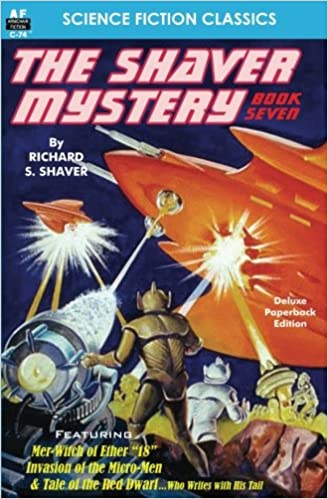
The conversation turns darker when the guests note that the visual iconography used to depict the Deros in Amazing Stories drew heavily on anti-Semitic caricature. Jerry observes that Palmer later became entangled with explicit anti-Semitism, and that the Dero mythology — hidden, malevolent controllers manipulating surface-dwellers from below — replicates the structure of medieval blood libel, which threads through witch trials, early modern conspiracy theory, and finds modern expression in Pizzagate and QAnon. This, the group agrees, is part of why the Shaver Mystery matters beyond its pulp-fiction novelty value: it sits at a genealogical junction between Theosophical lost-continent mythology, Hollow Earth pseudo-science, and the conspiratorial anti-Semitic tradition that Palmer would later make more explicit — a lineage that leads directly into the flying saucer era covered in Part 2.
📚 Further Reading
– 📚 The Man from Mars: Ray Palmer’s Amazing Pulp Journey 💵 by Fred Nadis
– 📚 Spooky Archaeology: Myth and the Science of the Past 💵 by Jeb Card
– 📖 Atlantis: The Antediluvian World by Ignatius Donnelly (1882)
– 📖 The Coming Race by Edward Bulwer-Lytton (1871)
– 📚 A Journey to the Earth’s Interior 💵 by Marshall B. Gardner (1913)
– 📚 Subterranean Worlds 💵 (2004 bibliography of Hollow World texts, ed. Peter Fitting)
🔗 Related Links
– Edmond Halley’s Hollow Earth hypothesis (1692)
– Hollow Earth — Wikipedia overview
– Lemuria — from Sclater’s biogeography hypothesis to Theosophical lost continent
– Amazing Stories magazine
–
Note: ads inserted into the distributed audio alter the timestamps in unpredictable ways, so timing references in these notes are approximate.
In this episode of MonsterTalk, we get a brief overview of the history of Hollow Earth theories and start our deep dive into the topic of The Shaver Mystery with repeat guests Dr. Jerry Drake and Dr. Jeb Card. Weird-Science, lost civilizations, UFOs, and Nazis — this story has more threads than a fancy bedsheet set!
Listen to MonsterTalk via iTunes, Spotify, Google Play Music, TuneIn, and Stitcher. Get the MonsterTalk Podcast App for iOS, Android, and Windows.
Some links from the Hollow Earth introduction
- Duane Griffin’s academic research on Hollow Earth history (From archive.org snapshot)
- 1665 — Athanasius Kircher — review of The Subterranean World (Mundus Subterraneus)
- 1692 — Edmond Halley’s paper “An account of the cause of the change of the variation of the magnetical needle with an hypothesis of the structure of the internal parts of the Earth”, Philosophical transactions, xvi (1692), 563–87
- 1721 — An Account of a Voyage from the North Pole to the South Pole via the Centre of the Earth (Anonymous French volume)
- 1741 — The Journey of Niels Klim to the World Underground
- 1818 — John Cleves Symmes issues tract urging exploration of the poles and hollow earth
- 1820 — Symzonia: Voyage of Discovery
- 1826 — James McBride — Symme’s Theory of Concentric Spheres
- 1838 — The Great United States Exploring Expedition
- 1833 — E.A. Poe’s MS Found in a Bottle
- 1864 — Jules Verne’s Journey to the Center of the Earth
- 1869 — Cyrus “Koresh” Teed starts Koreshanity
- 1871 — (more on this in pt2) Bulwer Lytton’s The Coming Race
- 1888 — Helena Blavatsky’s The Secret Doctrine
- 1905 — Frederick Oliver’s A Dweller on Two Planets
- 1906 — William Reed’s Phantom of the Poles
- 1909 — Cook & Peary race for the Pole!
- 1913 — Marshall Gardner’s A Journey to the Earth’s Interior, or Have the Poles Really Been Discovered?
- 1914 — Edgar Rice Burroughs At The Earth’s Core
- 1931 — Harvey Spencer Lewis’s Lemuria: The Lost Continent of the Pacific
- 1934 — Guy Ballard’s Unveiled Mysteries

There’s lots more discussed in the episode and in part 2’s show notes. Here are a few more helpful links:
- Dan Loxton’s Junior Skeptic Hollow Earth coverage Part 1 and Part 2 were very helpful.
- Wired magazine’s 2014 Hollow Earth article was also useful for me.
- I haven’t read it, but 2004’s book-length bibliography of Hollow World texts Subterranean Worlds looks both comprehensive and interesting.
Music
- Monstertalk Theme: Monster by Peach Stealing Monkeys
MTArchivist
0