Regular Episode
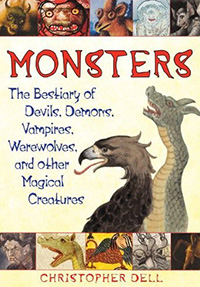
#028 – A Bestiary of Creatures
The result is a coffee-table book with a quietly skeptical subtext: every image in it was conjured entirely by human imagination, and Dell is at pains to note that no culture, in any era, has ever produced a verified monster specimen.
🦴 Monsters as a Universal Human Impulse
Dell opens with a striking observation: the oldest surviving sculpture on Earth — a roughly 32,000-year-old lion-man figure found in a cave in Germany — is already a human-animal hybrid. From Mesopotamia to ancient Egypt to every subsequent culture on record, the same blending of human and animal form recurs. Dell argues this universality is itself the most interesting thing about monsters: they are not a quirk of any one tradition but a persistent feature of human cognition and storytelling.
His skeptical bottom line, stated plainly during the interview: nobody, in any culture, in any era, has ever actually seen a monster — and yet we never stop believing in them or creating them. He draws a quiet parallel to religious belief more broadly.
🐉 Dragons: A Case Study in Monster Migration
Dell traces the dragon as a worked example of how monster archetypes travel across cultures and transform along the way. The lineage he sketches:
– Origins in Mesopotamia (roughly 6,000 years ago), visible in terracotta panels from the region of modern Iraq and Iran.
– Spread westward into Egyptian tradition, then into the Hebrew Bible as Leviathan and related sea-serpents.
– Greek mythology crystallizes the “hero kills dragon = restoring order from chaos” template that flows into Norse and broader European tradition.
– Simultaneously the dragon migrates east through Persian miniature painting into China and Japan — where it becomes something almost opposite: a largely benign, auspicious creature. (Both Dell and Blake were born in the Year of the Dragon.)
Dell also recounts the Chinese legend of the Yellow Emperor, whose serpent emblem absorbed pieces of conquered tribes’ totems until it became the composite dragon — a folk etymology that, Dell notes, contains a kernel of anthropological truth about how monster traditions accumulate features over time.
🏯 Japanese Monsters: The World’s Best
Dell is unambiguous about his favorites: Japanese monsters, particularly the explosion of creature-invention that peaked in the 18th and 19th centuries. He singles out the kappa as a personal highlight — a semi-amphibious, pond-dwelling humanoid with a water-filled dish on its head that features prominently in a famous Hokusai woodblock print. Key kappa facts discussed:
– It lurks near ponds and drags small children to their deaths.
– It has a fondness for cucumbers (its one known weakness of temperament).
– Its water dish must stay full when on land — and the kappa is bound by an unfailing sense of politeness, so bowing to one causes it to bow back, spill its water, and die.
– Warning signs about kappas can still be found posted near bodies of water in Japan today.
Dell contrasts Japanese monsters with their Western counterparts: Japanese folklore creatures are often darkly comic as well as dangerous, and the tradition has a remarkable creative energy — new monsters being added and refined continuously. He also touches briefly on the broader context of J-horror cinema (The Ring, The Grudge) as a continuation of that inventive tradition.
😈 Religious Monsters and the Devil’s Blank Canvas
On the relationship between religion and monster-making, Dell offers a counterintuitive observation: the three great monotheistic faiths — Judaism, Christianity, and Islam — are actually quite sparse when it comes to monsters in the conventional sense. The Bible’s concrete monsters amount to Leviathan, Behemoth, and a few hints at others. Islam has a rich tradition of jinn but they feature minimally in the Quran itself. Judaism has the Golem, though in its familiar form it is a relatively late development.
The devil is the telling exception: the Bible offers virtually no physical description of him, leaving artists free to invent — the only requirement being that the result terrify the faithful. Angels, by contrast, have comparatively standardized iconographic templates. Blake notes that the serene humanoid angel familiar from popular culture bears little resemblance to the multi-winged, many-eyed creatures actually described in scripture.
Dell argues that monotheistic traditions may have deliberately avoided populating their cosmologies with powerful monsters, to prevent any creature from seeming to rival the authority of the Creator.
🐺 The Beast of Gévaudan and the Psychology of Monster Panic
The conversation turns to the Beast of Gévaudan, the mid-to-late 18th-century French episode in which a series of deadly animal attacks — attributed to an enormous, possibly supernatural wolf or wolf-bear hybrid — triggered widespread hysteria and eventually a royal military response. Dell frames it as a textbook example of how a kernel of real danger (large predatory animals) gets amplified by collective fear into something demonic, and how people simultaneously dread and desire the monster to be real, because a genuine monster would be evidence of something beyond the mundane world.
The king’s soldiers eventually paraded what was probably a large but entirely ordinary wolf as the culprit. The film 🎬 Brotherhood of the Wolf 💵 (Le Pacte des loups, 2001) is briefly recommended — Blake’s description of it as “a French buddy cop movie from the 1700s” earns Dell’s approval.
🎨 Hieronymus Bosch, Hybrid Monsters, and the Limits of Human Imagination
Dell discusses Hieronymus Bosch as someone working at the extreme edge of a well-established tradition of deliberate visual horror — the Last Judgement with its gaping hellmouth had been a staple of Western religious art since the 12th century. The book includes a detail from The Garden of Earthly Delights, and Dell suggests that much of what passes for shocking in modern horror cinema was already being done — often more inventively — by painters like Bosch or Lucas Cranach five centuries ago.
On the question of hybrid-monster combinations that don’t seem to exist in the historical record: Dell was surprised to find almost no human-insect hybrids in pre-modern art, and speculates this may be partly a function of scale — insects were too small to register as fearsome before the microscope made their alien anatomy visible. The book does include one Japanese 17th-century image of what appears to be a cricket or grasshopper with a cat’s head, but Dell considers the insect-human hybrid gap a genuine lacuna in the monster tradition.
Dell closes with a thought that serves as the book’s real thesis: if monsters actually existed as physical creatures, they would be just another species — findable, dissectable, boring. It is precisely their impossibility that makes them appealing. Rather than lamenting the apparent non-existence of the supernatural, he suggests we should marvel at the fact that the human imagination contains all of it already.
📚 Further Reading
– 📚 Monsters: A Bestiary of Devils, Demons, Vampires, Werewolves, and Other Magical Creatures 💵 by Christopher Dell
– 📚 What Makes a Masterpiece 💵 by Christopher Dell (mentioned as forthcoming at time of recording, developed with input from Philip Pullman)
🔗 Related Links
– Lion-man of the Hohlenstein-Stadel — the 32,000-year-old sculpture discussed as the oldest known monster image
– Kappa (folklore) — Japanese water creature, Dell’s personal favorite
– Beast of Gévaudan
– Hieronymus Bosch
– The Garden of Earthly Delights
– Camille Flammarion — whose 19th-century book contained the “prehistoric monster in a modern town” engraving noted by Blake
– Kelpie — the Scottish water-horse briefly compared to the kappa
– Golem
– Jinn
Note: ads inserted into the distributed audio alter the timestamps in unpredictable ways, so timing references in these notes are approximate.
Author Christopher Dell has collected an astonishing array of art from around the world depicting many obscure and mysterious creatures in his new book Monsters: A Bestiary of Devils, Demons, Vampires, Werewolves, and Other Magical Creatures.
Christopher Dell joins the MonsterTalk crew to discuss why humans are so fascinated by these bizarre entities.
Music
- Monstertalk Theme: Monster by Peach Stealing Monkeys
Blake Smith
0