#027 – The Iceman Goeth
Late in the 1960s, a traveling showman named Frank Hansen toured county fairs and carnivals with a refrigerated trailer containing a six-foot hairy humanoid frozen in a block of ice. The exhibit might have faded quietly into carnival history had it not attracted the attention of two credentialed zoologists — Ivan T. Sanderson and Bernard Heuvelmans — who declared it a genuine unknown hominid and published scholarly essays saying so. What followed was decades of cryptozoological debate over a rubber carnival prop.
🎪 A Brief History of Sideshow
Matt traces the arc of American sideshow from its heyday in the 1930s through its steep decline by the time he entered the scene in 1991. He explains the crucial vocabulary: a gaff (or gaffe) is a fabricated three-dimensional exhibit — a fake — while pickled punks refers to preserved specimens of deformed neonates, some genuine, some fabricated. The mixing of real specimens with fakes was a deliberate feature of the form, not a bug: it lent an air of authenticity to everything on display.
Matt and the hosts discuss Marsh’s Free Museum in Long Beach, Washington, home of the celebrated gaff Jake the Alligator Man, as a living example of this tradition. By the early 1990s, sideshow had largely abandoned static gaff exhibits in favor of working acts — sword swallowers, fire eaters, human pincushions — and what few gaff artists remained (Matt names Mark Frierson, Doug Higley, and Portland artist William Bivens) were increasingly selling their work to private collectors on eBay rather than taking it on the road.
🧊 Enter the Iceman
Hansen first exhibited what he called the Siberskoye creature (a place name Matt notes does not exist — itself a classic sideshow tell) in the spring of 1967, just months before the Patterson-Gimlin film brought Bigfoot to national attention that October. Hansen capitalized brilliantly on the ensuing wave of Bigfoot interest. The origin story of the creature shifted repeatedly — floating in a block of ice off the coast of Asia, shot in the wilds of Minnesota by Hansen himself, shot by a woman defending herself from a hairy attacker — classic promotional churn that Matt immediately recognized as the sideshow promoter’s instinct to keep the story alive.
A Wisconsin reptile dealer named Terry Cullen brought the exhibit to the attention of Sanderson and Heuvelmans, who traveled to Hansen’s home in Rolling Stone, Minnesota in December 1968 and spent days examining the creature through several inches of ice and a thick pane of glass. Hansen refused to allow the ice to be thawed or tissue samples taken — a condition that, in hindsight, should have ended the inquiry immediately. Instead, both men published extensive anatomical write-ups. Heuvelmans went so far as to assign the specimen a Linnaean binomial: Homo pongoides.
🔍 The Gaff Revealed
The case was effectively closed in 2008, when Vern Langdon — a veteran creature costume designer who had worked at Don Post Studios on the Planet of the Apes films — surfaced on a Bigfoot forum during the unrelated Dyer and Whitton “Bigfoot in a freezer” hoax, noting the eerie parallel to the Iceman. In a subsequent hour-and-a-half podcast interview, Langdon laid out the timeline: Hansen had approached Don Post Studios as early as 1966 seeking a fabricated hominoid exhibit. Don Post declined, referring Hansen to sculptor Howard Ball, who built the creature from a rubbery polymer (Langdon said “hot-melt” vinyl; Ball’s relatives said rubber) and had the hair inserted by a separate artist. The fabrication cost was estimated at around $5,000. The exhibit was never a biological specimen — it predated any possible encounter with a real animal.
Joe Nickell, who saw the exhibit in Canada, provided a damning first-person account in his book 📚 Secrets of the Sideshows 💵: the ice had partially melted away, exposing part of the body — which he reached in and touched. “Not surprisingly,” Nickell wrote, “it was rubbery.” British primatologist John Napier, who examined the exhibit for the Smithsonian, noted in his book 📚 Bigfoot: The Yeti and Sasquatch in Myth and Reality 💵 that the hands were conspicuously “spatulate” — cartoonishly oversized, a signature artistic flourish Matt identifies as common across gaff culture, where makers tend toward grotesque exaggeration.
🧬 The Credulous Experts
Matt’s central question — how did two credentialed zoologists get fooled? — has a cultural answer: Sanderson and Heuvelmans had no frame of reference for sideshow tradition. The very things that were obvious tells to anyone with carnival experience (the fictional place name, the shifting origin stories, the refusal to allow physical examination) simply didn’t register as red flags in an academic context.
Matt illustrates Sanderson’s broader credulity with two choice examples from Sanderson’s 1969 book 📚 More Things 💵. First: Sanderson investigated a series of giant three-toed tracks found in Clearwater, Florida in 1948 and eventually concluded they were made by a 15-foot penguin. (The hoaxer, Tony Signorini, later confessed to fabricating cast-iron prosthetic feet.) Second: Sanderson believed the dinosaur special effects in the 1925 film The Lost World were achieved by fitting “skillfully constructed suits” over live chickens — rather than the stop-motion animation of Willis O’Brien. The advocates’ fallback argument — that Sanderson and Heuvelmans were zoological authorities who could not have been fooled — looks considerably weaker in that light.
🗞️ The Long Unraveling
Loren Coleman was the most prominent long-term advocate for the Iceman’s authenticity within Bigfoot research circles. In September 2008, prompted in part by the Langdon interview, Coleman posted on his blog Cryptomundo conceding he could no longer support the Iceman as genuine — though without crediting Langdon’s account. A telling detail emerged in the comments: when asked about Sanderson and Heuvelmans’s alleged list of fifteen anatomical differences between the original exhibit and a supposed replacement, Coleman revealed the list had never been made public — the two scientists had kept it secret so Hansen wouldn’t know what to change in any future display. Matt’s verdict is withering: submitting a scientific claim while refusing to disclose your measurement criteria is, as he puts it, “pure, unadulterated pseudoscience.”
Matt also notes a practical reason Hansen may have occasionally claimed the exhibit was a fabrication: when crossing international borders, if a customs official took seriously Heuvelmans’s classification of the specimen as Homo pongoides — same genus as humans — Hansen needed a legal out. Calling it a prop was good insurance against having it confiscated as potential evidence of homicide.
📚 Further Reading
– 📚 Bigfoot: The Yeti and Sasquatch in Myth and Reality 💵 by John Napier
– 📚 Secrets of the Sideshows 💵 by Joe Nickell
– 📚 More Things 💵 by Ivan T. Sanderson
– 📚 Animal Fakes and Frauds 💵 by S. Peter Dance
– 📚 Seeing Is Believing 💵 by A. W. Stencell
– 📚 Circus and Carnival Ballyhoo 💵 by A. W. Stencell
– 📚 On the Track of the Sasquatch 💵 by John Green (mentioned as formative reading for a young Matt Crowley)
🔗 Related Links
– Minnesota Iceman – Wikipedia
– Ivan T. Sanderson – Wikipedia
– Bernard Heuvelmans – Wikipedia
– Cardiff Giant – Wikipedia (Matt’s benchmark for great American hoaxes)
– Jim Rose Circus Sideshow – Wikipedia
– Don Post Studios – Wikipedia
– Fiji Mermaid – Wikipedia
– Patterson-Gimlin Film – Wikipedia
– Willis O’Brien (stop-motion pioneer) – Wikipedia
– Hypertrichosis – Wikipedia
Note: ads inserted into the distributed audio alter the timestamps in unpredictable ways, so timing references in these notes are approximate.
LATE IN THE 1960S, in the era which gave us the famous Patterson-Gimlin Bigfoot film, fairgoers in Minnesota were confronted with a marvel: a hairy, primitive-looking humanoid frozen in a block of ice. Was it an anthropological relic? Was it a sasquatch?
As investigators from the Smithsonian Institute and cryptozoological researchers studied the frozen creature, they came to very different conclusions as to what it represented. The MonsterTalk hosts interview Bigfoot researcher and former side-show performer Matt Crowley — and try to crack the case of The Minnesota Iceman.
In this episode
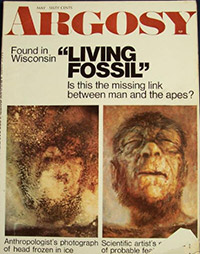
Argosy cover, May 1969
When you see an iceman (the frozen caveman sort, not the Marvel superhero) you probably think of Scooby Doo, the 1984 movie Iceman, or perhaps the 1970 film Trog? But it is likely that all these fictional tales owe their origin to the success of Frank Hansen’s 1968 traveling exhibit now widely known as “The Minnesota Iceman.” In this episode you’ll learn about the history of side-show exhibits, the specific meaning of some carnie terms, how cryptozoologists were fooled by a hoax, and the true story behind this bizarre exhibit featuring a strange looking humanoid frozen in a block of ice. Former sideshow performer and bigfoot researcher Matt Crowley joins us to discuss the history of this strange case.

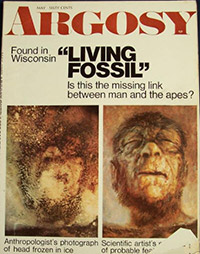
- The May 1969 Argosy article on the Iceman written by Ivan Sanderson
- Read Loren Coleman’s post rejecting the iceman
- John Napier of National Geographic’s take on the iceman
Music
- Monstertalk Theme: Monster by Peach Stealing Monkeys
- Frozen by Robjn
Episode Transcript
Read a complete transcript of this episode