Regular Episode
#023 – Just Scratching the Surface
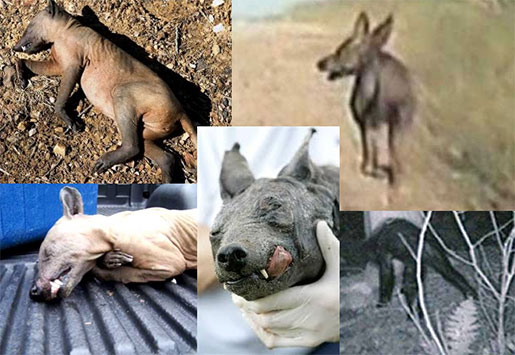
The hook is irresistible: many of the hairless, grotesque animals that get labeled “chupacabra” by credulous media outlets are, in fact, ordinary canids — coyotes, foxes, the occasional dog — ravaged by a microscopic arachnid. Ben coins the pleasingly accurate term “temporary chupacabras” for these unfortunate animals, and it sticks.
🔬 What Is Acarology, and What Is Mange?
Acarology is the study of mites and ticks — the Acari — a subclass of arachnids that includes some of the most medically and ecologically important creatures on Earth. Mange is the umbrella term for skin conditions in animals caused by mite infestations; in humans, the same condition caused by the same mite is called scabies.
The primary culprit in most “chupacabra” cases is Sarcoptes scabiei, a mite that burrows into the upper layers of skin. The immune response to this burrowing causes inflammation, skin thickening, and critically, reduced blood flow to hair follicles — which is why the hair falls out. In advanced cases, secondary bacterial infections set in, giving the animal a foul odor. In the most severe wild-animal cases, the condition is almost invariably fatal.
🧬 A Parasite That Evolved With Us
Dr. O’Connor describes research — including his own and that of his former student Hans Klompen, now at Ohio State University — showing that Sarcoptes scabiei is, at its core, a human parasite. Its closest relatives occur on our closest primate relatives, suggesting the mite has co-evolved alongside the primate lineage from the very beginning.
When humans began domesticating animals — dogs and pigs in particular — the mite opportunistically colonized those new hosts. Because dogs and pigs have had longer exposure to the mite than wild species, they can sometimes fight it off. Wild canids like foxes, coyotes, and wolves, however, have no such evolutionary history with it, and the results can be catastrophic. Dr. O’Connor recalls a sarcoptic mange epizootic among red foxes in upstate New York in the 1970s that killed between 98 and 99 percent of the local population. The mite has also spread to wombats in Australia — presumably via dingoes, who got it from domestic dogs, who got it from us.
🪲 Life Cycle of a Mange Mite
Like all Acari, Sarcoptes scabiei hatches from an egg with only six legs — three pairs, more like an insect at that stage — before molting into the eight-legged nymphal stages. The mange mites have two nymphal stages (protonymph and tritonymph); the deutonymph, or second nymph, which in free-living ancestors served as a dispersal form, has been evolutionarily lost. Adults of both sexes must mate directly before females can lay eggs, restarting the cycle.
A normal case of human scabies involves only about 20–30 mites, is self-limiting, and confers lasting immunity. The severe condition known as crusted scabies — which can involve hundreds of thousands or even millions of mites spreading across the body — occurs in people with compromised immune systems (the elderly, AIDS patients, transplant recipients on immunosuppressive therapy), and is clinically similar to what happens in mangy animals.
🦨 Why Do Mangy Animals Get Mistaken for Monsters?
Blake and Ben discuss the misidentification problem at some length. Blake had previously assumed the “temporary chupacabra” phenomenon was an urban-rural knowledge gap — city people unfamiliar with wildlife. But many of these sightings come from ranchers and rural residents. The case of Phyllis Canion of Cuero, Texas — a rancher who found hairless, dead canids on her property and became a prominent figure in chupacabra media coverage — is a prime example. Dr. O’Connor notes that in looking through internet photos of alleged chupacabras, anything that appeared to be a real animal looked, to his expert eye, like a mangy coyote, dog, or fox.
Ben also raises the Jacobs creature — a trail-camera photo from Pennsylvania that Bigfoot enthusiasts claimed showed a juvenile primate, but which wildlife biologists identified as a mangy bear. The case neatly illustrates how hair loss strips away the visual cues we rely on to identify species, making animals of very different kinds look superficially alike — consistent, as Blake notes, with the underlying fact of shared evolutionary anatomy.
🕷️ Dust Mites, Keratin, and a Remarkable Evolutionary Full Circle
Dr. O’Connor describes his ongoing research with colleague Pavel Klimov on the evolutionary origins of house dust mites. Contrary to the old parasitological adage “once a parasite, always a parasite,” the dust mites appear to have descended from bird feather parasites — full-time permanent parasites — and then successfully transitioned back to a free-living existence in nests and, eventually, human homes.
The proposed pathway: a keratin-digesting ancestor living on bird feathers occasionally fell into the nest, where sloughed-off feather sheaths provided an abundant food supply. Over time, some lineages adapted to nest-dwelling, then to human habitations, feeding on shed skin cells. The evolutionary punchline: the primary allergen responsible for dust mite allergies — found in mite feces and identified as a gut enzyme — turns out to be the keratin-digesting enzyme that enabled the entire transition in the first place. The very adaptation that allowed them to leave parasitic life behind is what makes them a medical problem today.
🧠 Delusional Parasitosis and the Psychology of Itching
Dr. O’Connor regularly fields queries from members of the public who are convinced they are being infested by invisible mites. He describes receiving bags within bags within bags — with a tiny unidentifiable speck at the center — from people whose sensation of being bitten has begun to dominate their lives. He handles these cases with evident care, gently introducing the concept of delusional parasitosis without dismissing the person’s experience, while directing them toward dermatologists who can rule out actual infestations. Ben’s book 📚 Scientific Paranormal Investigation 💵 is mentioned in connection with folie à deux — shared delusional beliefs between two people in close relationship — and Blake recommends the William Friedkin film 🎬 Bug 💵 (2006, starring Ashley Judd) as a psychologically realistic dramatization of this kind of shared infestation belief.
📚 Further Reading
– 📚 Scientific Paranormal Investigation 💵 by Benjamin Radford
– 📚 Tracking the Chupacabra 💵 by Benjamin Radford
– 🎬 Bug 💵, directed by William Friedkin (2006)
– 🎬 The Black Scorpion 💵 (1957), featuring special effects by Willis O’Brien
🔗 Related Links
– Sarcoptes scabiei (Wikipedia)
– Mange (Wikipedia)
– Scabies (Wikipedia)
– Crusted Scabies (Wikipedia)
– House Dust Mite (Wikipedia)
– Delusional Parasitosis (Wikipedia)
– Chupacabra (Wikipedia)
– Jacobs Creature (Wikipedia)
– Alopecia (Wikipedia)
– Folie à deux (Wikipedia)
Note: ads inserted into the distributed audio alter the timestamps in unpredictable ways, so timing references in these notes are approximate.
IN THIS EPISODE we get under the skin of the chupacabra legend, and find out more about the lice that cause the hairless canids the media loves so much. It’s okay to scratch — but don’t skip this episode! Once you get past the disgust factor, there is some amazing science going on in parasitology. Our guide into this fascinating world is acarologist Dr. Barry O’Connor, of the Department of Ecology and Evolutionary Biology and the Museum of Zoology, University of Michigan.
Topics include:
- What is acarology?
- The origin of mange & scabies
- The difference between the two diseases
- Why does mange cause hair loss?
- Why does mange cause death?
- What is the life cycle of a mite?
- What is the evolutionary origin of dust mites?
- Why does the media get excited by hairless animals?
Music
- Intro music by David Beard
- Monstertalk Theme: Monster by Peach Stealing Monkeys
Blake Smith
0