#022 – Cryptozoology & Science, Part 2
The book they’re working on — eventually published as 📚 Abominable Science! 💵 — grew out of Prothero’s observation that a search of Amazon’s top 100 cryptozoology titles turned up exactly zero skeptical treatments of the field as a whole. A few strong critical books existed on Bigfoot and Nessie individually — but nothing that examined cryptozoology’s underlying assumptions and methods across the board.
🦕 Mokele-Mbembe and the Monster Quest Experience
Prothero appeared as the token skeptic on a MonsterQuest episode devoted to Mokele-Mbembe, the purported living sauropod of the Congo Basin. His verdict: two creationist explorers leading local witnesses by showing them images of sauropods, a plaster cast of an ambiguous hole in a riverbank presented as a trackway, and not a single frame of genuine evidence. The episode, he notes, is also a case study in the broader problem of ethnozoology done badly — local peoples often make no distinction between animals they actually hunt and creatures from their oral tradition, and language barriers compound the confusion considerably.
His paleontological objection cuts even deeper: the African fossil record for the post-dinosaur interval is well enough known that a surviving sauropod population would leave some trace. It hasn’t. Prothero argues that this kind of prior-plausibility analysis — the kind a trained paleontologist brings automatically — is almost entirely absent from the popular cryptozoology literature.
🦴 The Case Against Bigfoot: Bones and Bipedalism
Prothero and Loxton both have extensive firsthand experience in the forests of the Pacific Northwest (Washington/Oregon and British Columbia respectively), and both have found bear skeletons in the wild — undercutting the claim, associated with the late Grover Krantz, that naturally deceased bears simply aren’t found. Prothero cites a 19-year Pennsylvania bear-population study documenting roughly 20 naturally killed bears per year as direct refutation.
A second anatomical problem: if the Patterson-Gimlin film depiction is taken at face value, Bigfoot is a fully upright, human-postured biped — which places its ancestry somewhere near Australopithecus on the hominid tree. Proponents who instead invoke Gigantopithecus as the ancestor are doubly stuck: Gigantopithecus sits far deeper in the ape lineage, would never have been bipedal, and is known only from a handful of teeth and jaw fragments — hardly enough to build a convincing reconstruction.
🔬 Is Cryptozoology a Science? The Amateur Question
The conversation turns to a frequent cryptozoological talking point: that new animals are discovered all the time, so why not a Bigfoot or Nessie? Prothero and Loxton note (echoing paleontologist Darren Naish) that real new-animal discoveries are almost always invertebrates, small lizards, or the occasional rare small mammal — not megafauna, and not animals violating well-established ecological and population constraints.
On amateurs in science: Prothero is candid. The Society of Vertebrate Paleontology runs about 50% amateur membership — partly because the professional field is tiny (roughly 300–400 practitioners worldwide) — but meaningful amateur contributions are limited. Most value comes from volunteers at dig sites. The implication for cryptozoology is pointed: people channeling genuine curiosity into phantom-chasing could instead be doing real field science.
🌊 Omphalos, Plesiosaurs, and the Origins of Nessie
Loxton traces the plesiosaur-as-sea-serpent hypothesis back to Philip Henry Gosse — the Victorian naturalist best known for the Omphalos hypothesis (the theological argument that the Earth was created with the appearance of age, which also prompted the question of whether Adam and Eve had navels). Writing before Darwin’s Origin of Species, Gosse proposed that relic plesiosaurs could explain the Great Sea Serpent — a position that wasn’t entirely unreasonable given how little was known of prehistoric life at the time. Early popular imagery of the prehistoric past was dominated by ichthyosaurs and plesiosaurs, largely because of the fossils recovered by Mary Anning at Lyme Regis. The plesiosaur hypothesis for Nessie has persisted ever since — even though Loch Ness was under glacial ice as recently as 20,000 years ago.
🐆 Most Plausible Cryptids — and the Chupacabra Problem
Asked which cryptids are most plausible, Prothero’s rule of thumb is: the more obscure, the more plausible, and the larger the habitat, the better the odds. Deep-ocean discoveries remain genuinely possible — the giant squid (Architeuthis) went from legend to confirmed specimen, and ROV footage from places like the Monterey Bay Aquarium Research Institute regularly turns up large, previously unknown squid. Alien big cats are at least plausible in principle (escaped or released exotic animals), though many sightings dissolve under scrutiny.
The chupacabra offers a useful counter-example: virtually every fresh “carcass” turns out to be a mangy or hairless dog or coyote. Prothero points out that a zoologist can identify an animal from skull and dentition regardless of pelage — the misidentifications arise because most people simply don’t know what familiar animals look like without fur. Loxton adds a wry shepherd’s footnote: when predation on sheep was attributed to mysterious big cats, the livestock worker on-site — someone with direct, first-hand knowledge — was saying it was domestic dogs. Cryptozoologists ignored that testimony entirely.
📚 Further Reading
– 📚 Abominable Science! 💵 by Daniel Loxton and Donald Prothero
– 📚 Bigfoot Exposed 💵 by David Daegling
– 📚 The Loch Ness Mystery Solved 💵 by Ronald Binns
🔗 Related Links
– Mokele-Mbembe (Wikipedia)
– Omphalos Hypothesis (Wikipedia)
– Philip Henry Gosse (Wikipedia)
– Mary Anning (Wikipedia)
– Gigantopithecus (Wikipedia)
– Homo floresiensis (“the Hobbit”) (Wikipedia)
– Giant Squid (Architeuthis) (Wikipedia)
– Darren Naish (Wikipedia)
– Roy Mackal (Wikipedia)
Note: ads inserted into the distributed audio alter the timestamps in unpredictable ways, so timing references in these notes are approximate.
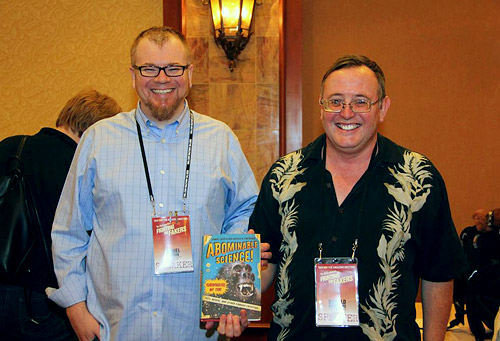
Photo (c)2013 – by David Patton
THIS WEEK, MonsterTalk continues its discussion of the intersection between science and cryptozoology. The hosts interview Dr. Donald Prothero and Daniel Loxton, who are working on a book (Abominable Science!) that will give a deep overview of the field of cryptozoology and how it intersects with actual science. This interview was recorded at The Amaz!ng Meeting 8 in Las Vegas. Topics discussed include:
- Monster Quest’s search for M’kele Mbembe
- What does the theory of Omphalos have to do with Nessie?
- Most likely cryptids to actually exist
- The role of the amateur in real science
Ben Radford and Blake Smith will be appearing at Dragon*Con 2010 recording a live episode on Saturday September 4th at 4:00 pm. They will also be attending the 2nd annual Jeff Medkeff Star Party on September 2nd. If you’re attending these events and listen to the show, please stop by and say hello! Or Humptydoo!
Music
Monstertalk Theme: Monster by Peach Stealing Monkeys