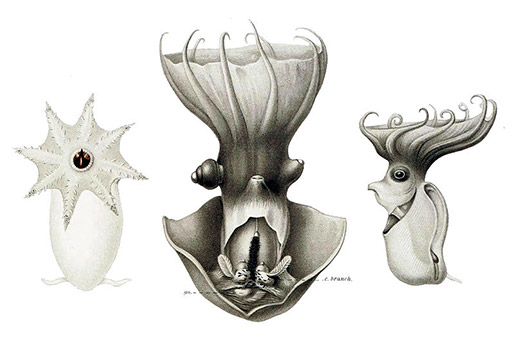
#019 – Cthulhu Rises
Blake Smith hosts this episode alongside Ben Radford (managing editor of Skeptical Inquirer) and Dr. Karen Stollznow, and the centerpiece is a live interview recorded at The Amazing Meeting 8 in Las Vegas with James “The Amazing” Randi — magician, paranormal investigator, and one of the founders of CSICOP. Randi is characteristically direct, emotionally candid, and (when the subject of parapsychologist William Roll comes up) genuinely angry.
👻 What Is a Poltergeist, Anyway?
The word poltergeist comes from the German for “noisy ghost,” and in paranormal lore it describes a mischievous or malevolent spirit that manifests through telekinetic phenomena: objects hurled across rooms, stones pelting rooftops, windows shattering, mysterious bangs, and occasionally the victims themselves becoming airborne. Blake notes that poltergeist cases have an investigative advantage over ordinary ghost hauntings — the phenomena, if real, should be physically observable and measurable rather than purely anecdotal. The hosts also observe that paranormalists almost universally link poltergeist activity to a child in the household, often one approaching puberty, claiming some psychic connection between hormonal change and supernatural “focus.” The skeptical reading, of course, is simpler: children are capable, creative, and sometimes highly motivated tricksters.
Karen mentions several Australian cases in passing, including the Guyra Ghost (1921) and the lesser-known Humpty Doo Poltergeist from the Northern Territory in the 1990s — the latter exposed when skeptical investigators noticed suspiciously battery-sized clean patches on dusty household fans that had clearly been used to fling objects around the room. The residents were eventually evicted.
📸 The Flying Telephone and the Contact Sheet
Randi recounts the famous photograph taken by Fred Shannon, staff photographer for The Columbus Dispatch: Tina Resch apparently cowering under a blanket on the sofa while a telephone hangs in mid-air beside her. According to Randi, the contact sheet from Shannon’s film roll tells a very different story. Tina had instructed Shannon to cover his eyes and turn away, only pressing the shutter when she gave a signal — a small vocal cue. The contact sheet, which Randi obtained in a tense confrontation with a Dispatch editor who tried to physically reclaim it, showed frames that made the mechanism of the trick clear: Tina would throw the phone, perform a frightened reaction, and duck under the blanket before Shannon looked up.
Randi’s account of walking out of the Columbus Dispatch building with the contact sheet — receipt in hand, threatening legal action against the security guard who tried to stop him — is one of the episode’s more vivid moments. The images, he says, were destined for his then-forthcoming book 📚 A Magician in the Laboratory 💵.
🔬 William Roll and the Parapsychologist’s Role
William Roll, a parapsychologist then at West Georgia College, investigated Tina’s case and concluded it was genuine. He studied her extensively, bringing her to his research facilities. Randi’s view is unambiguous and unsparing: he holds Roll “singly responsible” for Tina Resch’s subsequent tragedy, arguing that Roll catered to and encouraged a troubled teenager who had already been caught faking, treating her like a celebrity subject rather than a child who needed honest intervention — and that Roll’s motivation was, at least in part, the book he eventually produced on the case. (Randi refers to Roll’s volume during the interview; Roll did later co-author 📚 Unleashed: Of Poltergeists and Murder: The Curious Story of Tina Resch 💵.) It is worth noting that this is Randi’s personal account of events; Roll’s perspective, and the academic parapsychological literature on the case, present a different framing.
⚠️ The Tragic Aftermath
Blake provides a brief but sobering account of Tina Resch’s life after 1984. By 16 she was married and in an abusive relationship. By 25 she was twice divorced with a three-year-old daughter, Amber. She relocated to Carrollton, Georgia — near William Roll — and moved in with a man named David Herron. Within months, Amber was dead. The autopsy established blunt force trauma to the head as the cause of death. Herron received a 20-year sentence. Tina, fearing a jury conviction and the death penalty, entered a guilty plea and received a life sentence. Blake’s closing observation: on the day her daughter lay dying in the trailer, Tina was away with a friend working on an autobiography of her life as a poltergeist victim.
🎩 Randi on the Million Dollar Challenge and Other Matters
The interview ranges beyond the Resch case. Randi discusses the JREF Million Dollar Challenge — noting that poltergeist claims would be eligible — and describes the occasionally surreal applications he receives (including 37 handwritten pages of foolscap that he counts as “two paragraphs”). He recounts a homeopathy test conducted under Royal Society supervision and broadcast on the BBC, in which he deliberately withheld his own whereabouts from the researchers to pre-empt the “negative vibrations” excuse. (The results fell squarely within chance; the homeopathy advocates immediately said the test must have been done incorrectly.) He also touches on the exploitation of children in paranormal contexts more broadly, singling out the A&E programme Psychic Kids: Children of the Paranormal and a Mexican group called the Instituto Más Vida, whose wealthy young charges he exposed on Japanese television by the simple expedient of holding their drawings up in front of them rather than in their laps — whereupon their “psychic” reading ability promptly vanished.
📚 Further Reading
– 📚 A Magician in the Laboratory 💵 by James Randi (mentioned during the interview as forthcoming)
– 📚 Unleashed: Of Poltergeists and Murder: The Curious Story of Tina Resch 💵 by William Roll and Valerie Storey
– 📚 Flim-Flam! Psychics, ESP, Unicorns, and Other Delusions 💵 by James Randi
🔗 Related Links
– Tina Resch – Wikipedia
– William G. Roll, parapsychologist – Wikipedia
– The Guyra Ghost (1921 Australian poltergeist case) – Wikipedia
– The Enfield Poltergeist – Wikipedia
– Poltergeist – The Skeptic’s Dictionary
– James Randi Educational Foundation – Wikipedia
– CSICOP / Committee for Skeptical Inquiry – Wikipedia
Note: ads inserted into the distributed audio alter the timestamps in unpredictable ways, so timing references in these notes are approximate.
That is not dead which can eternal lie And with strange aeons even death may die.
—H.P. Lovecraft,
The Call of Cthulhu
The literary work of Howard Phillips Lovecraft is dark and macabre. It casts a long shadow in American Literature, influencing such writers as Rod Serling, Steven King, Bob Howard, Robert Bloch, and many others. In his stories he wove a tapestry of mad alien gods and unspeakable horrors and the insignificance of man. And of a mountainous evil that sleeps in the ocean, worshipped by mad cults and known only as … Cthulhu.
In this episode
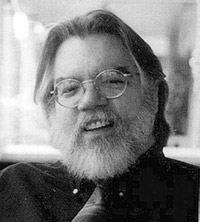
Robert M. Price, a noted Lovecraft scholar, discusses:
- The life of H.P. Lovecraft
- The history of the Cthulhu Mythos
- Lovecraft’s philosophy, religious beliefs and racism
- The cultural impact of Lovecraft’s work
- We then interview biologist PZ Myers about Cthulhu’s biological inspiration, discussing the weird alien biology and physiology of cephalopods.
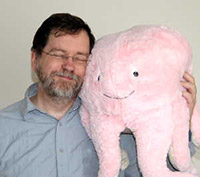
Links of interest
- Works by H.P. Lovecraft from Amazon.com
- More on PZ Myers’ favorite monster
- Robert M. Price’s interview of ST Joshi on Point of Inquiry
- Quirks and Quarks on the evolution of Cephalopod legs
Music
- Monstertalk Theme: Monster
by Peach Stealing Monkeys - Intro Music: Death by 1000psi
Interstitial Music: Goblin Dreams A.R. Morgan
Outro Music: Hey There Cthulhu by The Eben Brooks Band and used by special permission.
Episode Transcript
Read a complete transcript of this episode