#017 – Monsters from the Lab
Blake notes that his own introduction to Mothman came through the books of paranormalist author John Keel — particularly The Mothman Prophecies and Strange Creatures from Time and Space, both sporting cover art by the legendary Frank Frazetta. Both Keel and Frazetta had died in the months preceding this recording, facts that cryptozoologist Loren Coleman duly noted on his long-running “Mothman Death List.”
🦉 From Flatwoods to Point Pleasant: One Investigator’s Owl Theory
Joe’s path to Mothman ran through an earlier West Virginia case — the Flatwoods Monster of 1952. After visiting Flatwoods and conducting hands-on research, he concluded that what the witnesses saw was almost certainly a barn owl: the Ace-of-Spades face shape, the high-pitched hissing scream, the terrible apparent claws, and above all the dramatic eyeshine all fit the species closely.
When Mothman emerged in 1966, Joe initially assumed the same explanation applied — and wrote an article saying so before he had visited Point Pleasant. A subsequent on-site investigation forced a small but meaningful revision: Mothman, he concluded, was not a barn owl but almost certainly a barred owl (Strix varia). The critical clue was eyeshine. The initial November 15, 1966 sighting by Linda Scarberry and companions described eyes that shone only in response to the car’s headlights — “like bicycle reflectors” — not self-luminous glowing orbs. That distinctive crimson eyeshine is a hallmark of the barred owl. Crucially, the sighting took place in the old World War II munitions zone outside town, by then designated the McClintic Wildlife Preserve — a bird sanctuary with an ample barred owl population.
The one stubborn discrepancy is size: witnesses placed Mothman at something approaching human height, far larger than any owl. Joe’s response is to ask which is the more parsimonious explanation — that frightened people misestimated the size of something glimpsed briefly at night, or that a hitherto-unknown creature made a single appearance on Earth.
🧬 The Iconographic Evolution of Mothman
Drawing on his graduate training in iconography under scholar Guy Davenport at the University of Kentucky, Joe describes how he has applied the same analytical approach he used on the Shroud of Turin — tracing the evolution of an image over time — to Mothman and to an “alien timeline” charting how the cultural image of extraterrestrials has shifted from varied mid-century forms toward the now-iconic large-headed, almond-eyed gray.
The original Mothman, per the earliest witness accounts, had no arms and no neck — just eyes set atop a winged body. Over the decades, the creature has sprouted arms, grown bat-like wings, acquired alien-style wraparound eyes, and developed clawed feet. Blake notes he is wearing a Mothman shirt sent by listener Tanya Kaiser that illustrates the point perfectly: a fully limbed, alien-headed figure bearing little resemblance to what Linda Scarberry actually described in 1966. Even more striking: Scarberry herself, in later interviews, recalled seeing the muscles in Mothman’s arms — a detail entirely absent from her original account, a textbook illustration of how memory reconstructs itself over time, absorbing the surrounding cultural image.
🌊 Flap Dynamics: How Monster Sightings Spread
Joe outlines the typical lifecycle of a monster “flap” (a term borrowed from ufology): an initial intense sighting gets press coverage; the power of suggestion primes local observers to interpret any strange stimulus — anything with shining eyes, anything vaguely winged — as the known creature; pranks and hoaxes pile on in the wake of genuine reports; and eventually the flap runs its course. During the Mothman flap, one man reportedly shot and killed “Mothman” (the carcass turned out to be a snowy owl), red-light-bearing helium balloons were sent aloft, and at least one person glided silently over the area in an airplane with the engine cut. None of this, Joe stresses, accounts for the original sighting — but it illustrates how a genuine perceptual event can rapidly acquire layers of prank lore and copycat behavior.
🎪 The Monster-Town Pipeline: From Flap to Festival
Joe identifies a recurring pattern in communities that have hosted famous monster events. The initial flap fades into years of relative quiet — “like a dormant virus” — until a book revives interest, and eventually a local festival follows. He has seen this cycle play out at Point Pleasant (home to both a Mothman Museum and a large metal statue of the creature in the town center — depicting, naturally, a highly evolved post-1966 version), at Flatwoods, West Virginia, at Roswell, New Mexico, and at Hopkinsville, Kentucky (site of the Kelly–Hopkinsville “little green men” encounter of 1955), where the mayor gave Joe — and ufologist Peter Davenport — keys to the city and the use of the mayoral car for a day. As the years pass, Joe observes, the stories told by elderly witnesses tend to grow more spectacular, not less.
📺 Behind the Scenes at MonsterQuest
Joe offers a candid look at the production logic of mystery television. He appeared on the MonsterQuest episodes covering both Mothman and Flatwoods Monster, and describes being told by a producer — after a full day of shooting — that the executive in charge had approved his participation with the caveat: “This time, let’s hope he’s not too convincing.” His Flatwoods analysis (including a drawing comparing the original witness description to a barn owl) was left on the cutting-room floor; the program instead pivoted toward a reptilian creature interpretation, awkwardly yoking together gray-alien lore and Lloyd Pye‘s Starchild skull — a conflation that, Joe notes, even believers in the paranormal should find logically inconsistent.
He also recounts a telling exchange with an Unsolved Mysteries producer, who explained why catching a psychic in the act of cheating would mean “we wouldn’t have a show” — and who, when Joe complained that a solved mystery had been left unsolved on air, reminded him: “Dr. Nickell, the name of our show is Unsolved Mysteries.”
📚 Further Reading
– 📚 Real or Fake: Studies in Authentication 💵 by Joe Nickell
– 📚 Adventures in Paranormal Investigation 💵 by Joe Nickell
– 📚 Real-Life X-Files: Investigating the Paranormal 💵 by Joe Nickell
– 📚 Lake Monster Mysteries 💵 by Joe Nickell and Ben Radford
– 📚 Scientific Paranormal Investigation: How to Solve Unexplained Mysteries 💵 by Ben Radford
– 📚 The Mothman Prophecies 💵 by John A. Keel
– 🎬 The Mothman Prophecies 💵 (2002 film)
🔗 Related Links
– Mothman — Wikipedia
– Flatwoods Monster — Wikipedia
– Barred Owl (Strix varia) — Wikipedia
– Silver Bridge collapse (1967) — Wikipedia
– Kelly–Hopkinsville encounter — Wikipedia
– McClintic Wildlife Management Area (the “TNT area” of the original sightings) — Wikipedia
– Joe Nickell’s articles in Skeptical Inquirer
Note: ads inserted into the distributed audio alter the timestamps in unpredictable ways, so timing references in these notes are approximate.
In this week’s episode, MonsterTalk looks once again at genetics and creatures created in the laboratory. Dr. Marcus C. Davis joins the hosts to discuss what constitutes a “monster.” In his work, Davis deals with paleontology, as well as embryological manipulation — which, by some definitions, means he literally creates monsters.
What kinds of creatures are scientists making in labs today? What is the scope of their power? What guides their ethics? Learn more this week on MonsterTalk!
In this episode
Some questions we address with Dr. Marcus:
- What defines a monster — and what is the history
of the word in a scientific context? - What does it mean to create a monster in the lab?
- What are the ethical bodies that govern embryological and genetic experiments?
- How do scientists feel about being subject to those levels of oversight?
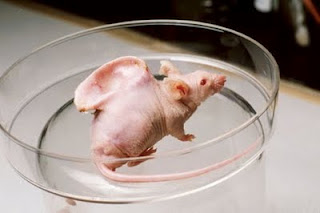
- What is up with that photo of a mouse with an ear on its back?
Links for more information on topics in the show
The governing bodies that guide embryology/development experiments:
National Institute of Health has animal health governing body called OLAW:
http://grants.nih.gov/grants/olaw/olaw.htm
Institutional Animal Care and Use Committee (IACUC):
http://www.iacuc.org/
Music
- Monstertalk Theme: Monster
by Peach Stealing Monkeys
Episode Transcript
Read a complete transcript of this episode.