Regular Episode
#010 – Fee-Fi-Fo-Fum!
A note on audio: the original recording suffered from persistent clicking throughout. Blake extends special thanks to Swoopy of the Skepticality podcast for heroic post-production work that rescued the interview. The content, as Blake cheerfully insists, more than makes up for any sonic roughness.
🦴 Giants in the Archaeological Record — Or Rather, the Lack Thereof
Dr. Feder is blunt: there is no credible archaeological evidence that humans were ever substantially taller in antiquity than they are today. He traces the persistent belief largely to the Old Testament, which contains roughly twenty specific references to giant peoples — including the kingdom of Og in Syria, populated (according to the text) by twelve-foot giants, and of course the Philistine champion Goliath, described at eleven or twelve feet tall.
Nineteenth-century excavations of Native American burial mounds in the American Midwest produced reports of unusually large skeletal remains, and these reports still circulate online as proof of ancient giants. Feder contacted forensic scientists at the Smithsonian Institution about one specific, frequently-cited case. The explanation is straightforward: when soft tissue and connective tissue decompose, bones migrate and separate, effectively “stretching” a skeleton by as much as a foot beyond the living person’s height. Add enthusiastic exaggeration from non-professional excavators with no photographic documentation, and a 5’10” individual can become a ten-foot giant in the retelling.
When Feder tracked down the actual femur measurements from that specific skeleton and applied standard forensic regression formulas, the individual came out at roughly 5’10” to 5’11” — unremarkable by any standard.
🔬 Forensic Osteology 101
One of the highlights of the conversation is Dr. Feder’s approachable rundown of how forensic anthropologists extract information from skeletal remains — the same toolkit that demolishes giant claims:
– Sex determination: The width of the sciatic notch in the pelvis is 95–96% accurate on its own; combined with the cranium’s mastoid process, accuracy rises to ~97%.
– Age at death: Tooth eruption sequence and the fusion of epiphyses on long bones allow age estimates to within six months for individuals under 21; cranial suture closure provides decade-level estimates in older adults.
– Stature reconstruction: The femur is the most reliable bone for stature regression formulas; the tibia is also useful. Arm bones are less reliable due to natural variation in limb proportions.
The upshot: if an alleged “giant” skeleton existed, modern forensic science could settle the question definitively — and to date, none of the cited cases survive scrutiny.
🧬 The Biomechanics of Bigness
Blake pivots to the physiology of extreme height, noting cases like Robert Wadlow (the tallest verified human in recorded history at 8’11”). Feder points out that human bipedalism is already a biomechanical liability — the shape of the sacrum, chronic back pain, and sciatica are the price we pay for walking upright on two limbs rather than four. Scale a human body much beyond the current upper range without fundamentally redesigning the spine, pelvis, and weight-bearing joints, and the system fails.
He extends this to Bigfoot claims: a fully bipedal primate at eleven or twelve feet presents serious biomechanical challenges that believers rarely engage with. For comparison, Gigantopithecus — the real giant prehistoric ape sometimes invoked in Bigfoot discussions — was a knuckle-walker distributing its mass across four limbs. The bottom line, Feder notes, remains the same regardless: show him the bones.
🏛️ Why Do Cultures Worldwide Invent Giants?
Feder’s answer is refreshingly simple: if you want to place something in a sacred or supernatural realm, you have to remove it from the ordinary. You can make it enormous, make it tiny, put it in the sky, or put it underground — but if it just looks like a regular person, it’s not impressive. Giants and fairies are two sides of the same mythological coin, and their near-universal appearance across cultures is exactly what you’d predict from that logic, not evidence of their literal existence.
He illustrates the point with a striking historical anecdote: when highland New Guineans encountered European explorers for the first time in the 1930s, they initially assumed the pale-skinned strangers with strange technology were gods — until one tribesman followed an explorer into the bush and witnessed something that definitively settled the question of divinity.
🗿 The Cardiff Giant: America’s Favorite Hoax
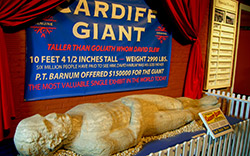
The centerpiece of the episode is Feder’s detailed account of the Cardiff Giant — a hoax he describes as his all-time favorite archaeological fraud, not least because it unraveled so quickly and so completely.
In October 1869, a farmer named Stub Newell hired workers to dig a well on his property in Cardiff, New York. Three feet down, they struck what turned out to be a ten-to-eleven-foot carved gypsum statue of a naked man — which Newell immediately monetized, erecting a tent and charging fifty cents admission. Within days, church sermons were citing it as proof of biblical giants, and visitors were streaming in from as far as Washington, D.C.
The mastermind was Newell’s cousin George Hull, an atheist cigar manufacturer whose inspiration came from an argument with an Iowa minister about the literal truth of the Bible’s giant passages. Hull commissioned two Chicago stonecutters to carve the figure from a block of gypsum he had shipped from Iowa, then aged the surface with acid and a board studded with knitting needles to simulate pores. After burying it on Newell’s farm for a full year to let it “season,” Hull gave the signal, and the scheme began.
Key developments in the hoax’s short life:
– P.T. Barnum offered $30,000 to buy the giant; when refused, he simply had a copy made and exhibited it as the authentic article — which, perversely, outdrew the original fake.
– A consortium of Syracuse businessmen bought a three-quarter interest for $30,000 (roughly three-quarters of a million dollars in today’s terms, per a Yale economist’s estimate Feder cites).
– Paleontologist O.C. Marsh examined the giant in New York and declared it “a transparent and ignorant hoax” immediately — to no effect until Hull himself confessed.
– A geologist examining the deterioration of the gypsum correctly estimated it had been in the ground for no more than about a year — precisely accurate.
– Mark Twain was so amused by the situation — in which Barnum’s fake of the fake outdrew the original — that he wrote a short story, A Ghost Story, in which the Cardiff Giant’s ghost realizes it has been haunting the wrong exhibit.
The actual Cardiff Giant today resides at the Farmers’ Museum in Cooperstown, New York — where, on Feder’s last visit, a departing couple looked at all the signage explaining the fraud and walked out asking each other whether giants were, in fact, real.
🧱 What Archaeology Actually Proves (And How It Does It)
Feder closes with a broader argument about the nature of the archaeological record: every civilization that has ever existed has left physical evidence behind, because nobody is tidy enough to erase all traces of their presence. He applies this principle equally to claims of Atlantis, ancient astronauts, the Roswell crash, and alleged pre-Columbian European settlements in New England. The colonial-era stone structures sometimes attributed to Neolithic Britons consistently yield 17th–18th century artifacts when professionally excavated — not because sacred sites leave no refuse, but because people always leave refuse.
He also discusses the Japanese archaeological fraud perpetrated by Shinichi Fujimura — a case notably absent from the Japanese edition of Frauds, Myths, and Mysteries, which Feder received just weeks before recording.
📚 Further Reading
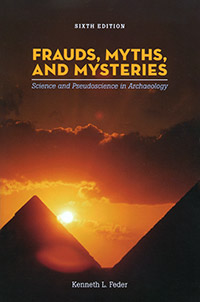
– 📚 Frauds, Myths, and Mysteries: Science and Pseudoscience in Archaeology 💵 by Kenneth L. Feder (McGraw-Hill)
🔗 Related Links
– Cardiff Giant — Wikipedia
– The Farmers’ Museum, Cooperstown, NY (current home of the Cardiff Giant)
– Robert Wadlow — Wikipedia
– Gigantopithecus — Wikipedia
– O.C. Marsh — Wikipedia
– Shinichi Fujimura (Japanese archaeological fraud) — Wikipedia
– Mark Twain, A Ghost Story — Wikipedia
– Mound Builders — Wikipedia
Note: ads inserted into the distributed audio alter the timestamps in unpredictable ways, so timing references in these notes are approximate.
There were Giants in the earth
in those days… —Genesis 6:1
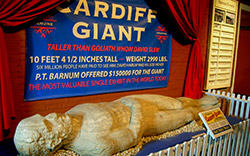
(Photo by John and Keturah. Used under a Creative Commons license.)
Giants appear in cultures around the world: Biblical tales of giants more than ten feet tall; Roman and Greek stories of titans and heroes; European stories of giants of mountain and hill. They all have one thing in common: enormous monsters.
On this episode of MonsterTalk we chat with archeologist Dr. Ken Feder about giants, biblical archeology — and one of the biggest hoaxes in American history.
In this episode
- The bible has stories of races of giants (but also people who lived to be several hundred years old!); Is there any reason to think that people who lived in ancient times were any larger than modern man?
- Are humans generally growing shorter or taller over milliennia?
- Why do ancient cultures postulate giants?
- What evidence would we expect to see if such creatures existed?
- From a physiological point of view, what are the advantages and detriments to gigantism?
- Gigantism often is implicit in the term “monster,” — almost all monsters are large (Bigfoot, Nessie, etc.) — you don’t really hear about many “monsters” that are only a few feet tall; what do you see as the link between gigantism and monsters?
- One of the most famous hoaxes in American history is The Cardiff Giant. Can you give us an overview of that?
- Were most scientists fooled by the giant?
- Why were so many people treating the Biblical giant-tales as literal truth?
- Are there other examples where people have misinterpreted archeological data to infer that it implied Giants?
- Does giant architecture imply giant builders?
Interesting links
A site that seems to promote credulous acceptance of retouched photographic evidence.
Music
- Opening Music: Battle of the Stone Giants by Dragon Ritual Drummers
- Monstertalk Theme: Monster by Peach Stealing Monkeys
Episode Transcript
Read a complete transcript of this episode.
Blake Smith
0