#196 – What Makes US Tick
Rather than fabricate show notes for a Peter Laws conversation that isn’t in the transcript, or produce notes about tick biology under the title “The Frighteners,” the honest output is the one below — written from what the transcript actually contains. If the Peter Laws interview belongs to a different episode or a segment was omitted from the transcript provided, please supply the correct transcript and I’ll regenerate.
🕷️ Clone Army: The Self-Reproducing Tick Invading America
Blake Smith and Karen Stollznow sit down with Dr. Danielle Tufts, a tick ecologist based in New York, to talk about one of the stranger recent arrivals to the American landscape: the Asian longhorn tick (Haemaphysalis longicornis). Native to East Asia and already established as a livestock pest in Australia and New Zealand, this species turned up in New Jersey in 2017 and was quickly confirmed on Staten Island as well. What makes it unusual — beyond the unsettling headlines about “clone armies” — is that the U.S. population reproduces entirely without males, through a process called parthenogenesis. Dr. Tufts was on the ground floor of confirming its presence in New York, and she brings both field experience and a welcome dose of scientific nuance to a topic that has attracted more than its share of conspiratorial heat.
🦠 What Is Lyme Disease, Actually?
Before getting to the new tick, the conversation covers the basics of Lyme disease — a bacterial infection caused by the spirochete Borrelia burgdorferi, vectored primarily by hard-bodied Ixodes ticks (Ixodes scapularis in the East, Ixodes pacificus in the West). The disease is named for Old Lyme, Connecticut, where it was first formally diagnosed in 1975 — a toponymous name in the tradition of Ebola and West Nile.
Key points from the discussion:
– There are over 20 genotypes of the outer surface protein C (OspC) gene in Borrelia burgdorferi, but only four or five are associated with severe, disseminated infection in humans.
– The nymph stage of the tick is the most dangerous to humans: small enough to go unnoticed, yet capable of transmitting pathogens after feeding on an infected reservoir host (typically a white-footed mouse).
– Deer do not transmit Lyme disease; they serve as mating and feeding hosts for adult ticks, making deer population management relevant to tick control.
– Transmission of Borrelia from tick to host takes roughly 24–48 hours, because the spirochetes must migrate from the tick’s midgut to its salivary glands before entering the host — a process triggered by the act of feeding.
– Lyme is estimated to cause over 300,000 human cases per year in the U.S., with true incidence likely ten times higher due to underreporting and diagnostic gaps.
Dr. Tufts notes that serology tests (which detect antibodies, not the bacterium directly) can produce false negatives early in infection, before the immune response has ramped up. Her practical tip: if you find a tick on yourself, save it in alcohol and have it tested — if the tick doesn’t carry the pathogen, you don’t need to worry.
🔬 Tick Removal, Folk Remedies, and What Actually Works
Blake and Dr. Tufts run through the most common (and most misguided) folk approaches to tick removal before landing on the correct method:
– Do not burn the tick, smother it with petroleum jelly, or squeeze it from above. All of these can cause the tick to regurgitate into the wound, potentially speeding up pathogen transmission.
– The correct technique: use fine-tipped forceps held parallel to the skin, get as close to the attachment point as possible, and pull steadily upward. This minimizes the chance of leaving mouthparts embedded and avoids compressing the tick’s body.
– After removal, preserve the tick in ethanol (hand sanitizer works in a pinch) for potential testing.
🧬 Parthenogenesis and the Clone Tick Problem
The episode’s headline topic: the U.S. population of Haemaphysalis longicornis is triploid and reproduces by obligatory parthenogenesis, meaning females produce genetically identical offspring without any male involvement. (No males have yet been detected in the U.S. population; in some Asian populations the ratio is roughly one male per 1,500 individuals.)
Dr. Tufts explains the three reproductive forms of the species — diploid sexual, triploid obligatory parthenogenic, and aneuploid facultative — and notes that the clonal strategy has real biological costs:
– Low genetic diversity means a harmful mutation spreads instantly through the entire population.
– Egg hatchability and developmental rates are lower in parthenogenic populations than in sexually reproducing ones.
– This vulnerability is one avenue researchers are exploring for eventual population control.
The “armies of cloned ticks” framing in the press, while technically accurate, overstates the immediate threat. Dr. Tufts’ field work on Staten Island — including collecting ticks from deer being vasectomized (not castrated — an important distinction for deer behavior) by the White Buffalo wildlife management company — found high tick abundances but nothing approaching the catastrophic numbers in some news reports.
🐄 Exsanguination Reports: Separating Fact from Fear
One North Carolina news report described five cattle dying of acute anemia after being infested with over a thousand longhorn ticks each — a story with obvious cryptid-adjacent resonance for MonsterTalk listeners accustomed to “bloodless cattle” reports. Dr. Tufts is skeptical: her own field collections haven’t produced tick densities remotely close to those figures on deer or wildlife, and the report lacks the kind of primary documentation she’d want before accepting the numbers. An older published paper (from approximately the 1950s) is frequently cited for exsanguination claims; very little recent primary literature addresses it directly.
The broader point: sensational tick-load stories travel fast and are hard to falsify, especially when photographs and formal veterinary documentation are absent.
🦠 Disease Risk from the Longhorn Tick: Current Status
In its native East Asia, H. longicornis is a vector for several serious pathogens including theileriosis in cattle, various rickettsial diseases, and severe fever with thrombocytopenia syndrome (SFTS) virus — the last of which carries a high mortality rate in China and South Korea. However, comprehensive metagenomic screening of U.S. specimens has so far found no pathogens. Dr. Tufts suggests the most likely explanation is that the founding female (or females) were pathogen-free, and because all U.S. ticks are clones of that founder, the population inherited a clean slate.
The more pressing open question is whether these ticks can acquire local pathogens — such as Borrelia burgdorferi — by feeding on infected reservoir hosts already present in the U.S. Lab experiments show that longhorn ticks strongly avoid mice (the primary Lyme reservoir) and also appear to avoid humans; they strongly prefer dogs, cats, and livestock. Only two or three confirmed human bites have been recorded in the U.S. to date.
🧫 How Scientists See Inside a Tick
Blake asks how researchers actually determine what pathogens a tick is carrying — a question partly prompted by his pre-show reading of 📚 Bitten 💵 by Kris Newby. Dr. Tufts walks through the process:
– Ticks are immersed in liquid nitrogen to make their hard exoskeleton brittle enough to crush.
– DNA is extracted from the crushed material using standard detergent-based lysis.
– Quantitative PCR (polymerase chain reaction) is then used to detect and quantify specific pathogen DNA sequences — producing a fluorescent signal if the target organism is present, silence if it isn’t.
– Large-scale metagenomic studies take this further, screening the entire bacterial, viral, and fungal content of a tick sample simultaneously.
On the conspiracy side: researcher Sam Telford of Tufts University (yes, a coincidental namesake institution for Dr. Tufts, whose ancestor Charles Tufts donated the land) has helped counter the “government bioweapon tick” narrative by locating preserved tick and mouse specimens from the 1880s and 1940s that test positive for Borrelia — predating any government program by decades. Dr. Tufts also notes that ticks make poor bioweapons by design: they require days of attachment to transmit most pathogens, are large enough to notice when engorged, and have very low host-specificity for humans in the case of the longhorn.
Blake mentions reading 📚 Bitten 💵 as preparation and flags it as a readable but flag-raising book — methodologically mixing solid science with speculative leaps, and conflating a scientist’s acknowledgment of a new research direction with endorsement of the author’s specific hypotheses.
📚 Further Reading
– 📚 Bitten: The Secret History of Lyme Disease and Biological Weapons 💵 by Kris Newby (discussed with skeptical caveats)
🔗 Related Links
– Asian Longhorn Tick (Haemaphysalis longicornis) — Wikipedia
– Lyme Disease — Wikipedia
– Borrelia burgdorferi — Wikipedia
– Parthenogenesis — Wikipedia
– Severe Fever with Thrombocytopenia Syndrome (SFTS) — Wikipedia
– CDC: Longhorned Tick Information
– CDC: Lyme Disease
Note: ads inserted into the distributed audio alter the timestamps in unpredictable ways, so timing references in these notes are approximate.
There are a lot of weird Tick stories in the news lately. From stories of exsanguinated cows in North Carolina to books about government conspiracy and bioweapons testing of ticks as delivery vehicles for disease, it seems everybody’s trying to latch onto tick and tick-borne disease stories. Acarologist Dr. Danielle Tufts, visits with us to help debunk some of the outright myths about ticks, to tell us more about how these diseases are transferred, and to get a better grip on how frightened we should be, and what we can do to protect ourselves from the millions of tiny vampires waiting out there.
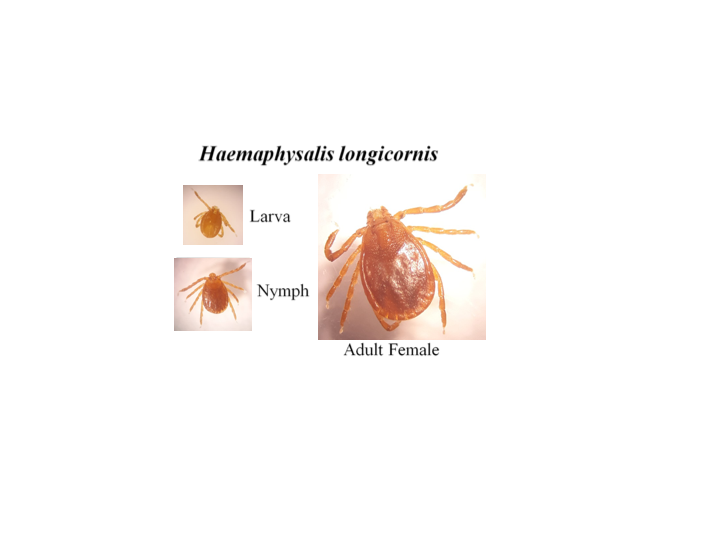
Photos of tick lifecycle and academic articles on relevant tick species are attached to the show notes.
Some terms from the show you might not be familiar with:
Serology – the scientific study or diagnostic examination of blood serum, especially with regard to the response of the immune system to pathogens or introduced substances.
We discuss three types of chromosomal polyploidy:
Diploid – containing two complete sets of chromosomes
Triploid – containing three complete sets of chromosomes
Aneuploid – contains an abnormal number of chromosomes
I’m skeptical of the content of these two books, but they are the source of a lot of the current concern about tick conspiracy: