S05E31 – From Loup Garou to Rougarou (pt 2) with Louisiana Dread’s Kyle Crosby
S05E31 – From Loup Garou to Rougarou with Louisiana Dread’s Kyle Crosby (Part 2 of 2)
🎙️ Episode Summary
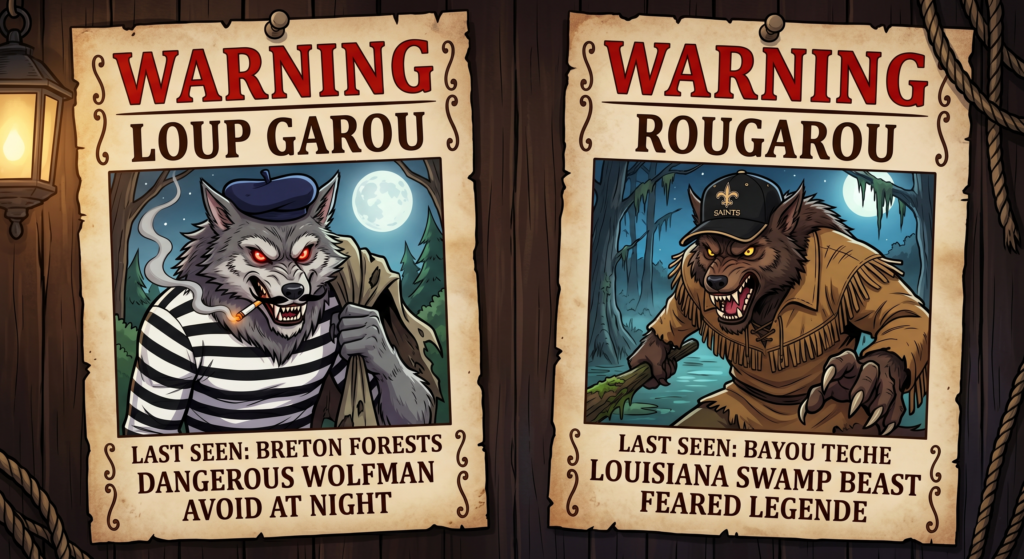
This is part two of our conversation with Kyle Crosby, creator and host of Louisiana Dread. In Part 1, we covered the history of the Acadians and how they carried the loup-garou legend from France to the bayous of Louisiana. Now, in Part 2, Kyle walks us through the transformation of the loup-garou into the Rougarou – from strict werewolf to all-purpose shapeshifting boogeyman – and takes us on a tour of Louisiana’s other legendary creatures, from the Axeman of New Orleans to the feu follet to the Grunch.
🐺 The Rougarou – Curse, Boogeyman, or Both?
Kyle describes growing up terrified of the Rougarou in Lafourche Parish – it kept him indoors after dark and faithful to his Lenten penance, because breaking that penance seven years in a row meant you’d turn into one. The Rougarou’s lore varies by region, but some common threads emerge: if bitten or scratched, you can’t tell anyone for a year and a day or you’ll become one yourself. You’re a Rougarou for 101 days, and once the curse lifts, you can never speak of it. A voodoo priestess, a traiteur, or a witch can inflict or relieve the curse. During the day, the cursed person is weak and feeble; at night, they become a shapeshifting beast. Unlike the French loup-garou – always a wolf – the Louisiana Rougarou can take nearly any form, giving the swamp at night an uncanny quality where any sound or shadow might be something else entirely.
Kyle notes the Rougarou is less malevolent in some tellings than its French ancestor – the cursed person’s main goal is to transfer the curse by biting or scratching someone else. But in his family’s version, courtesy of a horror-movie-loving grandmother, the Rougarou was going to rip you to shreds.
🔢 Can’t Count Past 12
Blake brings up a classic piece of Rougarou defense: leaving 13 objects by your door. The Rougarou can only count to 12, so it sits there counting and recounting until sunrise forces it back into human form. Kyle confirms this was traditionally done with chicken bones – because the Cajuns spreading these tales orally were poor – while wealthier folks used coins. (Kyle suspects those coins may have attracted a different kind of visitor.) Blake connects this to the broader folklore motif of supernatural creatures with compulsive counting behavior – vampires who must stop to count scattered rice or salt – a kind of folkloric OCD.
👻 A Cautionary Tale – and a Way to Cope
The conversation turns to the Rougarou’s deeper cultural function. Kyle explains that the legend served dual purposes: as a cautionary tale to enforce obedience (especially in children), but also as a coping mechanism for loss. Missing children were sometimes attributed to the Rougarou because the alternative – that a human neighbor could commit such an act – was too horrifying to accept. Within a deeply Catholic community, the idea that a human would risk eternal damnation by kidnapping a child seemed impossible; a mythological beast was a more bearable explanation.
🎉 Rougarou Fest
Kyle and Blake discuss the annual Rougarou Fest in Houma, Louisiana – a free, family-friendly festival every October featuring a parade, live music, amazing food, and a big Rougarou appearance. All proceeds benefit the South Louisiana Wetlands Discovery Center. The 2026 festival is scheduled for October 23-25.
⛪ Why the Rougarou Persists
Karen asks why the Rougarou endures as a cultural force, and Kyle connects it to the persistence of Catholicism and the Cajun community’s fierce attachment to their heritage. He notes that the 1921 Louisiana Constitution effectively banned French from public schools – at a time when 85% of the state spoke French. Today, fewer than 4% do, but there’s a growing movement to preserve the language and the folklore that comes with it.
🪓 The Axeman of New Orleans
Kyle tells the story of the Axeman of New Orleans, an unsolved serial killer case from 1918-1919 that straddles true crime and the supernatural. The victims were primarily Italian grocers on the West Bank – part of a large Sicilian immigrant community that Kyle notes arrived in Louisiana in greater numbers than even New York or New Jersey, with three boats per month from Palermo. He traces the community’s history to the Sicilian “lemon wars” and the early formation of La Cosa Nostra, which he says had roots in New Orleans before spreading to New York, New Jersey, and Chicago.
The Axeman always used the victim’s own axe – common household tools kept for chopping firewood and, critically, for breaking through the roof during hurricane flooding. Kyle recounts the story of the Cortimiglia case, where a political figure named Louis Marrero – described by Kyle as virulently anti-Italian – blackmailed a surviving victim into falsely accusing two Italian men with alleged Mafia ties. When her husband woke from his coma and contradicted her testimony, she eventually recanted, and Marrero’s political career was destroyed. (The town of Marrero in Jefferson Parish still bears his name.)
The story takes a supernatural turn when a letter arrived at the Times-Picayune from someone claiming to be a spirit from Tartarus, promising a “Passover” – but sparing anyone playing jazz. That night, every jazz band in the city was booked, the wealthy hired them for private parties, and the poor packed the dance halls. No one died. The Axeman was never caught.
📝 Correction: In the interview, Kyle places the Axeman’s jazz letter in October 1919. The letter was actually published on March 13, 1919, with the threatened “Passover” night falling on March 19, 1919.
🔥 The Feu Follet (Cajun Will-o’-the-Wisp)
Karen asks about the will-o’-the-wisp, and Kyle introduces the Louisiana version: the feu follet (or fouffoyer, as he pronounces it). He tells the Cajun origin story of a wicked blacksmith named Will Smith (no relation) from Acadiana who dies, gets a second chance from St. Peter, lives even more wickedly, and is then rejected by both heaven and hell. The devil condemns him to walk the earth with only a burning coal to light his way – and that coal is the mysterious bioluminescent light seen glowing over the swamps at night, luring the unwary to their deaths. Blake shares his own childhood memories of wanting desperately to see a will-o’-the-wisp on his grandfather’s swampland, and never quite managing it.
🦎 Louisiana’s Monster Menagerie
Kyle rattles off a few more creatures from Louisiana’s deep bench of folklore: La Tataille (or Le Bêtail) – a beast of the swamp around Lafayette and the Atchafalaya; Madame Grand Doigt (Madam Longfingers); and Le Litiche – a half-alligator, half-human creature. Kyle notes that different regions have their own dominant monsters, with the Rougarou and feu follet claiming his home turf.
🐐 The Grunch
Kyle saves his personal favorite Louisiana monster for last. The Grunch originates from a story about traveling circus sideshow performers in the 1920s who were ostracized and abused by the public and retreated from New Orleans to a road in New Orleans East (or, in some versions, west along the Mississippi to Muntz). After being continually harassed – even by kids throwing rocks – they stopped praying to God and started praying to the devil, who gave them a creature to defend them as long as they lived. The Grunch is described as half man, half goat, half reptilian – a math problem Blake is quick to flag – that drains blood like a chupacabra but also eats people. A photo allegedly taken in New Orleans East after Hurricane Katrina is sometimes claimed to show the creature. An alternate origin story drops the deal with the devil and goes with generations of inbreeding among the isolated performers producing the monster – a pattern Blake notes shows up in dozens of cryptid origin stories involving wrecked carnival trains.
🎬 Find Kyle
Louisiana Dread
🌐 Website: louisianadread.com
📺 YouTube: @LouisianaDread
Check out Kyle’s gumbo reviews on YouTube – if you can’t make it to Louisiana, at least you can live vicariously.
📚 Further Reading & References
- Rougarou – Wikipedia
- Axeman of New Orleans – Wikipedia
- Will-o’-the-wisp – Wikipedia
- Louisiana French – Wikipedia (includes history of the 1921 language suppression)
- Cajun Folktales – 64 Parishes (overview of the feu follet, rougarou, and other folklore figures)
- Rougarou Fest – Official Site (October 23-25, 2026 in Houma, LA)
SEO Transcript
This is not a fully accurate transcript, and was machine generated. It’s here for helping search engines find the episode but not intended to be a faithful transcript of the episode. (But it’s not AWFUL.) Some of the material in this transcript only exists in the Patreon/Premium edition of the show and was excised for the commercial version.
———————
Monster House presents…
This is the ad-supported version of Monster Talk.
We’re dependent upon the revenue from these ads and from the support of our patrons at patreon.com forward slash monster talk to continue making this show.
As a disclaimer, your hosts are unable to control what ads you will hear, and while we have done what we can to avoid ads that are divisive, the system that injects them sometimes ignores our preferences and always seems to ignore our efforts to not interrupt the conversational flow.
While we understand this can be disruptive, we’re trying our best.
Patreon remains the best way to enjoy commercial-free listening to our content.
Plus, you generally get extended coverage of the subject.
We’re working on other ways to consume our content as well, so please stay tuned.
It’s actually quite unlike anything we’ve ever seen before.
A giant hairy creature, part ape, part man.
In Loch Ness, a 24 mile long bottomless lake in the highlands of Scotland.
It’s a creature known as the Loch Ness Monster.
Monster Talk.
Welcome to Monster Talk, the science show about monsters.
I’m Blake Smith.
And I’m Karen Stollznow.
And this is part two of our conversation with Kyle Crosby of Louisiana Dread.
In part one, we dug into the history, the Acadian expulsion, the layers of trauma and culture that built Cajun and Creole Louisiana, and the old world roots of the Lugaroo.
If you haven’t listened to that yet, I’d recommend going back.
It sets the stage for everything we’re about to talk about.
What you need to remember, though, is that the Lougarou that came over from France was a werewolf.
Wolf is right there in the name.
Loup means wolf.
But Louisiana doesn’t have wolves.
What it does have is swamps and darkness and owls and mangy dogs and alligators and about a thousand sounds at night that you can’t quite identify.
And somewhere along the way, the Lugaroos stopped being a wolf and started being, well, anything.
It’s a shapeshifter, a curse you carry for 101 days, a creature that pulls your toes if you leave your feet out from under the covers at night, which honestly, y’all should know better than to do that, right?
Today, Kyle’s going to walk us through the Rougarou as he grew up with it, a creature that scared him into keeping his Lenten penance and staying indoors after dark.
And we’ll talk about why it persists, what it meant to communities dealing with real-world horrors, and how it sits alongside the whole ecosystem of Louisiana monsters, including one born from a traveling circus and the devil himself.
It’s time for Kyle to hit us with some mysteries, murders, the mafia, music, and, of course, Monster Talk.
Okay.
And we’re back.
All right.
So first of all, thank you again, Kyle, for spending so much time with us.
This is such a beautiful part of the world.
Such a beautiful part of this country.
Oh my God.
The food is so good.
I can’t think about Louisiana without thinking about it as haunted because much like Savannah, you know, the most haunted city in America, New Orleans is also the most haunted city in America.
So.
They look a lot alike, too.
They do.
I went to, you know, at Gods and Monsters, I think I actually took the time to point this out, that we didn’t have Spanish moss there in Texas, but they did have, what was it called?
Ball moss or something.
I looked it up, but yeah, that was really interesting.
I once heard that Savannah was described as New Orleans with a penicillin shot.
that’s pretty funny i mean it’s one of the few places in georgia where you can walk on the street with a drink without getting in trouble so yeah maybe amen amen place to go so i guess we should i again i don’t want you to be constrained to the rougarou because there’s more than there’s probably more than a dozen scary stories coming out of louisiana and yeah
But we are fascinated by the Rougarou.
And as you already mentioned in part one, it turned from being strictly a werewolf into something more of a boogeyman.
Can you talk a little bit about how you first heard about it?
Or what do you hear in Rougarou stories contemporary?
What is a Rougarou?
Yeah, definitely.
And first, I am so grateful to be on this show because, again, you and I, we hit it off immediately whenever we started talking and you brought up, you know, how much you’ve been to Louisiana and you liked it at the conference.
I had a great time.
So I really appreciate y’all having me on.
So when it comes to the Rougarou and my upbringing, it was always, always used to strike fear in me.
And it freaking worked.
Um, I did not go outside after the lights went on, uh, on the street lights came on and the sun went down.
The Rougarou was going to eat me.
If you, um, you give up something for everybody who’s not Catholic, you know, Lent, you do that every year, you give up something.
Um, if you break that penance seven years in a row, you turn into a Rougarou.
So I was not breaking my penance.
You know, I was not doing anything because one year it’s like, well, I did have a, I gave up macaroni and cheese, but I had one noodle with cheese.
I don’t know if that counts towards the Rougarou thing, you know, so you never could be too sure.
It was always in the back of our heads too, as we grew up and we started to realize, you know,
Maybe we outgrew the Rougarou coming after me.
But at night, if you’re in the swamp or you’re in the marsh and it’s dark, you can’t really see much.
You hear the noise of the swamp.
You can never really be too sure that you are alone.
And nine out of 10 times, you’re not alone.
Whether that be a raccoon, an alligator, whatever.
Best case scenario, right?
It’s eerie.
And it’s not just the Rougarou that can strike fear.
Because we have over 15 different cryptids that are in Louisiana alone.
And doing the research and getting to learn all this stuff is absolutely phenomenal.
Best perk of the job.
And they all derive from different areas.
Do you have one in particular that you’d like to hear about first?
Well, so are you thinking like Honey Island or what are you thinking?
Honey Island is one of them.
Yeah.
Honey Island Swamp Monster is really good.
But again, the Rugaru is king.
It’s always going to be the best one.
That’s what people paid for.
They’re here for the Rugaru.
So we should probably cover that one first.
Yeah, definitely.
So, I mean, the Rugaru.
it’s all religious, right?
It’s 101 days.
If you are bitten or scratched by a rougarou, and it’s difficult to really talk about in a generalized sense because there’s so many different tweaks here and there in different regions.
For instance, like if you are bitten or scratched by a rougarou, you can’t tell anyone for a year and a day or else you’ll turn into one.
There’s another piece of the lore from where I’m from that I was always taught that you are a Rugaru for 101 days.
And after that, you can’t tell anyone you were ever a Rugaru or you will turn into one.
Also, if you see a Rugaru and you find out someone is a Rugaru, you can’t tell anyone or you’ll turn into one.
A voodoo priestess or a traitor or a witch can turn you into one.
They can also relieve you of the curse because at the end of the day, it is a curse.
It’s not, you know, this romantic thing.
You are very feeble, weak, your most vulnerable self during the day.
because at night you turn into this shape-shifting beast.
Now, for the most part in literature, you’re going to find a way scarier lycanthrope, werewolf-like creature in France, as opposed to what we have down here, which is more, it’s less malevolent.
It’s a curse and they’re just trying to rid themselves.
Their main goal is to get rid of the curse and the way you can do that is to bite or scratch someone and the curse transfers to the other.
Ah, yeah.
So when and why does the Rougarou shift from a curse that you earn to a boogeyman that comes for you?
It was always a boogeyman to me.
I learned recently that in some areas of Louisiana, it wasn’t a malevolent creature.
I was always told, maybe because my grandma was a freak that loved horror movies, that it was going to literally rip me to shreds.
So it was always a violent, evil, scary creature to me.
But in literature, because I guess it’s mostly an attempt to get to children,
And they’re all written by adults.
There’s never a child that writes about a Rougarou.
So it’s always, you know, oh, you better do this or the Rougarou is going to get you.
Not, hey, the Rougarou can get you at any time.
Some instances, there’s the Rougarou can pull your toes at night if you sleep with your feet out, you know, that kind of stuff.
That’s just good sense.
I mean, even a skeptic knows you got to keep your feet covered.
Right.
That could be anything to get you.
That’s science is what that is.
That’s science.
Right.
And so, I mean, I feel like it’s always been a…
a curse and it’s always been a boogeyman like creature because they’re not mutually exclusive you can some things can be true but shapeshifters are such an interesting concept anyway like you say the the lugeroo is a wolf it’s always a wolf but the rugeroo could be just about anything which means you know when you’re walking out at night and you hear you know an owl is it an owl maybe it’s not an owl maybe something else you know so
Or you run into a friend and they’re acting a little weird.
Is it your friend?
Or is it something else?
It has… Uncanny valley.
Yeah, there you go.
This uncanny quality.
Exactly.
Yeah.
So one of the things I read about was the idea that if you leave 13 objects by the door, that a Rougarou can’t count past 12.
Have you heard that before?
Oh, yeah.
Can’t count past.
That’s how you defend yourself against one.
If you hear that owl outside, you put 13 something.
Usually it was chicken bones because the people spreading the tales orally were very poor.
So it would just be chicken bones, but you could mostly, the wealthy would put coins, 13 coins, and they would wake up the next morning, come out, and then the 13 coins would be gone or 12 coins would be gone.
I think somebody robbed them, but it was more chicken bones for the Cajuns because, again, they didn’t have much.
Yeah, that’s fascinated me for a long time.
I think when you get past just watching monster movies and you start reading the literature and reading the old stories that are rarely put on film, this idea about the undead, and specifically vampires usually, having this almost what sounds like OCD.
You could throw rice, you could throw salt, and they have to stop and count every bit of it.
I’ve always found that fascinating.
fascinating like and that that is um he just he’ll keep counting because he’s frustrated because he doesn’t know what the next number is so he’ll keep counting to 12 until the sun comes up and then he gotta he gotta run back because he’s turning back to human you you mentioned hearing about the rougarou uh and being warned against it so it does have that um i don’t know
I don’t know what the exact word is that.
A cautionary tale.
A cautionary tale, yeah.
I think there’s a lot of stories about water monsters that are sort of similar, where clearly there’s an element of keep the kids away from the water so they don’t drown, right?
But did you hear any specific Rougarou stories where it was like, this didn’t happen to me with my cousin Jimmy.
This absolutely happened to him.
You know, that kind of thing.
Oh, yeah, my physics teacher in high school.
Whoa.
Okay.
They were playing golf in the back by a golf club in the back by the marsh and by the levee and all.
And…
He hit the ball a bit too far towards the woods and it was getting dark.
The sun was about to go down.
And by the time he went to get the ball, the sun was down and it was very, very dark in the woods.
And he saw two red eyes glaring at him and kind of it seeped back into the woods itself.
So you couldn’t see him anymore.
And he said, that’s when I saw the Rougarou.
Wow.
Oh, yeah.
Two red eyes.
I’d never heard him or anything.
But he said him and his friends hauled ass after that.
So would you say that today there’s still people who.
believe in the Rookaroo or is it more one of those things like in Australia where people go there and they talk about, but where the drop bears or here in the US talking about tree alligators, is there a section of society that still think that there is something or might be something?
100%.
There are many people in Louisiana that have reached out to me, much less that I haven’t even talked to yet, that believe that they have seen one, that believe that it is real.
that it lives amongst us.
But also, you know, and not to get very sad, but the Rougarou in itself is a story for obedience, right?
It’s a story, a cautionary tale to warn people.
But it also was a way to cope with loss.
as opposed to like missing children.
The Rougarou was blamed a lot for children who just went missing because why did my child get taken from me?
There’s no way a human could do something so heinous as stealing my daughter from me at such a young age.
It had to be this mythological creature that has taken my daughter from me.
Because again-
No human would do that knowing the consequences when they die, that they will go to hell.
But as we know today, humans are very capable of doing much worse.
So it’s not, it was more of a coping mechanism as well as a level of obedience.
Right, yeah, a way to explain the world.
Yeah, because you don’t want to admit that, yeah, my neighbor kidnapped these kids and all that kind of stuff.
There’s no way.
So it had to be this beast.
Karen’s a linguist, so we…
And I just am just a word nerd.
I don’t think I have any speciality except for puns.
But I’ve heard that the roo-ga-rooing has become a verb.
Have you heard that in the wild?
Oh, God, no, I have not.
Wild, that’s interesting.
I heard it.
I saw it on some webpages as, you know, something like make it a ruckus or, you know, getting up to no good.
But so if it’s not widely known, I guess it is now.
That’s interesting.
I’ve never heard of Rugaruin.
Rugaruin.
I don’t want to waste a question.
So how about this?
Are you familiar with Rugaru Fest?
Because we’ve been really covering a lot of monster festivals, and apparently there is a Rugaru Fest in October.
Oh, yeah.
It’s one of the most fun festivals I’ve ever been to.
Oh, really?
Oh, yeah.
It’s awesome.
There’s a parade.
Then there’s a big Rougarou that comes out.
There’s lots of vendors, amazing music, amazing food, awesome drinks.
The community shows up.
And, you know, the people of Louisiana are very special.
We love to show our hospitality.
We love to talk to people.
We love to have a good time.
Is that Huma or Houma, Louisiana?
Houma.
I would have got there eventually.
There’s only so many ways you could pronounce it.
I’ll put a link to that in the show notes.
That’s in October.
Oh, it starts on my wife’s birthday, October 23rd.
Nice.
All right.
Oh, I have to add that to our bucket lists.
Yeah, that would be cool.
A birthday present.
Yeah.
So you got it.
So, Kyle, why does the Rougarou persist as this cultural force today, do you think?
I think because religion, the Catholic faith has persisted so much.
I think it has a lot to do with Catholicism and the belief and holding on to what we hold dear.
There’s a reason why it’s over 100 years removed from our…
language being removed, but yet lots of us still hold on to the last vestiges of it.
85% of the state spoke French in 1921.
Today, less than 4% of people speak it, but now there’s more of a surge of preservation than there has ever been.
And I think that that comes with folklore too.
Our folklore has been passed down for several generations.
And that story has been kept alive.
It’s just such a beautiful place and a beautiful culture and beautiful people.
So unique.
It is.
And I don’t know what I would do if…
I mean, I realize obviously I’m just some guy up in Georgia, but, you know, I use a lot of blackened seasoning.
I wouldn’t see that gone.
But, you know, when I think about monsters of that area, and you’ll recall I asked you about this at the Texas conference, but besides the Rougarou, I know there’s a few other monsters people probably want to hear about.
But this one’s a weird one because it straddles that world of true crime and the supernatural.
Can you tell our listeners a little bit about the Axeman?
Oh, I knew that was coming.
Absolutely.
I love the Axeman.
Because the Axeman, that also kind of transcends time.
Not as popular as the Rougarou, and it’s younger than the Rougarou.
Because this happened in 1919.
1918, 1919, a slew of axe murders started happening on the West Bank.
Now, to preface this, in the late 1800s, we had more Sicilians and Italians come through Louisiana than New York and New Jersey.
Wow.
So you have a large influx of Italians here.
And they faced racism and prejudice.
And they moved to the West Bank of New Orleans, which is today Jefferson Parish.
And they would be grocers.
They would do that kind of stuff, right?
But you’d have three boats per month from Palermo, Sicily to New Orleans.
So you had so many people coming through.
And a lot of people escaping this…
lemon craze that was going on in Sicily at the time, enough that, you know, people would hire armed associates to protect their lemon interests.
And it was called La Costa Nostra.
Well, where do you think those people came?
To Louisiana, to the West Bank.
They would go and escape that, but they also started their own.
They would also start their own businesses and they would form with the early formings of the mafia.
I just kind of quickly insert here that I never expected the mafia to be turned into a liminal experience.
Absolutely, my friend.
It came before the organized crime in New York and New Jersey and Chicago.
It started in New Orleans.
Wow.
So you have these Italians, these Italian grocers showing up dead in their house and they’re all killed with an axe.
And one common misconception is that the Axeman killed a lot of people.
I think he only killed about six total, 12 victims.
They didn’t have that many deaths.
Lots of them survived the attack.
But it also faced political pushback from a guy named Louis Marrero.
who the town of Marrero in the West Bank is named after today.
But he was very anti-Italian, and he put the blame on these Italian deaths on the mafia.
So one night, this couple was attacked and they survived, and they said it was a tall man dressed in all black with a top hat, and he had an axe.
Also of note, it was always the people’s axe that got attacked.
He never had his own axe.
He killed you with your own axe.
Because the majority of homes back then had an axe in the backyard to cut firewood, but also for storms.
If a hurricane came, you kept your axe with you in the attic.
And you would stay in the attic as the water rises.
You have that axe to break a hole in your roof.
So everybody would have an axe.
Now, it took one family to get assaulted, and both the man and woman went into a coma at Charity Hospital, and the woman came out of her coma first.
And Louie Marrero and his goons went into the hospital, and…
blackmailed her, threatened her to say that it was these two Italian men that had old mafia ties that assaulted her.
And she said, okay, I’ll do it.
So in court, she testified and she blamed those two that were sentenced to death.
The husband wakes up from a coma.
He’s like, no, this ain’t true.
This was not these guys.
He divorces his wife after she doubles down on, he goes, I don’t, this is terrible.
I don’t, I don’t condone this at all.
They divorce.
Then the wife comes clean saying, no, Louie Marrero blackmailed me and blackballed me essentially.
And the two men was set free.
Louie Marrero’s political career tanked because everybody saw how corrupt he was.
And now a letter arrives at the desk.
of the newspaper, the Times-Picayune, claiming to be this phantom, this mystical creature from, quote, Tartarus, that was sent and is making a Passover tonight in October of 1919, and everybody who’s playing jazz will be spared of my Passover.
Wow.
So that night…
All the jazz bands were bought up by the wealthy and they would go to the wealthy people’s houses and play.
So the poor people would clamor into dance halls and listen and dance to jazz.
And no one died that night.
Right.
It’s pretty nuts.
Yeah.
And super creepy.
I don’t know why.
I mean, he’s got to be quite old now, but he still kind of scares me.
Never been caught.
Never been caught.
According to the note, he’s very nuts.
According to the movie, he was very old.
I wanted to ask about another monster.
So the Will-o’-the-Wisp.
So these are found around the world, one of these universal claims about flickering lights that are seen at night over graveyards and bogs and swamps.
So I guess it makes sense that you would find these in Louisiana.
Absolutely.
Yeah.
So we call it the Fufoyer.
The Foufouillet and the story goes is that there was a blacksmith in Acadiana south of Lafayette near New Iberia and his name was Will Smith.
No relation.
No relation.
We’re going to need to get some genealogists on that.
So Will Smith was a wicked man.
And so wicked is that he dies and he goes to the pearly gates in St. Peter’s like, look, you were bad, but we’re going to give you another chance.
You have another chance at life.
Go live it morally.
So he comes back to earth and he lives it even more wicked than the last time.
So then he bypasses the pearly gates and he goes straight to hell.
And the devil says, I don’t even want you, man.
But you’re going to be damned to walk the earth.
And you’ll only have this burning coal to light the way.
So this light, this bioluminescence that we see in the swamp is the fufuye.
luring you to your death.
Wow.
That’s a cool story.
You know, my family, my grandfather had a…
Probably, it was only maybe…
I’m guessing 20 acres of swampland.
But I used to love to go out there at nighttime.
And, you know, we didn’t have alligators, but we had snapping turtles and catfish and all the other things a good swamp should have.
But I wanted to see a Will of the Wisps so bad.
And I never saw anything like it.
I still have it.
But, man, I would love to.
I’d love to.
That’s one of my favorites.
It’s beautiful.
I’ve seen one.
Yeah.
I’ve seen it.
It’s also with lightning bugs.
It just looks surreal.
It’s beautiful.
Very beautiful.
There’s, like, you know, lightning bugs, bioluminescence, starlight.
There’s so many different explanations.
And I imagine, kind of like with Bigfoot, people are seeing a lot of different things, and you’ve got to follow this.
But still, when you’re out there…
There’s something really special about that marshland, swampland.
It’s so magical.
Yeah, very, very.
And it made me a little bit of fear, a little bit of beauty.
Yeah, it’s quite a mix.
It’s his own kind of gumbo, right?
Visual gumbo.
Do you know, and I’m probably going to butcher this, La Tatia?
La Tatia?
La Tatai.
So the Tatai is…
It’s kind of like a paramount fae, like a father figure, but it’s a beast.
Another folklore beast.
There’s another one called Madame Grontoit.
That’s Madame Longfingers.
So the tatai is a beast.
It’s a creature in the swamp that’ll eat you.
The same thing with the litesh.
Litesh is also a beast that’s half alligator, half human.
I never heard much of the Tatai.
I heard of a Betai, where I was from, which is like a beast.
The Tatai is, that’s like Lafayette, north of Lafayette, and then Jafalaya, around Opelousas and stuff, too.
We had the Rougarou down, and we had the Foufouillet down where I’m from, Rougarou.
We had the Betai, Madame Grontoit,
But again, y’all, there’s so many different creatures, as y’all can see.
Oh, yeah, yeah, yeah.
I mean, again, I kind of joked about it earlier, but I mean, it’s just such a rich ecosystem of monsters and ghosts.
We didn’t even really touch on ghosts at all.
I feel like we ought to bring you back at some point.
So I hope you’d be welcome to that at some point.
Absolutely.
That sounds wonderful.
Kyle, I think we could just keep talking for hours about these monsters.
They’re so interesting.
And with so many unique monsters at your disposal, this is going to be a difficult question.
What’s your favorite monster?
Oh, that is – it’s tough because I grew up with the Rugaru.
I identify as a Rugaru.
Okay.
My obsession with monsters, I will say, started with Godzilla, King of the Monsters.
Addicted to monsters after that.
I wanted to be Godzilla.
In terms of…
Louisiana Monsters.
The Grunch kind of has a soft place in my heart just because of the lore behind it.
Would you mind if I tell you real quick?
No, tell us about The Grunch.
So The Grunch, back in the early 1900s,
the 1920s-ish.
I feel like I’ve been talking about the 1919, 1920s a lot on this podcast.
But during the Great Depression, traveling circus…
took a nosedive.
People used to love the traveling circus before the Great Depression, but it ruined these traveling circus.
But the, like the, what do you call them?
The matador, not the matador, the guy in charge, the master of ceremony, whatever.
The master ceremony.
Ringleader, yes.
So like the ringleader, the trapeze artist, those people can get jobs at bars and restaurants in the city of New Orleans.
But the sideshow performance…
were people with abnormalities, deformities, conjoined twins, the bearded woman, the strong man or the dog-faced man, you know, things like that.
They were ostracized and they were very much so abused by the public.
And they said, hey, we don’t want to live in the city anymore because we keep getting abused.
So they moved outside the city to New Orleans East back when it was just all swamp and woods on a road called the Grunch Road.
Now, there’s another part of the lore that says that they, instead of going east, they went west along the Mississippi River to a town called Muntz.
But regardless, the story remains the same, that they set up a tent.
or a camp, and people would go out of their way to harass these people, leave the city.
Kids would go ride their bikes and throw rocks at them and stuff.
So they started praying to the devil to help them.
They stopped praying to God because God wasn’t answering their prayers.
So they prayed to the devil.
And the devil, in exchange for their souls, obviously, that’s always the deal, right?
He gave them a creature.
that won’t prey on them, but will defend them as long as they live.
And these people live very long lives.
They eventually died of natural causes, but this grunge creature is still around and it’s half man, half goat, half reptilian looking creature.
Half-failed math student.
I don’t know how many halves you can have, right?
Like a man-bear pig, right?
Right, right.
But it’s man, goat, reptile, and it…
It’s like a chupacabra.
It’ll drain blood, but it also eats people.
And there was a photo taken right after Hurricane Katrina in New Orleans East, Little Woods area that claims to be the grunch in itself.
But there’s another story that they never made a deal with the devil, that they just intermarried.
and had um they were all inbred after you know a generation or so and then a generation of inbred sideshow performers created this monster kind of like uh the jersey devil how the woman gives birth to the 13th child and it’s the devil oh yeah i told my wife and my cousin this story and she loved it yeah
So that would probably be, I just love the lore of being, you know, this sideshow performer circus type of thing.
Wow.
Well, Kyle, oh my gosh.
Thank you so much for taking the time to talk with us and our listeners.
Oh, my pleasure.
This was so fun.
So much.
Go ahead, Karen.
Sorry.
I was just going to say, and we’ll have to keep in touch and bring you back to talk about ghosts.
Oh, I’d love that.
I have so many ghosts.
I’m looking at six ghost books in front of me right now that I got to do some research for some more stories coming up.
Well, it’s easy to find Kyle.
But in case you’re having trouble, there’s links in the show notes for both these episodes.
Check him out.
Louisiana Dread.
Check out his gumbo reviews.
We can’t all go have gumbo, but we could at least live vicariously through YouTube.
So, yeah.
And if ever you come to Louisiana.
Louisiana, you know where to get the best gumbo if you watch.
Exactly.
You’re on.
Fantastic.
And good luck with your work on selling the series.
It sounds amazing.
Yeah, yes.
Thank you so much.
I just, I really appreciate it.
You’re just a treat to talk to you.
I appreciate it so much.
Oh man, that means a lot.
I appreciate that.
I’ll come on the show whenever y’all need.
I love talking about this stuff.
I love talking about Louisiana and promoting our culture and sharing our culture with anyone who appreciates it.
You have a good night, Kyle.
Thanks a lot.
All right, my friends.
Good night.
Bye-bye.
Talk soon.
Monster Talk.
You’ve been listening to Monster Talk, the science show about monsters.
I’m Blake Smith.
And I’m Karen Stollznow.
You just heard Kyle Crosby of Louisiana Dread wrapping up our two-part dive into the Rougarou and the rich haunted folklore of South Louisiana.
Kyle is a filmmaker, historian, and cultural advocate, and he’s currently working on adapting Louisiana’s dark history into a scripted horror anthology series, which I can’t wait to see.
Links to all of Kyle’s projects are in our show notes, his YouTube channel, his social media, all of it.
Just go out there and check them out.
And Kyle, if you’re listening, thank you so much.
This was a real treat, and we minute it about having you back to talk ghosts if you can make time for us.
We hope you’ve enjoyed this episode of Monster Talk.
Each episode, we strive to bring you the very best in monster-related content with a focus on bringing scientific skepticism into the conversation.
If you enjoy Monster Talk, we now have a variety of ways to support the show, all with convenient links at monstertalk.org forward slash support.
That’s monstertalk.org forward slash support.
We have links there to our Patreon page as well as a donation button.
Another great way to support the show is to buy books from our Amazon Monster Talk wishlist, which directly helps us with our research.
We love used books very much, so don’t feel compelled to buy new ones.
And we love Kindle so we can share our digital libraries with each other.
And finally, without spending any money at all, you can support us by leaving a positive review at iTunes or wherever you get your podcasts.
Positive reviews help keep us visible in iTunes, which is a great way to help us find new listeners.
And please share our show on your favorite social media platforms.
If you enjoy what we do here on Monster Talk, please consider leaving a review, sharing an episode with someone who might dig it, or just telling a friend.
Word of mouth is still the best way people find podcasts, and we appreciate every recommendation.
And to our patrons and supporters, we thank you.
You make this show possible, and Karen and I don’t take that for granted.
Monster Talk theme music is by Pete Stealing Monkeys.
We’ll see you next time.
This has been a Monster House presentation.
We’ll see you next time.
I mean, technically we won’t see you, but we’ll be talking at you.
Honestly, idioms rarely hold up to scrutiny.