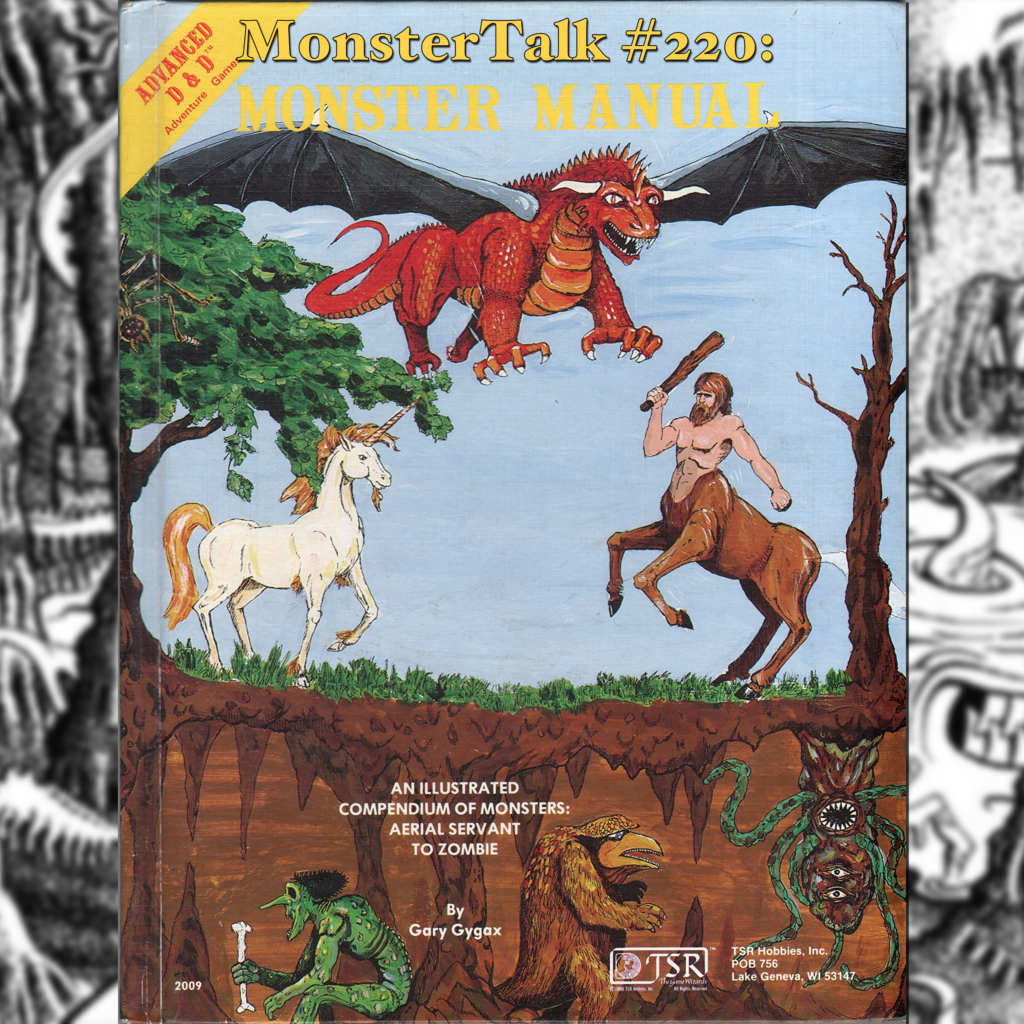
220 – Monster Manual
The episode opens with a clip from Stranger Things — kids arguing over whether the shadow bearing down on their dungeon party is a Demogorgon — before Blake and Karen note that for millions of people, Dungeons & Dragons is the primary lens through which they first encountered mythology, folklore, and the whole bestiary of human imagination.
🎲 From Prussian War Rooms to Fantasy Basements
Jon traces the ancestry of RPGs back to Kriegsspiel — the Prussian military “war game” tradition that grew out of dissatisfaction with chess as a training tool. Where chess abstracted warfare into elegant but unrealistic pieces, 19th-century military scientists wanted grids that could actually simulate infantry, cavalry, and artillery. That impulse toward realistic simulation never went away; it migrated into American hobby culture through companies like Avalon Hill, which in the 1950s sold board-game recreations of battles like Gettysburg.
The crucial bridge figure for miniature wargaming is H. G. Wells, whose 📖 Little Wars (1913) proposed using toy soldiers from a middle-class British nursery to fight playable tactical battles — prioritising fun over simulation fidelity. Once miniatures entered the equation, rules became a commercial engine: manufacturers like Jack Scruby in 1950s California published wargame rules specifically to sell more figures.
Jon’s own origin story begins at the British Museum, where a first-century AD Roman 20-sided die in a display case sent him down a research rabbit hole: who was the first person to roll a die against a statistical model to decide fictional events? That question became Playing at the World.
⚔️ Chainmail, Gygax, and the Birth of D&D
In 1971, E. Gary Gygax and Jeff Perrin released Chainmail, the first commercial rules set for medieval fantasy miniature combat. The fantasy supplement tacked onto that book — covering orcs, wizards, and dragons — drew heavily on Tolkien, Robert E. Howard‘s Conan stories, and Michael Moorcock. Three years later, Gygax and Dave Arneson published the original D&D box set (1974), published by TSR.
The sources for the game’s monster roster were eclectic to say the least: T. H. White‘s translation of a 12th-century bestiary, a volume called A Fantastic Bestiary by Lainer (whose index the designers evidently raided wholesale), and Ray Harryhausen‘s stop-motion creatures from films like 🎬 Jason and the Argonauts 💵. The game’s most iconic invented creatures — the Mind Flayer and the Beholder — emerged from that same culture of creative mashup rather than from any single literary source.
📖 The Monster Manual and the Art of “Stats”
The original Monster Manual (1977) was the first volume of the Advanced Dungeons & Dragons line, and its primary job was housekeeping: monsters had been scattered across issues of The Dragon magazine, supplements like Greyhawk and Eldritch Wizardry, and the original rulebooks. Gathering 350 creatures into one taxonomic reference was as much a practical act as a creative one.
Jon explains what “stats” actually are for Karen (and any non-gamers in the audience): the quantification of a creature’s attributes — hit points, armor class, damage — that make it possible to simulate an encounter. The concept of hit points originated in D&D and became foundational to computer game design. Putting a dragon or a devil into a simulation forces a specificity that folklore and fiction never require: Tolkien’s Balrog can be vague about wings; a dungeon master cannot be.
The Monster Manual spawned sequels almost immediately. The Fiend Folio (1981) collected monsters from the UK magazine White Dwarf. Monster Manual 2 followed in 1983. By second edition, TSR was selling loose three-hole-punched monster pages meant for binders — an escalation that says everything about the appetite for new creatures to slay.
😈 The Satanic Panic and James Dallas Egbert III
The cultural backlash against D&D traces directly to a single incident: in 1979, a university student named James Dallas Egbert III disappeared from his dorm room at Michigan State University in East Lansing. The private detective hired to find him — and subsequently the national media — fixated on his D&D hobby, spinning a narrative that he had retreated into the steam tunnels beneath campus, believing the game was real. The story dominated front pages and evening news broadcasts for roughly a week. Egbert had in fact run away to Louisiana and eventually returned home safely — but the narrative had already hardened.
Religious fundamentalists absorbed that narrative into the broader Satanic Panic, circulating tracts like Dark Dungeons by Jack Chick and petitioning school boards for bans. Patricia Pulling, founder of Bothered About Dungeons & Dragons (BADD), became the movement’s most visible spokesperson — memorably featured on 60 Minutes opposite Ed Bradley, even as CBS aired the Dungeons & Dragons Saturday morning cartoon on the same network.
Jon adds a detail that gives the panic some context: the same month Egbert disappeared, The Dragon magazine published stats for Satan. He is careful not to endorse the fundamentalists’ conclusions, but notes that the 1980 supplement Deities & Demigods — which included detailed Norse, Egyptian, and Lovecraftian pantheons alongside Moorcock’s Melnibonéan mythos — did provide genuine ammunition to anyone already primed to see paganism under every 20-sided die. (Blake notes the show previously explored these themes with religious-studies scholar Joseph Laycock, author of 📚 Dangerous Games 💵.)
🖥️ From Tabletop to Screen: The PLATO System, Computer RPGs, and Critical Role
The same simulation logic that made D&D compelling made it a natural fit for early computers. Jon’s book traces lines of influence from tabletop wargames through the PLATO mainframe network — where a game called D&D ran that was essentially identical to the commercially sold Telengard — to the narrative-driven computer RPGs that now generate opening-weekend revenues that make Hollywood jealous.
The dungeon as an adventure space translated directly to computer games because its core mechanic — verbal (or textual) description prompting player decisions, mapped on graph paper to avoid getting lost — is structurally identical to the branching-path logic of a computer program. Blake draws the line through Diablo and The Elder Scrolls to the present day.
On the spectator side of modern gaming, Jon points to Critical Role — a group of professional voice actors who film their D&D campaigns and became superstars doing it, launching what was at the time the most successful media Kickstarter in history for an animated adaptation. Online play platforms like Roll20 have further expanded who can participate and from where.
📚 Further Reading
– 📚 Playing at the World 💵 by Jon Peterson
– 📚 Dungeons & Dragons Art & Arcana: A Visual History 💵 by Michael Witwer, Kyle Newman, Jon Peterson & Sam Witwer
– 📚 Hero’s Feast: The Official D&D Cookbook 💵 by Kyle Newman, Jon Peterson, Michael Witwer & Sam Witwer
– 📚 The Elusive Shift: How Role-Playing Games Forged Their Identity 💵 by Jon Peterson (MIT Press)
–
🎙️ Blake Smith and Karen Stollznow roll for initiative as they welcome historian and game scholar Jon Peterson to discuss the origins of role-playing games, the cultural panic that surrounded them, and the foundational monster compendium at the heart of it all: the Monster Manual. Jon is the author of 📚 Playing at the World 💵, which has been used as a university course text on the history of RPGs, and a contributor to 📚 Dungeons & Dragons Art & Arcana: A Visual History 💵. He also arrives with fresh news: a forthcoming official D&D cookbook called 📚 Hero’s Feast 💵. (Yes, real food. Yes, there is a Mind Flayer cocktail.)
The episode opens with a clip from Stranger Things — kids arguing over whether the shadow bearing down on their dungeon party is a Demogorgon — before Blake and Karen note that for millions of people, Dungeons & Dragons is the primary lens through which they first encountered mythology, folklore, and the whole bestiary of human imagination.
🎲 From Prussian War Rooms to Fantasy Basements
Jon traces the ancestry of RPGs back to Kriegsspiel — the Prussian military “war game” tradition that grew out of dissatisfaction with chess as a training tool. Where chess abstracted warfare into elegant but unrealistic pieces, 19th-century military scientists wanted grids that could actually simulate infantry, cavalry, and artillery. That impulse toward realistic simulation never went away; it migrated into American hobby culture through companies like Avalon Hill, which in the 1950s sold board-game recreations of battles like Gettysburg.
The crucial bridge figure for miniature wargaming is H. G. Wells, whose 📖 Little Wars (1913) proposed using toy soldiers from a middle-class British nursery to fight playable tactical battles — prioritising fun over simulation fidelity. Once miniatures entered the equation, rules became a commercial engine: manufacturers like Jack Scruby in 1950s California published wargame rules specifically to sell more figures.
Jon’s own origin story begins at the British Museum, where a first-century AD Roman 20-sided die in a display case sent him down a research rabbit hole: who was the first person to roll a die against a statistical model to decide fictional events? That question became Playing at the World.
⚔️ Chainmail, Gygax, and the Birth of D&D
In 1971, E. Gary Gygax and Jeff Perrin released Chainmail, the first commercial rules set for medieval fantasy miniature combat. The fantasy supplement tacked onto that book — covering orcs, wizards, and dragons — drew heavily on Tolkien, Robert E. Howard‘s Conan stories, and Michael Moorcock. Three years later, Gygax and Dave Arneson published the original D&D box set (1974), published by TSR.
The sources for the game’s monster roster were eclectic to say the least: T. H. White‘s translation of a 12th-century bestiary, a volume called A Fantastic Bestiary by Lainer (whose index the designers evidently raided wholesale), and Ray Harryhausen‘s stop-motion creatures from films like 🎬 Jason and the Argonauts 💵. The game’s most iconic invented creatures — the Mind Flayer and the Beholder — emerged from that same culture of creative mashup rather than from any single literary source.
📖 The Monster Manual and the Art of “Stats”
The original Monster Manual (1977) was the first volume of the Advanced Dungeons & Dragons line, and its primary job was housekeeping: monsters had been scattered across issues of The Dragon magazine, supplements like Greyhawk and Eldritch Wizardry, and the original rulebooks. Gathering 350 creatures into one taxonomic reference was as much a practical act as a creative one.
Jon explains what “stats” actually are for Karen (and any non-gamers in the audience): the quantification of a creature’s attributes — hit points, armor class, damage — that make it possible to simulate an encounter. The concept of hit points originated in D&D and became foundational to computer game design. Putting a dragon or a devil into a simulation forces a specificity that folklore and fiction never require: Tolkien’s Balrog can be vague about wings; a dungeon master cannot be.
The Monster Manual spawned sequels almost immediately. The Fiend Folio (1981) collected monsters from the UK magazine White Dwarf. Monster Manual 2 followed in 1983. By second edition, TSR was selling loose three-hole-punched monster pages meant for binders — an escalation that says everything about the appetite for new creatures to slay.
😈 The Satanic Panic and James Dallas Egbert III
The cultural backlash against D&D traces directly to a single incident: in 1979, a university student named James Dallas Egbert III disappeared from his dorm room at Michigan State University in East Lansing. The private detective hired to find him — and subsequently the national media — fixated on his D&D hobby, spinning a narrative that he had retreated into the steam tunnels beneath campus, believing the game was real. The story dominated front pages and evening news broadcasts for roughly a week. Egbert had in fact run away to Louisiana and eventually returned home safely — but the narrative had already hardened.
Religious fundamentalists absorbed that narrative into the broader Satanic Panic, circulating tracts like Dark Dungeons by Jack Chick and petitioning school boards for bans. Patricia Pulling, founder of Bothered About Dungeons & Dragons (BADD), became the movement’s most visible spokesperson — memorably featured on 60 Minutes opposite Ed Bradley, even as CBS aired the Dungeons & Dragons Saturday morning cartoon on the same network.
Jon adds a detail that gives the panic some context: the same month Egbert disappeared, The Dragon magazine published stats for Satan. He is careful not to endorse the fundamentalists’ conclusions, but notes that the 1980 supplement Deities & Demigods — which included detailed Norse, Egyptian, and Lovecraftian pantheons alongside Moorcock’s Melnibonéan mythos — did provide genuine ammunition to anyone already primed to see paganism under every 20-sided die. (Blake notes the show previously explored these themes with religious-studies scholar Joseph Laycock, author of 📚 Dangerous Games 💵.)
🖥️ From Tabletop to Screen: The PLATO System, Computer RPGs, and Critical Role
The same simulation logic that made D&D compelling made it a natural fit for early computers. Jon’s book traces lines of influence from tabletop wargames through the PLATO mainframe network — where a game called D&D ran that was essentially identical to the commercially sold Telengard — to the narrative-driven computer RPGs that now generate opening-weekend revenues that make Hollywood jealous.
The dungeon as an adventure space translated directly to computer games because its core mechanic — verbal (or textual) description prompting player decisions, mapped on graph paper to avoid getting lost — is structurally identical to the branching-path logic of a computer program. Blake draws the line through Diablo and The Elder Scrolls to the present day.
On the spectator side of modern gaming, Jon points to Critical Role — a group of professional voice actors who film their D&D campaigns and became superstars doing it, launching what was at the time the most successful media Kickstarter in history for an animated adaptation. Online play platforms like Roll20 have further expanded who can participate and from where.
📚 Further Reading
– 📚 Playing at the World 💵 by Jon Peterson
– 📚 Dungeons & Dragons Art & Arcana: A Visual History 💵 by Michael Witwer, Kyle Newman, Jon Peterson & Sam Witwer
– 📚 Hero’s Feast: The Official D&D Cookbook 💵 by Kyle Newman, Jon Peterson, Michael Witwer & Sam Witwer
– 📚 The Elusive Shift: How Role-Playing Games Forged Their Identity 💵 by Jon Peterson (MIT Press)