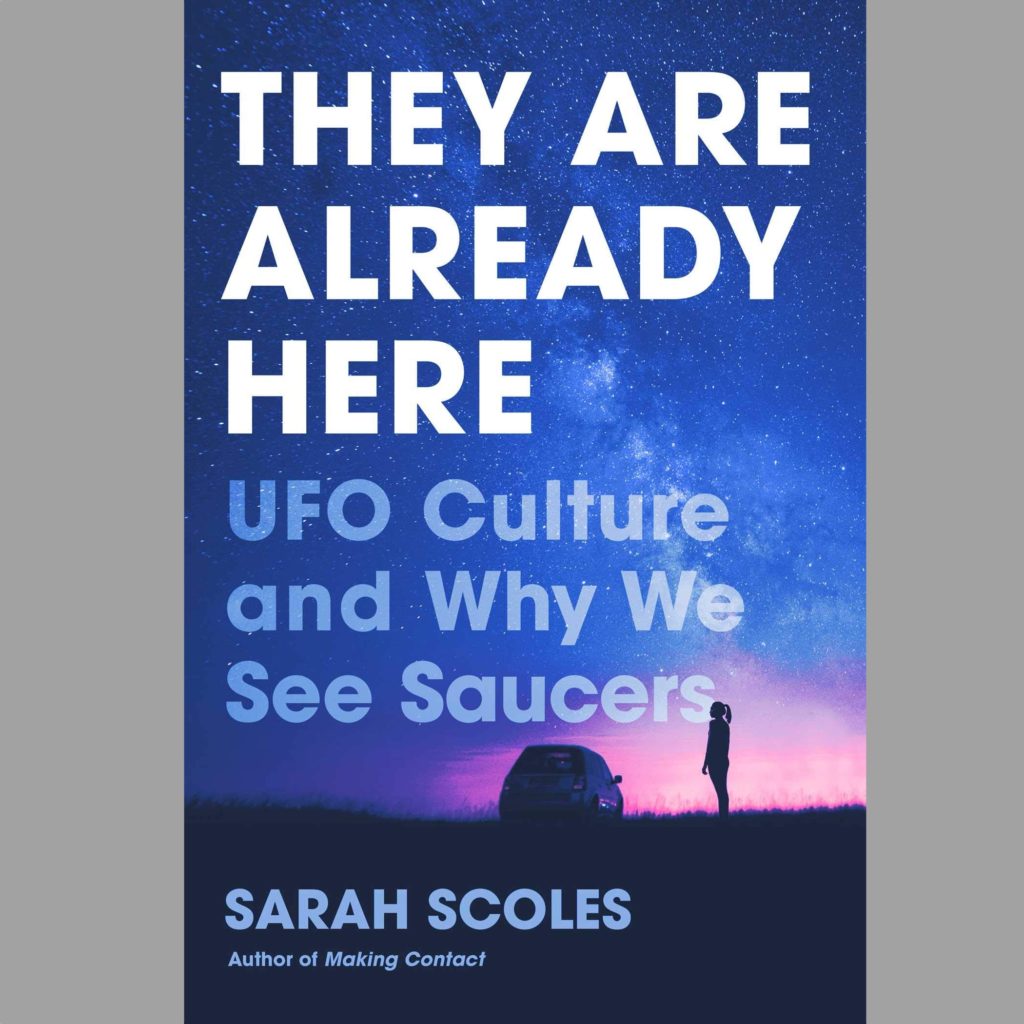
221 – They Are Already Here – with Sarah Scoles
Download the episode (Right-click, Save as MP3)
This is the first of a two-part space-themed arc on MonsterTalk, and the conversation ranges from the December 2017 New York Times front-page bombshell about a secret Pentagon UFO program all the way to the weird cultural ecosystem that surrounds — and in some ways may have manufactured — that story.
📰 The New York Times Story and the AATIP Program
On December 16, 2017, the New York Times ran a front-page story revealing the existence of the Advanced Aerospace Threat Identification Program (AATIP) — a Pentagon initiative that ran roughly from 2007 to 2012 and consumed some $22 million in “dark budget” funding. The story carried three bylines: Pentagon correspondent Helene Cooper, and longtime UFO journalists Ralph Blumenthal and Leslie Kean. Blake and Sarah note that Kean is a board member of a UFO investigation organization and has a track record of sticking to UFO explanations even when mundane ones emerge — which raises legitimate questions about journalistic disinterest.
What did AATIP actually produce? Thirty-eight technical reports — touching on the Drake equation, traversable wormholes, anti-gravity, and exotic propulsion — some drawing on papers already in the public domain. The Pentagon’s own documentation, Sarah notes, never explicitly mentions unidentified objects. Its current official stance is that AATIP did not study them at all.
🎸 To The Stars Academy and Tom DeLonge
Tom DeLonge, frontman of Blink-182, announced To The Stars Academy of Arts and Science (TTSA) in October 2017 — just months before the Times story ran — and published the same three Navy videos on its website on the very same day the article appeared. DeLonge claimed to have assembled a team of former intelligence and Department of Defense insiders to reverse-engineer what he strongly implied was alien technology, funded partly through public investment. Sarah’s assessment: so far TTSA has functioned primarily as an entertainment company, producing books, music, T-shirts, and a TV series. DeLonge’s stated rationale — softening the public up for a “bombshell truth” by packaging it as fiction first — is an interesting media strategy, whatever one makes of the underlying claims. His nonfiction Secret Machines series is co-written with Peter Levenda, described by Blake as “America’s leading mystical figure.”
🕵️ Luis Elizondo and the Question of Who Ran What
Luis Elizondo claims to have been the director of AATIP, famously suggesting that “all roads led to Rome, and Rome was my desk.” Sarah spent years trying to get the Pentagon to confirm this. Their most specific response — obtained by journalist Keith Kloor — was that Elizondo “did not have any responsibilities related to AATIP” during his time at the Department of Defense. Not merely not the director: not connected to it at all. Whether the Pentagon is being economical with the truth, or whether Elizondo is, remains an open question — which is itself a fairly representative summary of where UFO research tends to end up.
🏨 Robert Bigelow: Keeping the Lights On
Robert Bigelow, the budget-hotel mogul turned space entrepreneur, is the largest known private funder of paranormal and UFO research in the United States. His fingerprints are everywhere: he bankrolled a radio program that became the foundation for Coast to Coast AM (hosted by Art Bell, with reporting from George Knapp); he purchased and studied Skinwalker Ranch; he founded the National Institute for Discovery Science to apply instrumented, credentialed investigation to paranormal claims; and he had a direct pipeline into MUFON case reports. He doesn’t use email, rarely gives interviews, and has released very little of what his research produced — which, Sarah observes, probably reflects the fact that it didn’t produce very much.
🛸 UFO, UAP, and the Semantics of Seriousness
The U.S. Navy’s shift from “UFO” to UAP (Unidentified Aerial Phenomenon) is discussed at some length. Sarah’s reasonable speculation: “UFO” carries so much cultural baggage — six decades of tabloid photos and alien-invasion films — that military investigators understandably want a label that doesn’t pre-load the conclusion. Blake points out the irony that “UAP” is already being colonized by the same community that uses “UFO” to mean extraterrestrials, ultra-terrestrials, or beings from other dimensions, depending on which interview you catch them in.
🛐 UFOs, Community, and the Religious Impulse
Blake raises Diana Pasulka‘s book 📚 American Cosmic 💵, which frames UFO belief as the seed of a new religion. Sarah’s view is more sociological than theological: for some people, the extraterrestrial hypothesis fills the same psychological niche that religion fills for others — a more advanced intelligence that explains our origins and hints at something larger than everyday life. She’s less interested in formal UFO cults than in the community function: local MUFON meetings, UFO tourist sites, and conference circuits give people with shared enthusiasms a place to belong. Karen discusses the UFO-religion hybrid group Share International, founded by Benjamin Creme, which blended contactee-style “space brothers” theology with a messianic figure called Maitreya — a genuinely strange case study in how UFO culture and millenarian religion can fuse.
📚 Further Reading
– 📚 They Are Already Here: UFO Culture and Why We See Saucers 💵 by Sarah Scoles
– 📚 American Cosmic: UFOs, Religion, Technology 💵 by D.W. Pasulka
– 📚 Searching for Sasquatch: Crackpots, Eggheads, and Cryptozoology 💵 by Brian Regal
– 📚 The Illuminatus! Trilogy 💵 by Robert Shea and Robert Anton Wilson
🔗 Related Links
– Original New York Times AATIP story (December 16, 2017)
– Advanced Aerospace Threat Identification Program (AATIP) — Wikipedia
– To The Stars Academy of Arts and Science — Wikipedia
– Luis Elizondo — Wikipedia
– Robert Bigelow — Wikipedia
– Skinwalker Ranch — Wikipedia
– Leslie Kean — Wikipedia
– 📺 Paul Rudd’s Mac and Me prank on Conan O’Brien — supercut
Note: ads inserted into the distributed audio alter the timestamps in unpredictable ways, so timing references in these notes are approximate.
Author Sarah Scoles joins us to discuss her amazing book They Are Already Here: UFO Culture and Why We See Saucers. It’s a terrific ride through UFO culture and the fallout from the 2017 New York Times front-page article about the US Government Program to examine unidentified objects in the sky.
Links/Additional Reading/Terms:
AATIP – the Advanced Aerospace Threat Identification Program – the pentagon program associated with Luis Elizondo.
TTSA – To The Stars Academy – the entertainment/media company set up by BLINK-182 frontman Tom Delonge and storied paranormal researcher Harold Puthoff.
UAP – Unidentified Aerial Phenomenon – the new terminology used by the military to discuss unknown flying objects while trying to avoid all the connotations of UFOs.
UFO – Unidentified Flying Objects – a perfectly reasonable term for unknown flying things in the sky (coined in 1953), except for the wacky cultural baggage it immediately picked up. Honestly, the term UFO attracts “wacky” like a piece of half-chewed bubble gum dropped in a dog bed attracts hairs.
Robert Bigelow – Hotelier, sugar-daddy to weirdness, and also space entrepreneur.
The New York Times story that broke the AATIP program publicly.
The follow-up story from two of the authors (Kean & Blumenthal)
The incredibly long-running joke Paul Rudd has been doing on the Conan show