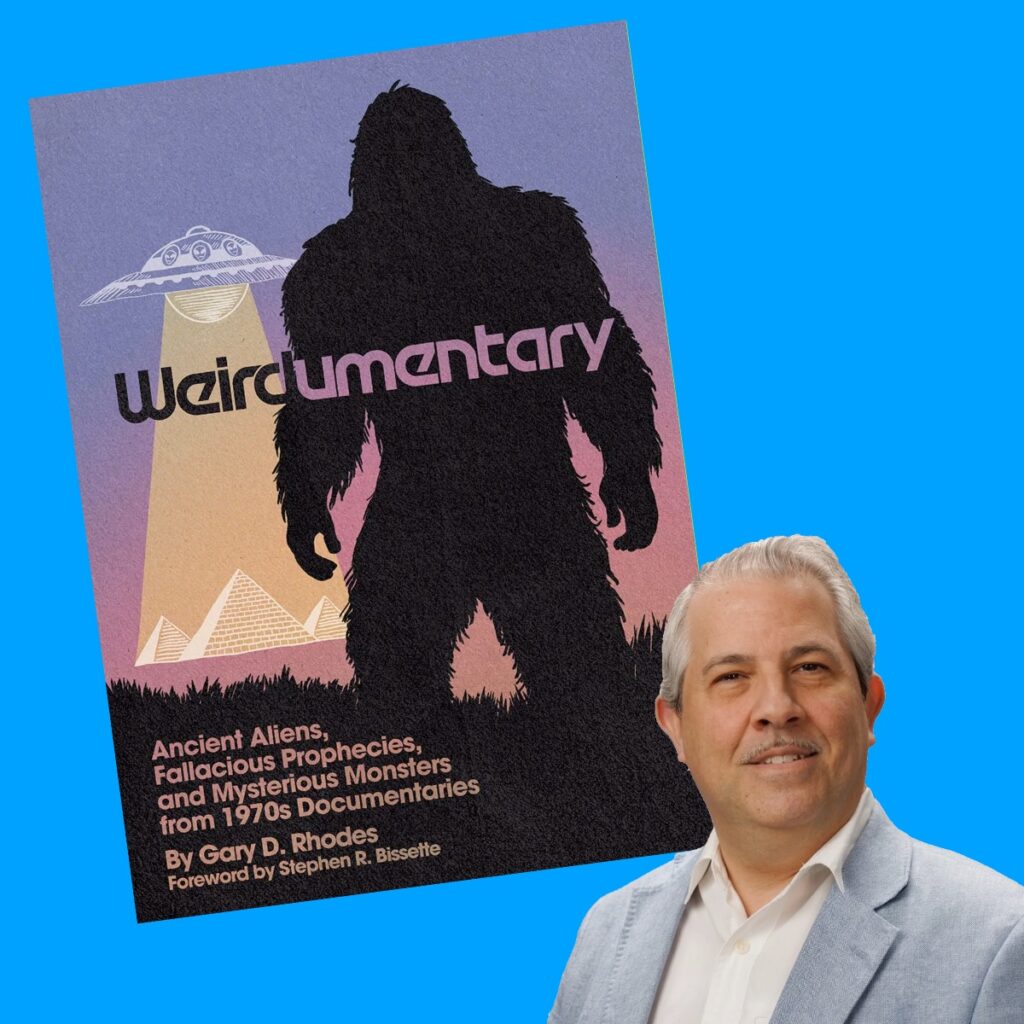
BONUS: Weirdumentary with Gary Rhodes
I’m excited to be posting this BONUS content – an interview with film historian Gary D. Rhodes. Gary is joining me to talk about his newest book Weirdumentary: Ancient Aliens, Fallacious Prophecies, and Mysterious Monsters from 1970s Documentaries. I can’t overstate how enjoyable this book was and how likely listeners to MonsterTalk and In ReSearch Of… are to be equally thrilled with it.
Weirdumentary has a forward by Stephen Bissette who wrote a book also likely to be of interest to listeners: Cryptid Cinema(affiliate link)
(A follow-up to that book is under construction and will include research by your’s truly about the “4-walling” tour of the PGF.)
I linked to Feral House’s page for Weirdumentary above at the request of Gary. If you’re curious about their catalog, we talked with their owner recently about monstrous food and they also produced Al Ridenour’s new book about Carnival.
This is not a complete list of the films in the book – and it also covers a few TV series including In Search Of… and Arthur C. Clarke’s _____ (he had three ITV series covering topics similar to ISO with each season getting a slightly different name).
1970: Chariots of the Gods, The Unexplained
1971: The Hellstrom Chronicles, The Man Who Saw Tomorrow
1972: Bigfoot Man or Beast, Monsters! Mysteries or Myths?, The Devil’s Triangle, The Legend of Boggy Creek
1973: In Search of Ancient Astronauts
1974: Deadly Fathoms, In Search of Ancient Mysteries, In Search of Dracula, UFOs: Past, Present and Future
1975: Mysteries from Beyond Earth, The Force Beyond, The Legendary Curse of the Hope Diamond, The Man of Miracles, The Outer Space Connection
1976: Beyond Belief, In Search of Noah’s Ark, Mysteries of the Gods, The Amazing World of Psychic Phenomena, The Legend of Bigfoot, The Legend of Loch Ness, The Miracle Healers, The Mysterious Monsters, World Beyond Death
1977: Aliens from Spaceship Earth, Journey into the Beyond, Mysteries of the Great Pyramid, The Lincoln Conspiracy, The Underground Doctors, The Unknown Force
1978: Are We Alone in the Universe?, Beyond and Back, Curse of the Mayan Temple, Manbeast! Myth or Monster?, Mysteries from Beyond the Triangle, Mysteries of the Mind, Mystery of the Sacred Shroud, Secret of the Bermuda Triangle, The Amazing World of Ghosts, The Late Great Planet Earth, The Lost City of Atlantis, The UFO Journals, UFO – Exclusive! , UFO: Top Secret, Unknown Powers, World of the Unknown
1979: Attack from Outer Space, Charles Berlitz’s The Bermuda Triangle, Death: The Ultimate Mystery, Encounter with Disaster, Hypnosis and Beyond, In Search of the Historic Jesus, The Doomsday Chronicles, The Prophecies of Nostradamus, UFOs Are Real, World of Mystery
1980: Land of Celtic Ghosts, Mysteries of the Mind, UFO Syndrome
1981: Search for the Titanic
SEO Transcript
This is not a fully accurate transcript, and was machine generated. It’s here for helping search engines find the episode but not intended to be a faithful transcript of the episode. (But it’s not AWFUL.) Some of the material in this transcript only exists in the Patreon/Premium edition of the show and was excised for the commercial version.
———————
Dr. Gary D. Rhodes is a filmmaker and professor of media production at Oklahoma Baptist University.
A renowned film historian, he’s arguably the world’s leading expert on Bela Lugosi and early horror cinema.
And his extensive body of work includes, I’m going to say over 20, but well over 20 books, including such titles as Birth of the American Horror Film and documentaries like Lugosi…
Hollywood’s Dracula.
He specializes in American film exhibition and the intersection of documentary and fiction.
And today, or tonight, we’re going to be talking about his new book, Weirdumentary.
Welcome to, well, I’m going to say welcome to the shows because I booked you initially to talk on my show In Research Of.
which is a show where I and Dr. Jeb Card watch old episodes of In Search Of.
And then, as we like to say, add in the information the producer chose not to include.
Absolutely.
It’s been a ride.
I just noticed this morning, I guess we started like in February of 2020, so like a month before the pandemic.
And we’re into season five now in recording.
So, yeah.
It’s a long show and it has a lot of good information and it’s very interesting.
And it has a prominent place in your book, which is why I was targeting that.
But my other show is called Monster Talk.
That’s the one that’s been going on since 2009.
And I realized there’s a whole lot of overlap there too.
So I thought rather than just target this at either audience, I would make this a universal Monster House Productions podcast that will go into both feeds.
Well, I can’t thank you enough for having me.
I apologize.
We had a couple of moments, a couple of times that I had to cancel, but I’ve long been a fan of Monster Talk, and I’m so grateful to be with you today.
Well, it’s really exciting.
Now, it’ll probably surprise people that I’m having you on to talk about where your mentor is when you’ve done so much work in horror.
But can you talk a little bit about your other interests before we get into the weirdumentaries?
You’ve done a lot of work on Bela Lugosi and early horror cinema.
I feel silly asking the question because I think most of our audience are probably monster people and horror people.
But how did you get into that?
Were you one of the monster kids, picked up the distribution stuff from TV, like horror hosts?
Or how did you fall into this?
That’s a wonderful question.
Thank you.
You know, for me, I guess if I am a monster kid, I’m 53, I’d be about the youngest of that monster kid generation, meaning…
I think we got cable in my home at about the age of 10.
And by the age of 12, we had a VHS player.
I mention that because until the age of 10, we had three networks and PBS.
And so me and the other kids at school, you know, if they were showing an old black and white movie.
you know, we watched it.
And so I grew up watching the films we didn’t.
There had been, I was from Oklahoma, there were various Oklahoma horror hosts, but that had kind of died out by the late 70s when I was young.
but they would play them sometimes on Sunday afternoon.
And I have such fond memories of watching them, not only around the Halloween season, but at other times of the year.
My mother was actually, though, my mother was an original shock theater fan back in like 58, 59, 60.
So I guess it comes from that and my mother’s fascination with these films.
And I suppose…
Many of us as little kids love ghost stories, campfires, tales, all of that.
It never left me or I never left it one way or the other.
Yeah, I think I first got into – well, no, I shouldn’t even say that.
I was starting to say something about the –
is it David Scull?
Uh, yeah, I knew David well from about 1991.
Yes.
I think, I think maybe he had the first sort of academic book that I read on this.
And then I realized, well, no, what am I talking about?
Because I grew up reading, uh, you know, Fangoria, famous monsters, all the books in the school, you know, library about monster movies.
Oh yes.
I mean, I think maybe his was the first grownup academic book on that.
And I, that sadly he left us fairly recently.
Um,
But yeah, so in your work, though, your professional work, some of what you’ve written talks about, I think I might be.
oversynthesizing this, but the way that audiences are effectively trained, nobody goes to movie training, how to watch a movie, but you end up being trained.
And I think that has an impact on how you categorize what’s a weirdumentary, because there’s this concept of having an expert on screen and how important that is.
And that is somewhat subverted in the films you’ve selected for this book.
Yeah.
Yeah, yeah.
Well, you know, this goes back to me.
And, you know, at times I’m doing very egghead academic peer reviewed stuff that probably only a small number of scholars read.
And then sometimes I’m writing for, you know, well, I’ve done things for USA Today and Washington Post and stuff.
So different audiences.
But for me, the reason I say that would be the prologue to saying I think we’re trained as audience members without knowing it in a lot of ways.
I mean, we all, even if we can’t articulate it verbally, we all kind of know that a fade to black means the end, whether it’s the end of a film or the end of a part of a TV show, and then there’s a commercial, or maybe sometimes it’s in the middle of a film and it’s the end of somebody’s life or consciousness, you know, like the POV of their eyes going dark.
So I think we’re trained in a lot of ways by movies and growing up with them.
And at this point, of course,
There’s no one alive who didn’t grow up with them.
I mean, somebody may have avoided them if they were in some community or family that disdained film or wouldn’t allow them to be watched, but obviously film dates to the 1890s, so we’re all part of this knowledge base.
And to move along really quickly, I’d say that newsreels come in around 1912, and they’re silent for a while, but they still have a kind of expert narrator, not with voice, but with on-screen text, intertitles, you know, the old silent film way.
And then they’re so popular, of course, they move into the sound era and are popular into the early 60s when, of course, television news takes that place.
And television news, we all grow up with and we see experts.
We hear the so-called in documentaries and news, the so-called voice of God, you know, the disembodied narrator.
Sometimes it’s a famous person.
Sometimes it’s not.
But, you know, maybe they have allegedly an authoritative sounding voice.
They sound famous.
like they know what they’re saying, even if they are not that well-versed in what they’re saying or if they’re just a paid actor.
Even TV commercials, I think, do this for us, you know, try bare aspirin over some other brand, what have you.
So I think there is this veneer of an expert voice, an expert narrator.
as well as, I mean, we would see it even as you and I were talking, if we put on the news about world events of today, of recent times, let’s bring on an expert about this country, this war, whatever else.
So yes, I think we’re very much trained in a lot of ways about film, including what’s supposed to be real, what’s supposed to be nonfiction, what’s supposed to be trustworthy.
Yeah, I think Jeb Card and I have talked a lot about the path to the show in search of because originally that would have been Rod Serling.
And, you know, he’s got that voice you’re talking about, the gravitas, and he’s a great presenter and writer.
But when they brought in Leonard Nimoy after Serling died, it changes it because you get this sort of, I think, I would argue that it’s a credibility propped up by his fictional role as Mr. Spock on TV.
Like, he’s so associated with being the science officer of the Enterprise that it’s like if he’s going to tell you something, he’s got a little more credibility than, say, a Shatner, although Shatner appears in your book, too.
I love that they had sort of competing nonsense documentaries.
It’s great.
Yeah, yeah.
Well, and it’s fascinating because, you know, the Shatner, the first Shatner one that he narrated and appeared on camera was called Mysteries of the Gods.
Hello, I’m William Shatner.
As Captain Kirk and with the rest of the crew of the USS Enterprise, we made many wondrous voyages into the future, into the vastness of space.
But that was fiction.
I’d like to take you along on another kind of voyage, but this is based on reality.
The real world we live in.
It was 1976, and of course this is, I guess, his 50th anniversary for Weirdumentary, because he still has on, this year, a show of this type, some of your listeners may know, called The Unexplained.
So, Shatner now has 50 years of these kinds of, of narrating these kinds of films and TV shows.
It’s amazing to me, not only his literal longevity, but his professional longevity.
And he still seems sharp as a tack, which is great.
I’m proud of him.
Wonderful.
No, it’s inspiring in a lot of ways.
I mean, I even heard him speak about a year, a year and a half ago live and with the questions and everything, talk about sharp as a tack.
He’s quite something.
He really is.
I think, you know, he I as a Star Trek fan, I mean, you know, all the the back story drama stuff is like you can live to a point where all that stuff just falls away and you’re just a legend.
And I think he’s reached that point.
Yeah.
Yeah.
Yeah.
Well, it reminds me of that wonderful line of dialogue in Chinatown.
Oh, yes.
You know, John Houston says, what what is it?
Politicians, whores and ugly buildings all get respectable if they last long enough.
I say it all the time.
It’s so brilliant.
It really is.
But we’re here today to talk about weirdumentaries.
And I have to say this book is gorgeous.
I happen to own a substantial chunk of these hard to find movies, many of which I’ve scraped from the furthest corners of the Internet.
Yeah, yeah.
But some of them are lost, and all we have is marketing material.
But what makes a weird geometry?
What are people going to get when they get into this book?
Well, yeah, thank you.
You know, there have been these kind of films investigating, inquiring after everything from, say, the afterlife, spiritualism.
You know, there have been films, kind of pseudoscience documentaries, at least as early as 1923, when there was a film called Is Conan Doyle Right?
And it was asking about his belief in spiritualism.
So, you know, these kinds of topics kicked around a lot.
But when it comes to what I’m calling the weirdumentary, a particular formula really coalesced by 1972.
They really seemed to come on around 1970.
By 1972, there’s a really ironclad formula.
There’s even one company that largely specializes in them that we can talk about if you want.
And a lot of these were getting theatrical releases.
So they had that imprimatur as well as the would-be experts and on-screen co-hosts and so forth.
And then this kind of comes to an end in my mind, particularly in terms of these slightly larger budgets, slightly more distributed, certainly sometimes theatrical.
What I’m talking about kind of comes to an end in 1981, 82 with…
The Man Who Saw Tomorrow, which was Orson Welles’ hosted documentary about Nostradamus.
So it’s this particular period of time.
And they share some particular traits, which I can talk about if you’d like.
Sure.
Yeah.
I was going to say this period, I believe you were alluding to Schicksal and Classics.
Oh, yes.
Yes, absolutely.
We do need to talk about that because I did some work for Steve Bissett.
It was independent research I was doing, and he’s going to include it in his next scripted cinema book.
Another great book.
I am looking forward.
Absolutely.
He’s a great writer and he’s so great.
But he had he was very clear to me that he says, you’ve got to be really careful about.
signed because a lot of people think wrong ideas about what they were involved in, what they weren’t involved in, what they distributed, what they didn’t.
So yeah, I do want to talk about that.
But yeah, if you want to, I don’t want to lose track of the original question, you offered to extrapolate a little bit.
So please do.
I think that, you know, in the book I look at, and I think it was something special about that period to begin with.
Just a quick thought would be Eric Von Daniken’s book, Chariots of the Gods, was released in 1968.
First released.
And it spoke about how aliens from the distant past, from other planets and so forth, visited Earth to help early man.
you know, whatever it would be, build up pyramids or so forth.
That same year, Stanley Kubrick’s film 2001, A Space Odyssey is released.
And I suppose the two men behind those two projects might not have, they couldn’t have been more different in most respects.
And 2001 was a stated fictional film where Von Daniken posed his as nonfiction.
Although Kubrick’s 2001 certainly feels at times like a documentary, what am I getting at?
They both came at the end of kind of the 60s, after the Summer of Love and so much else, so much interest in everything from holistic medicine to New Age to different philosophies to inquiring into the unknown.
Kubrick’s 2001 actually offered the same explanation that von Daniken did in terms of the monoliths planted on Earth as well as on the moon that helped from the earlier australopithecines through the star baby at the end of the film.
Yeah, and that ties in Arthur C. Clarke, too, who is also in your book with his TV series.
Wow, this stuff is all connected in so many ways.
It is quite connected.
And, you know, and that wasn’t just, you know, people of the youth culture and so forth, obviously investigating some of these topics.
I mean, at this point, as we speak in 2026, and I’m not a university professor of science, but I would strongly believe that most universities.
Thinking about some of these issues, investigating them into the paranormal and so forth, would often be met with disdain, laughed at, beneath contempt.
But in the 1970s, a lot of university professors, various researchers, various enterprises from SETI to particular scholars, including Clark, Arthur C. Clark, were taking these things seriously.
Not even if they didn’t actually believe in them, but they were interested in pursuing…
the unknown.
And that included not just what we’ve been talking about, but also, well, you mentioned cryptids and Steve Bissett.
I mean, here we’re talking everything from Bigfoot to Loch Ness Monster.
We’re talking about all the different things the human mind might be able to do.
You know, Uri Geller bending spoons, maybe foretelling the future like Nostradamus.
Also, rethinking and challenging history, speculative history.
Is what we’ve heard about, say, Abraham Lincoln’s assassination really true?
Is there more to the story?
So there’s even some conspiracy elements there.
Well, this is kind of the era.
and the topic, and it appeals even now to people.
Of course, there’s still these kinds of shows, but I think it had a far greater grip on society in the 70s, and including the fact a lot of these films were released theatrically.
So on the one hand, you have topics that we’ve just been talking about.
That’s part of what I’m calling the weirdumentary.
But there’s a couple of three other things that become part of the brew, the key ingredients.
One of them does become a notable narrator.
So we’ve already kind of covered that.
So Rod Serling, Burgess Meredith, John Carradine, Shatner, Nimoy, Orson Welles on more than one occasion, various others.
And sometimes if the budget was lower, it was somebody who seemed quite authoritative like Brad Crandall.
but maybe not quite as well known as the others.
So you had these topics.
You had the stately, would-be, believable narrator, usually of some note, often positioned in some office with books on the wall behind them to make them seem even more academic-y or academic-y, I guess, or whatever.
But so you had those two things.
And then there’s this wonderful film of 1972.
We all probably remember Charlie Pierce’s Legend of Boggy Creek, which had very documentary aesthetics in the recreations of the folk monster, a kind of cryptid type character in Arkansas.
And using things like handheld camera, which became such an aesthetic sign of the real, like we were talking about earlier.
If the camera shook a bit, that was what people saw on TV about footage from Vietnam or riots or so forth.
A lot of documentary, the documentary film movements of the 1960s, the D.A.
Pennebakers and the Maisels Brothers, Les Blank, too.
You know, there were certain aesthetics that went with documentary at the time and news gathering.
So Legend of Boggy Creek kind of helped introduce, let’s do recreations and recreations that bear some aesthetic sensibilities.
Of what people consciously or not think is true footage like well, like famously the Patterson Gimlin footage, but also just again, the very footage we might still see this aesthetic.
You know, if you turn on the news and somebody’s filming in a war zone, obviously they don’t have time to put up a tripod.
Maybe the boom pole comes into the shot or something like that.
It’s natural lighting.
All of that, of course, is not only tied with arguably what is supposed to be real, and I think more people would have believed that in the 1970s, but it was also cheap to achieve.
Yeah.
Because you could shoot quickly.
You didn’t have to, you know, natural lighting.
You didn’t have to have a lot of lights in a lot of cases.
So low-speed recreations, a particular type of host, and this particular group of weird topics…
That, to me, is the weirdumentary.
So that’s beautifully done.
The Mysterious Monsters hits all those notes, I think.
Oh, yes.
We’ve covered that in a special bonus episode for the In Research Of show.
And I grew up in the evangelical community, so we had Hal Lindsey with the Christian stuff like The Late Great Planet Earth.
Right, which of course became the film narrated, I would say weird documentary narrated by Orson Welles, too.
There you go.
And so this stuff, it was pervasive in the 1970s.
It really was.
And for a lot of us, I think, you know, if we were kids then, these things really did kind of have that gut punch.
They really did.
I mean, everybody was asking, not everybody, but a lot of people were asking at various levels of culture in America.
What if?
What if this exists?
Does it exist?
Let’s look into it.
Well, if you’re a little kid and if you’re already drawn to things like horror and science fiction, if you’re a little kid, you know, stuff like, you know, Ivan Marx’s film Legend of Bigfoot, you know, it seemed like, oh, gosh.
He must just be out there just around the corner.
If they just look three or four trees further.
I mean, doesn’t that feel.
I’m talking about me at the age of five.
But yeah, yeah.
But I mean, it feels like a Disney documentary in a lot of ways.
But it’s Ivan Marks and, you know, he’s no Disney.
But I mean, it really has that low cost nature film vibe.
You know, only as an adult that I realized what a.
amusing grifter i’ve remarked right right right well that’s that’s kind of how i you know this book is not one that i i definitely wrote with tongue in cheek uh trying to have fun trying to have fun with the films because i really do love a lot of them now some of them are very difficult slogs you know yeah yeah
But the best of them, a lot of these, whether it’s Ivan Marks or the Mysterious Monsters, some of the ones we’re talking about, a handful of others we might mention, you know, some of them are still a lot of fun, even though, yeah, of course, we view them quite differently now.
Maybe a bit more of what would you say, kind of in a campy light?
Yes, I think very much so.
And I think I’m sort of an, I don’t know, this sounds weird to say, but I think I’m like a…
somewhat notable online skeptic like absolutely but but i’m also uh very very in love with these things like i mean i like i the question of whether they’re real or not i think that’s an important one i like to answer it but i never stopped loving this and the biggest sin of some of these movies is not that they were giving out misinformation but they were doing it in a boring way i
Yeah, no, some of them were dreadfully boring because they were trying to cash in, obviously, you know, on the success of the others.
And the misinformation thing becomes a curious thing because certainly that’s what it was in large measure.
But, you know, the filmmakers, certainly the ones that were a little bit more savvy in some of the companies.
So carefully would they put, sometimes buried at the end of the credits, well, you know, these are merely opinions, one of many that we’re presenting, you know, and there are other views.
And, you know, they’d almost get in that kind of little disclaimer thing in a moment of the film.
in a place of the film, like buried in the credits that, you know, well, certainly as a kid, I didn’t even notice, you know, but it was a way of saying like, uh, if not actually winking at the audience, it was a way of, of among other things, maybe of avoiding, uh, you know, lawsuits or whatever.
I mean, in search of, you know, with Nimoy does that too, doesn’t it?
That, you know, that these are in the credits.
Sometimes it will say one possible explanation.
Exactly.
They’ve got a disclaimer right there.
Yeah.
You know, I think the only time that that really was flagged like in a big way,
Orson Welles in the Nostradamus Man Who Saw Tomorrow does have a brief moment.
I think it’s the most fascinating in the film now where he actually says, you know, some people, including me, disagree with these opinions.
I’m paraphrasing, you know.
No, no, I know.
I’m not trying to cite the dialogue exactly.
And it’s very brief.
But it’s basically, you know, him saying, look, I’m doing this, but I’m still distancing myself, you know, from it.
Wells comes up on our show a lot because Jeb is very fond of that famous frozen peas commercial where he was recording and getting angrier and drunker.
We know a remote farm in Lincolnshire where Mrs. Buckley lives.
Every July, peas grow there.
Oh, yeah.
Yeah.
No, I know that one.
Well, he and I would have a lot to talk about, I’m sure, because Wells, you know, from start to finish captivates, you know, so many of us from from from the great payday to to some of the more.
Yeah.
More more stranger moments.
Yeah.
No, he’s he’s.
Yeah.
A larger-than-life character, to be sure.
Yeah, absolutely.
So we should talk about the legacy of these kinds of movies.
The weirdumentary era, I think it could be argued, ended in the early 1980s.
That certainly consists of what you include here in your definition.
Yeah, yeah.
And this – I assume it’s not because audiences stopped being interested.
It’s because of the rise of cable television and that sort of thing.
Absolutely.
Yeah, cable became and still is streaming, you know, the home –
for these programs.
It seems lately that I’m seeing, even now, ever the more, you know, of them, not just Shatner’s The Unexplained, but it seems so many people from, what, Ving Rhames to Lawrence Fishburne to… To Danny Trejo, of all people.
Danny Trejo, yes, absolutely.
And Trejo’s new one has an interesting disclaimer at the beginning.
You know, there’s two disclaimers.
One is viewer discretion advised, some of this disaster footage, whatever might be disturbing.
The second disclaimer footage I find even more fascinating, much more, because it says some of the recreations in this program might be created by AI.
Wow.
Yeah, so from Ivan Marks with one 16 mil and a shaky camera.
And his wife wearing a Bigfoot outfit.
And his wife wearing a Bigfoot outfit to AI creating.
Well, we started, I did, started talking about HAL 9000, 2001, in other words, and we’re back to that.
But anyway, yeah, so this keeps going.
But yeah, I would agree completely.
You know, it becomes the place for cable.
It’s still huge.
I would argue it’s not as huge, if only because we’re beset by so much content.
Everything from the video store populating every town by the mid-’80s, and you could start watching what you wanted when, to the sheer number of channels, and so somebody could click on MTV all night rather than just the three networks or PBS.
I think these things are still huge.
I think cable did become the next home.
But for me, things did did change and including the fact that that some of these I actually saw theatrically, you know, and that that’s another element of it for me, as well as what some classic did, you know.
Yeah, I wish, the only one that even comes close, and I don’t believe this is in your book because it’s not technically a weirdumentary, but it uses every single trope, which would be Sasquatch, The Legend of Bigfoot, which was a Sun Classic distribution, I believe.
But they included the Patterson-Gillen film, and they do recreations of famous Bigfoot stories, all wrapped up in a sort of travelogue of…
them pursuing uh the the goal of trying to catch a bigfoot uh right right you if a savvy person in the audience would notice that well this isn’t really a documentary because someone’s filming this and they’re changing their shots and you know absolutely like it gives itself away like the horror mockumentary or found yeah
Yeah, Blair Witch type thing.
For me, I did stick mitigated by by Legend of Boggy Creek, which I think did play a role in getting these others that came after to to do the recreation footage, which was one of some classic specialties, you know, is in their films were doing recreations.
On very low budgets, of course.
But in general, the films I include did pawn themselves off as nonfiction.
Yes.
Yeah, yeah.
Where there were so many others.
I mean, we were talking about gut punches as kids.
I mean, I remember Sun’s wonderful film, Hanger 18.
Oh, yeah, we’ve covered that one.
Wonderful.
And it’s like, I love it.
But some of those kinds of things, yeah, they didn’t fit because they were much more…
And ostensibly, you know, this is a what a docudrama, a fictionalized version of, you know, of the of the entire subject rather than I’m a documentary, even if I have to say somewhere quietly.
Yeah, there’s so many variants on that sort of rapper inspired by real events, you know, like that.
Yeah, yeah, yeah.
We actually, for Monster Talk, we’ve done a YouTube series that I still, I’m overly, what is the word?
I think maybe it’s a bit precious to me, but debased on a true story where we sort of look at these based on a true story things and sort of deconstruct.
No, not really.
I love it because how loose that language is.
And you were kind enough to mention my book, The Birth of the American Horror Film, which covers the genre to 1915.
And it was around, gosh, 1908 or so.
I’ll have to send you the thing.
There was one ghost movie and it was a very short film, Nickelodeon era.
It doesn’t exist, sadly, but the marketing materials do.
And it said based on a true story.
Oh, nice.
So this thing that you’re talking about, which I find so fascinating, too.
It goes back, yeah, that far into early cinema.
So it’s, you know, because as a kid, sometimes I would be seeing it more.
Well, even on posters for films I couldn’t yet see, like, you know, Texas Chainsaw Massacre or, you know, you know what?
Yes.
Yeah.
Right.
Like with John Lear.
Yeah.
Yeah, exactly.
Yeah, John Larroquette telling us how real it was.
And of course, by the time I saw it, I had already met Robert Block and realized that to the extent it was based on truth, it was the same single real-life person as he had based Norman Bates upon.
Yeah.
We based, you know, very, very loosely, but it’s loose.
What’s a looser word than loose in the thesaurus maybe is what, what I need right now.
The, the, that’s so funny.
They had, you remind me, I was listening to an interview and I can’t remember who it was with.
It was Joe Bob Briggs talking about how people would tell him that they need, he would meet people who said, well, I have a friend who’s, you know, lost someone in the Texas Chainsaw Massacre.
Like it was a real event.
Oh, goodness, goodness gracious, yeah.
You just kind of, what do you do with that?
Well, exactly, because as I’m sure you know, and it’s so much fun, obviously we know everything about it, meaning that it’s fake, but I actually took, she was then my girlfriend, now wife, to the actual home.
The setting of the home.
Is that the one they get turned into a barbecue place?
Well, yeah.
Well, I think they turned maybe the gas station into a barbecue place.
That’s it.
It’s a restaurant, too.
Yeah.
They had several cuts of meat, and I shouldn’t even admit this, but of course I, and I do love my steaks rare, but I ordered it.
At the house of the Texas Chainsaw Massacre, you know, everybody getting their pictures taken in front of it.
And, yeah, you know, Briggs meets somebody who says it was a real thing, you know.
So, yeah, they’re talking about a disconnect, you know.
I mean, at least it was a friend told them, not a, you know, that at least gives you a little bit of distance so you don’t have to, you know, worry that you’re with someone who might be dangerous.
Right, right, right.
Yeah, exactly.
Exactly.
But you’ve got so many wonderful movies and specials in here.
But you did put in a very prominent role In Search Of, which I’m glad you included it.
It certainly seems like it almost has to be.
But how did you feel about, because you did something interesting by spreading it out amongst the different chapters.
Right, because I break the book into various sections because to me all of this does kind of – well, you were saying about things – you didn’t use the word synergies, but like connections, networks, things that – to me, all of these topics I cover are kind of connected, but they’re still singular in a way.
In other words, there’s a section in the book on ancient aliens.
There’s a section on the paranormal.
There’s a section on prophecies.
or speculative history.
So I did try to break them into, well, I guess we might say if we wanted to be boring sub-genres or something, you know, like I’ve just defined.
So that’s where In Search Of, as well as Arthur C. Clarke’s Mysterious World, not only show up, but they show up in so many of the different sections because, well, I think they figured out long ago, and as people like Alan Landsberg, long ago, what I did when I was…
thinking about this book initially, that they realized, yes, we can have everything from the death of Marilyn Monroe or what happened to Amelia Earhart, along with exorcisms, voodoo episodes, the real life Dracula, you know, all that made up, in other words, those seasons of In Search Of.
As I think about it now, and I really hadn’t so much, but yeah, I think somebody like Landsberg with that series knew well what…
I’m calling it weird, but he knew well what that was, meaning that these strange subjects of inquiry could fit within the umbrella of, in his case, one TV series, as well as some of the others he made, too.
Yeah, yeah.
We just, in season, was it season five?
Death, Daredevil Death Wish.
Yeah, yeah.
That’s early season five, where they use some, not the same footage, but some of the same people from a special they had done on That’s Incredible, his other show, which, you know, there was a, I guess it seems like from our research, there was a lot of…
public outrage for like some of the stunts being quite violent on that show.
Right, right, right.
Well, that’s one of the things I remember as a kid.
And even through the years, I think with my sisters or friends from that period, we’ll jokingly say to one another, you know, don’t try this at home kids or whatever kind of disclaimer they had to give.
Right.
Yeah.
On, on that’s incredible.
So.
I think there’s a podcast I like to listen to with some game designers, and they have a trope that they say, you know, if you look out the window and you see Zeppelins everywhere, you know you’re in an alternate timeline.
And this is not really usable for many circumstances, but if you look out and you see someone wearing a bee beard, you know you’re in the 1970s.
Absolutely.
Absolutely.
Well, and that’s true of a lot of obviously the recreations in these films from, you know, the the clothing styles to, you know, the cars and everything.
It really does wonderfully evoke the period on the one hand in a kind of a truly nonfiction way, while at the same time being, you know, bogus dramatizations, you know, of the paranormal content or whatever else, you know.
And some of those haunt me.
I mean, the legend of Boggy Creek and the mysterious monsters just have – there’s moments where you get Bigfoot invasively sticking his arm through a window or coming through a door.
Right, right.
It’s like, you know, when I’m out in the woods as a kid, I’m thinking, it’s Bigfoot out here.
But that was all about, hey –
is it dark outside?
Cause he could be right there, right?
Absolutely.
Absolutely.
He’s right there, uh, peering in when, when, when he’s, if he’s illuminated, it’ll be by the UFO landing, you know, nearby.
Yeah.
Yeah.
No, but, but, but, and, and these things did like, like we were saying, you know, they did seem so, Oh, fascinating and possibly real.
The possibility was there was more, it was, it was very much there.
And the fire of that, particularly in the imagination of, uh,
of a young kid.
For me, one of the ones that also, I bet some people will remember it.
It was always one of my favorites was, and this was Sun Classic as well.
Charles Berlitz’s Bermuda Triangle.
I got to watch that while in the Bermuda Triangle last summer.
That was so neat.
Oh, gosh.
I wish I’d have been there.
It was amazing.
I wish I’d have been there.
I wish I’d have been there because I still love going to some of those locations.
Actually, during our honeymoon, my wife and I went to several places, among them Point Pleasant.
Oh, neat.
For Mothman, for fun.
But anyway, I…
Yeah, Charles Berlitz’s Bermuda Triangle, if you saw it as a kid, and I think that’s something, you know, that if you tell something, and I teach film students, you know, if you tell somebody that’s 18 or 20, 22 now, and you say, well, gosh, Tron, or whatever it was in the past, Star Wars, the effects, or whatever you’re talking about, you had to be there to really understand that this was so new, and they can understandably not…
do that because they can’t go back in time.
For me, that would be, I feel similar if I was to try and say how I feel about Charles Berlitz’s Bermuda Triangle because at the time, it seemed deeply compelling, deeply believable when I saw it at the age of seven.
Brad Crandall seems such a, again, authoritative host.
His office that he’s in has all kinds of little boat models he picks up as if…
Those are evidence of something.
I don’t know.
Yeah, he’s one of those people.
I didn’t know who he was, but he has so much screen presence.
Oh, the voice.
I think a lot of people would recognize his voice even now, though they wouldn’t his name.
And yeah, I saw that in a theater.
When I go back to it now, of course, it’s, you know, the special effects and dramatizations are rather…
You know, poor and and parts of the film are very boring.
But as a seven year old, somehow it had me enraptured, you know, entranced at the front row of my local movie theater, you know?
Yeah.
Did you when you were pursuing these?
I know part of this is academic.
And I bet this is the question you probably get asked all the time.
How many of these did you watch?
Well, I’ve watched every one in the book that survives.
Wow.
Some of the really early ones, like, you know, they don’t survive, unfortunately.
There was only one, though, of the big period under review.
To go back again to basically, I’m talking 69, 70, Patterson Gimlin, the original Chariots of the Gods documentary through, which a lot of people I’m sure would be shocked to find now was nominated for a Best Documentary Award.
Yeah, we talked about that.
Yeah.
And that’s the English cut, not the German.
Is that right?
Yeah, I think it would have been the English language cut, which, you know, I didn’t even realize as a kid, you know, what that would have meant or that Harold Reinald was a German filmmaker and so forth.
But you watch it now, if one does, and you can see at certain moments, like when they open up an ornate Bible.
on screen it’s german script rather than english so there’s a couple of little kind of giveaways yeah they replaced you know the um the uh um uh what what am i trying to say the uh the the narration you know uh right for german yeah yeah
I wish, this is so frustrating.
These movies, as precious as they are to me in a nostalgia way, very few of them are really great quality.
Nobody’s going to go back and remaster these, right?
And I don’t even know how they would for something like Chariots because it’s comprised of so many pieces of footage from different places.
You can tell from shot to shot, there’s all kinds of different…
film style.
I don’t know how to put that.
I’m assuming that I don’t know if the filmmaker made all these himself or what, but like the quality is wildly all over the place throughout the movie.
Well, yeah, and then, you know, the duping of some of these films and when it finally got theatrically released in America and so forth.
You know, there actually is a company that’s put out a small number of these and really treated them very well in terms of trying to, if not restore them in…
you know, in, in expensive, huge terms, but to try and clean them up a bit, uh, VCI, um, has a few of these out, but I think you’re right about most of them for me.
You know, you can find a lot of these on the internet and I’m pleased that, uh, you know, if somebody gets the book and they, they see some of these, you can find a lot of them on YouTube.
Yeah.
Uh, but there were a handful that I, I had to search for a long time for the VHS, uh, which was the only way some of them were ever, uh,
distributed outside of maybe a theater, and even then, you know, maybe not so much.
But of the 70s and early 80s ones, I saw all of them but one.
And there was one, and Steve Bissett and I have talked about this.
In fact, he mentions it in his foreword to my book.
He wants to watch this one film like I do, not because it’s probably any good, but it’s the only one that I couldn’t find.
Yeah.
From the period.
It’s called Mysteries from Beyond the Triangle, 1978.
And the little bit online about it…
Today, people give different wrong dates, everything about it.
I went back through all the movie trades, all the newspapers.
I found stuff from the period.
That was the only one of the core era we’re talking about that I couldn’t see, didn’t see because I couldn’t.
I hope a copy’s out there somewhere.
And you try.
Sometimes for me, it’s even thinking, okay, I know the director was so-and-so.
Let me try to reach out to maybe his heirs or so-and-so who has a copy.
And that’s the only one.
It was one of the many.
I mean, we’re talking about the Sun classic, Charles Berlitz’s Bermuda Triangle, but there were several, including one narrated by Vincent Price, The Devil’s Triangle.
In that period, obviously, that was maybe the peak moment for popularity of the Bermuda Triangle, but that one
So if anybody out there listening has a copy, I would pay a premium price to watch it.
You know, just to be complete.
Exactly.
I mean, it is that kind of obsessive desire to hunt down something that I think makes for a good academic.
Well, thanks.
It was a lot of fun though, because I loved these growing up and some of them did have a real impact on me, but I probably only saw 25% of the ones that I…
came to write about for the book.
I saw the main ones, the ones people like you and me, we probably do remember, obviously, Chariots of the Gods or Man Who Saw Tomorrow.
The Mysterious Monsters, I think a lot of people do remember fondly, perhaps less fondly if they go back and watch it now.
But some of them were quite obscure.
So I probably only saw about 25% of them at the time.
as a kid.
And yeah, so, but it was fun finding the others.
That’s so neat.
Well, if anybody finds it, obviously, I think word will get back to you.
These, you know, we’ve got good listeners and, you know, you’ve probably already done the work, but sometimes these things do turn up.
I remember when I was growing up, I would see stills
from Edison’s Frankenstein movie.
Oh, me too, me too.
Listed as a lost film.
I’m like, this looks crazy.
And now you can see a high-diff restoration on YouTube.
Yeah, it’s amazing.
I remember that feeling too.
I believe you were talking about those horror film kind of school books.
Yeah.
And like the school libraries would have elementary libraries, like by Ian Thorne.
You know, and the Frankenstein one, as I recall, I hope I’m recalling correctly.
It may have been a famous monsters that I saw, but I saw that still image of myself too.
And it just burned itself into my brain.
If I can have 10, 15 seconds, I’ll tell my favorite story like that, which is very quick.
Sure, go ahead.
We probably, those of us who were reading the stuff back then, whether it was, you know, the earlier books on horror by people like…
Calvin T. Beck or Carlos Clarence, William K. Everson, so forth.
You know, they would always talk about how the first horror film was probably one called The Devil’s Castle from 1897 or so, and made by Georges Méliès, the famously made Trip to the Moon in 1902.
Another great one to watch restored.
Yeah, it’s amazing.
The restoration of that is breathtaking.
Yeah.
And many more people, of course, know about him now, thanks to Scorsese and the film Hugo, where Ben Kingsley plays him as a character.
Well, anyway, from the age of 8 or 10, just reading about The Devil’s Castle, oh my goodness.
And then somewhere around 2002, a copy turned up.
It’s a French film.
It was very popular when released in America, shown in America by exhibitors.
And a copy around 2002 showed up.
in New Zealand of all places.
Wow.
And it too can be watched on YouTube.
So, you know, we, we sometimes, especially in the pre home video age, you know, we, we were just dying to see some of these things.
And then now I feel kind of the reverse where I’m just overwhelmed by, by possibilities of what I can watch.
You know, there’s too much.
Well, there is too much.
And I think there’s a peril in that this ability to watch things streaming has created the false impression that, therefore, everything’s available all the time.
And that’s so far from true.
Dramatically untrue.
And even what is on a streaming channel, we also know, well, we’ll see the leaving soon.
Yes.
Tag.
And so there’s this constant, it feels to me constant at least, coming and going, as well as the stuff that’s never there, occasionally stuff that’s on YouTube but then gets pulled for whatever reason.
I have to say, maybe it was because one of the happiest eras of my life was the beginning of the home movie, the movie, home VHS movie rental places, you know, the VHS rental places.
So exciting.
And so to this day, I’m still a physical media diehard, you know.
And I am…
A huge proponent.
I think my hoarding has made me switch to digital.
I know what you mean, because at a given point, well, you know, we mentioned famous monsters.
And about the age of 12 or 13, I met Forrest Ackerman, and we became close friends until the time of his death.
And I knew his wife well, and he even, as part of a larger dedication, dedicated one of his books to me.
But
But Forry, I remember saying that his wife really had had it with his collection when she opened up the refrigerator and he had poked stuff even to the fridge just to find a place for some films.
And so, yeah, it can become overwhelming.
Seriously, thank you so much for giving me so generously of your time.
I really appreciate it.
I can’t imagine a book better suited for our audience than this book, especially in research of audience.
It is so on point for everything we talk about.
and for that time period and it’s beautifully laid out i know people say sometimes they’ll call something a coffee table book but i don’t really keep a coffee table i do drink a lot of coffee but exactly but but this is a book i would love to have out for guests if we actually had guests but since we’re anti-social we don’t uh i’ll do this instead and say if you’re thinking of having me over have this on your coffee table i’d love to pick it up and it’s just it’s great
Well, and if I can make the plug, I’ve got to say, you know, the publisher, Ferrell House, it has long been a source of incredibly fascinating books.
In fact, when I was 13, the very first book I worked on, and I wasn’t the author, I was a research assistant, was Nightmare of Ecstasy, the Ed Wood biography.
Oh, wow.
Which Ferrell House published.
And I say that only because, you know, my first experience working on a book was
was Farrell House.
And then all these decades later, you know, it’s one of my own books that they published.
And I think Farrell House, they do such amazing books on all kinds of curious, strange topics, wonderful topics.
They did go, and this is nothing to do with me, but I’m praising them.
They went way above.
what most any publisher would do on Weirdumentary by, yes, the great graphic design, the sheer number of color images.
So I hope if anybody is interested, they can buy it from Ferrell House directly or an independent bookstore.
So we support those or as need be.
And I do understand Amazon or wherever else.
Yep.
I will put links to all those things in the show notes, along with, if I can find them, I will take some time and try to put some of the YouTube links.
Sometimes we’ve had the weird experience and sad experience of when we link to in search of episodes that are on YouTube, they quickly disappear.
And so we worry sometimes that by putting a link, it causes that content to evaporate.
But still, I think listing some of these and letting people have a link straight to them would be a useful bonus and maybe a reason to bother going to the show notes.
Absolutely, because even though a lot of them are boring, there are still a small number, like Chariots of the Gods, that are really fun, engaging.
Some of them have great soundtracks.
So some of them really are a lot of fun to watch, even for a skeptic like me or you.
Yeah, I think so.
I think so for real.
Gary, thank you so much.
I know we had to do a lot of work to get this to come together, but it was totally worth it.
And I hope this will not be the last time we speak.
I hope we will do it again.
And I’m grateful for you and your listeners.
And I’m certainly grateful for your patience with me.
Not a problem.
Letting this happen.
Thank you so much.
Have a great evening.
You too.
Wonderful.
See ya.
Bye-bye.