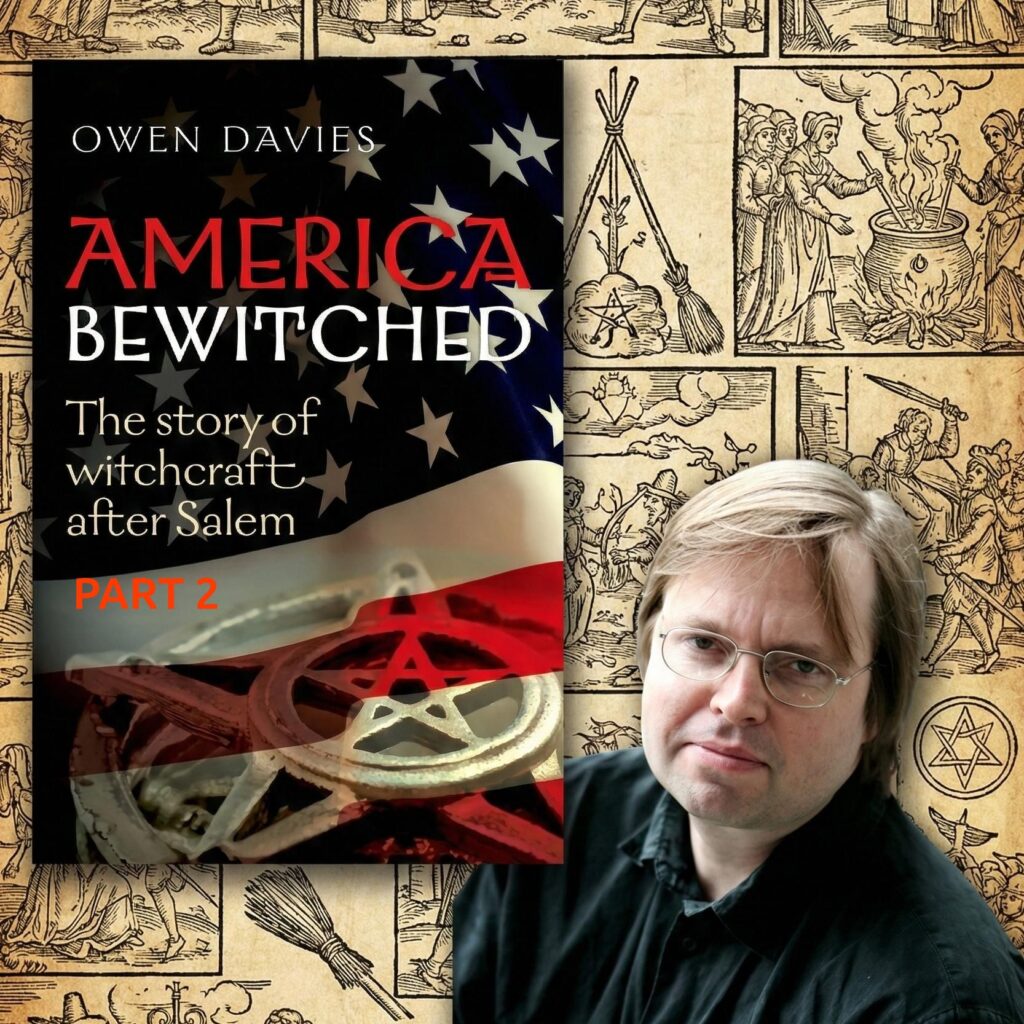
S05E18 – America Bewitched with Owen Davies (part 2)
In part two of our two-part interview with Owen Davies, we continue the discussion of witches and witch prosecutions with thoughtful considerations of the meaning of witch and how it can be an identity or an accusation. Be sure and catch both parts of this fascinating chat.
Some related viewing/reading:
A curious case of Black Magic in Norfolk
Blake’s article about the “PA Hex Hollow” murders (Skeptoid #996)
Books by Owen*:
Grimoires: A History of Magic Books
Popular Magic: Cunning-folk in English History
Magic: A Very Short Introduction
Folklore: A journey through the past and present (with Ceri Houlbrook)
The Oxford Illustrated History of Witchcraft and Magic
America Bewitched: The Story of Witchcraft After Salem
*We use Amazon affiliate links for books when available
SEO Transcript
This is not a fully accurate transcript, and was machine generated. It’s here for helping search engines find the episode but not intended to be a faithful transcript of the episode. (But it’s not AWFUL.) Some of the material in this transcript only exists in the Patreon/Premium edition of the show and was excised for the commercial version.
———————
Monster House presents…
This is the ad-supported version of Monster Talk.
We’re dependent upon the revenue from these ads and from the support of our patrons at patreon.com forward slash monster talk to continue making this show.
As a disclaimer, your hosts are unable to control what ads you will hear, and while we have done what we can to avoid ads that are divisive, the system that injects them sometimes ignores our preferences and always seems to ignore our efforts to not interrupt the conversational flow.
While we understand this can be disruptive, we’re trying our best.
Patreon remains the best way to enjoy commercial-free listening to our content.
Plus, you generally get extended coverage of the subject.
We’re working on other ways to consume our content as well, so please stay tuned.
Witches are a peculiar monster.
As monsters go, they’re close to unique in that in order to combat them, you eventually find yourself at a forked path.
The well-trodden path, bright and lit, leads to a comforting place where you can be 100% certain that all the problems ailing you will go away if you can just get rid of that pesky monster whose power is absolutely diabolic and evil.
The methods for getting rid of the monster vary, but they promise to bring closure even if they don’t restore what’s been lost.
The other path, it’s dark and crooked, and you can barely see where it’s heading.
And if you start to go down that path, every comfortable explanation will be ripped away, and you’ll come to question every belief in your life.
And at the end, instead of the monster, there’s just a humble table, sitting in a shadowy clearing, and upon it, a single object.
There is something poetically apt about that object on the table.
It’s an old technology, surrounded by folklore all its own.
Myths and legends about its use and meaning, the dangers it holds, the fascination, they fill volumes.
And given that we’re using it to fight witches, it’s especially apt because the best examples of this object require the metal silver.
The stories about the need for silver to combat witches are numerous and graphic, and the historic link between the metal and the undoing of witches is old and deep.
But this is no bullet or knife, and if you really want to defeat the witch forever, you’re going to have to pick it up and use it.
Together, we’re going to walk that more difficult path, and I’m going to ask you to pick up what’s on that table.
You may have already guessed what it is.
It’s actually quite unlike anything we’ve ever seen before.
A giant hairy creature, part ape, part man.
In Loch Ness, a 24 mile long bottomless lake in the highlands of Scotland.
It’s a creature known as the Loch Ness Monster.
Monster Talk.
Welcome to Monster Talk, the science show about monsters.
I’m Blake Smith.
And I’m Karen Stollznow.
Welcome to part two of our conversation with historian Owen Davies.
In part one, we talked about the persistent myth that witch hunts in America ended with the Salem trials.
In part two, we’re going to talk about the real dangers and real complexities of fighting witches.
Stories about horrific witch hunts still emerge from parts of Africa and often make their way into American and European tabloids.
Those stories bother me for several reasons.
First, they’re usually written in a way that implies witch hunts are something that only, and I’m air quoting here, primitive people have to deal with.
That’s an over there problem.
That’s a those people problem.
But that simply isn’t true.
And I don’t mean it’s not true because witches secretly exist in the so-called first world.
Forget that.
Forget colonialism for a moment.
Forget even the question of whether witchcraft is real.
Let’s just take an intellectual step back and look at the hidden premise of this kind of coverage.
that witches are not real, and that only ignorant or superstitious people would ever believe otherwise.
Now, for the record, I am a skeptic when it comes to witchcraft having literal magic power.
I don’t talk about that much, largely because I have many friends who practice Wicca, paganism, or other magical traditions, and I generally regard those practices as the way I do any religion.
But witch is a magic word.
It’s a word with the power to turn a person into a monster.
Now, there’s other words that work this way, like Nazi or pedophile.
But the difference is that there are real Nazis and there are real pedophiles.
And there are even real people who self-identify as witches who attempt to reclaim or rehabilitate the word after centuries of demonization.
But they’re not witches in the sense that matters here.
As Owen Davies points out in the interview, a witch, in the accusatory sense, is always an evil entity.
A witch is not a kindly, herb-burning, peace-and-love hippie feminist.
A witch is a monster, a source of misery, misfortune, and supernatural harm.
So when someone’s accused of being a witch, they’re being labeled as something other than human.
The term itself is dehumanizing.
It’s demonizing.
If you don’t grasp that fact, then the European witch trials require elaborate socioeconomic explanations.
Scholars propose mass hysteria, ergot poisoning, patriarchal repression, complex modern theories that attempt to rationalize what otherwise looks like an incomprehensible wave of violence against people who could not possibly have done the things they’re accused of.
But explaining misfortune as the result of a witch’s curse isn’t irrational if your worldview is supernatural.
In a cosmology where invisible agents actively work against a benevolent divine order, witches make sense.
And once witches make sense, the urge to fight them also makes sense.
The real danger with witches isn’t magic.
It’s accusation.
Any epistemology that allows witches to exist will eventually make room for destroying them.
That belief system is only irrational from the outside.
Asking someone who genuinely believes in the supernatural malice of witches to abandon that belief is far more difficult than you might imagine.
So let’s continue our conversation with Owen Davies, where we’ll take a deeper look at some of the aspects of the witch.
Monster Talk.
All right, we’re welcoming back Owen Davies to continue our conversation about witchcraft and following on his book, America Bewitched.
We talked about what witches are and the history of the post-Salem persecution and trials around witchcraft in America, which have not stopped.
And here, I want to talk more in part two about…
how witchcraft is so dependent.
on people’s beliefs and not necessarily the beliefs or behavior of the person accused.
It’s such a strange situation there.
But the whole word witch is so loaded with meaning and various meanings.
Karen, as our listeners will know, has written an entire book just about the word bitch, which rhymes.
And it’s like, I feel like a similar volume or maybe a collection of volumes could be written about the word witch.
It’s often a euphemism for bitch.
I’ve seen in a range of sources witch and bitch going together a lot.
Oh, yeah, like hand in hand.
Yeah, yeah, yeah.
So I had fallen into thinking about witchcraft in basically three ways.
People who self-identify as modern neo-pagan witches.
Witches of folklore, like your Baba Yaga type, old crone in the woods.
And then the third is the one I think about the most, which is the witch as accusation.
That not identity, but like it’s what you get accused of.
Like, I don’t know if in fact, I don’t remember reading about any maybe where the accused also identified as a witch.
Like it’s very unusual.
It’s something that is attacks.
It’s an attack.
Right.
So but I.
I saw a lot of parallels in your work and, and I, and I just wanted to see if you could talk a little bit about those, if those are the right categories.
Yeah.
With, with, with how that’s played out in your own research.
I have three categories, three categories of which, which, which I think works pretty, pretty neatly.
So the ones of the trials are called conflict, which is their, their accusations born of conflict, you know, within families, within neighbors, et cetera.
And the accusation derives from a conflict.
Those people might not have had a reputation as a witch at all.
It’s only when misfortune or conflict happens that suspicions arise that they are a witch.
So that’s a conflict witch.
That’s the basis of trials, the trials and accusations.
As you say, there’s also a folkloric witch.
who is stereotypical, and that does bleed into conflict, which people have stereotypical notions, but people can look like a witch, behave like a witch, in terms of being of a certain age, having…
certain physiognomy, being marginal in the community.
Weighing the same as a duck.
And often begging so that their poor marginal women live on.
And they existed.
These were women who existed, but they didn’t necessarily ever get accused.
They never end up being beaten up or anything.
They were kind of the village witch, folkloric witch.
They looked witchy.
They were witchy types.
And that, you know, and then of course that, you know, and there’s a fairy tale element to that and which is the witch in fairy tale.
So yeah, exactly.
They’ve got conflict witch, you’ve got the kind of the folkloric witch.
And then the category which people don’t think about much is the accidental witch.
And this is the smallest category, really, in terms of witch trials and stuff.
But they are there.
And accidental witch is when basically cunning folk are involved.
And there’s a divination ritual to identify who is the witch who’s been doing this to me.
You perform a ritual.
And the basis of most of these rituals is that it draws the suspect to reveal themselves.
So they come knocking at the door, et cetera.
And that is the witch.
They might have been your best friend up until that point.
You might have lived with them as good neighbours for 30 years.
But if you turn up at the wrong moment during that ritual, you become a witch.
And your life is turned upside down.
And some of these stories are just as sad as some of the conflict witch ones.
Because the person who’s accused can’t understand.
They’ve been in good repute.
They’re not folkloric witches.
They’re good citizens.
And all of a sudden, they’re accused of witchcraft.
by one person and that spreads around the village or community and then before you know it, you have to leave.
I’m curious about something that Blake touched upon where you mentioned the witch as an accusation, a title that’s thrust upon an unwilling recipient.
Have there been cases that you’ve come across of people who’ve been willing recipients in the sense of being accused of witchcraft and, well, hell yeah, I’m a witch and I…
turned him into a Newton and they’re fine to take that label and believe that they do have powers.
And I’m not talking about false confessions as such.
No, sort of.
Yes, sort of.
So when we’re talking particularly about those marginal women begging, often widowed, living by themselves, outcast types, unfortunately.
Now…
they still would never call themselves a witch.
That’s just too dangerous.
That is just too dangerous.
Right through, you know, people are being shot dead in the States in the 1950s, 60s and 70s just because you’re being called a witch.
You’re not going to call yourself that.
But they sometimes, sometimes would play upon the reputation they had.
So that’s a different matter.
You wouldn’t call yourself a witch, but you would behave, you would use it.
So if people are suspicious of you and you actually want to extract charity from people,
or don’t want to be bothered or pestered, then you might build upon that reputation.
There are some examples.
It’s not common.
It’s not common.
That’s an empowering thing in those cases.
Interesting.
Exactly.
It can be a bit empowering on a very small scale.
That actually struck me in the book.
I had not really considered the scenario of the beggar woman.
as witch because people don’t want they feel guilty about not paying her and you know and and she’s you know she’s somebody who you can be afraid of or or or not like coming around you know and just when some bad thing happens boom there’s your go-to right yeah so it’s like it’s like there’s a this sort of hidden motivation
uh you know i i don’t know it it’s just surprised me like just how someone’s own guilt for how someone else has to live leading to like this way to get out of that if they’re gone if it turns out that they’re evil you know that that’s that’s all to the betterment of your poor ego or whatever yeah i mean that was that was um famous keith thomas thesis 1971 religion decline imagine can he propose this was kind of the main reason for witchcraft accusations this guilt
this guilt and women.
And feminists, you know, a couple of decades later, quite rightly criticised this, saying, because Keith Thompson took about why there were women, other than through the idea that they were poor, elderly women, etc.
So that became quite prominent.
These were completely dismantled now, but there are cases.
The reason why he came to this was because there are cases in the early modern period, and there are cases in the 18th, 19th and 20th centuries.
You know, it’s…
It’s only when society itself changes and you don’t need…
This comes back to your point, Blake.
You know, if we come to a point where women have to go begging from their neighbours, you know, just to live, there’s a prime kind of key moment snapping where…
accusations might return you know i hope that’s not a hypothesis we have to see played out yeah hopefully so the rise of neo-pagan witchcraft uh has been very tied up with feminism and i didn’t really invite you on here to do a feminist chat but i was it just seems like women self-identifying as witches and feeling empowerment would trigger
misogynistic backlash, but I didn’t know if that’s a real thing that’s gone on or if that was, I was just curious about that.
Not so much.
I mean, out of Wicca and that milieu of the 50s and 60s, we see the rise of what’s called the goddess movement.
And so you have Wiccans who are worshipping not just a horned deity, but also a female deity, and that can be the earth goddess mother.
Then we get quite a distinct sort of idea that
you know, in the Neolithic in Europe, that they were basically goddess worshippers.
And that was actually put around by some eminent archaeologists.
So there was, at the time, there seemed to be a confirmation from academics, scholars, that there was an age of the goddess worship in Europe.
But out of that came then neo-pagan goddess worship, and that’s quite an interesting movement.
That’s quite strong in…
certainly in Britain today.
I don’t know so much how well it’s fared in America and Australia at the moment, but certainly there’s a part of it which is focused on Glastonbury.
There’s a Glastonbury goddess movement.
Now, again, these people don’t refer to them.
Some of them will probably refer to themselves as witches in a neo-pagan sense.
Some of them won’t.
It’s become much, much more plural in the world of non-Christian spiritual
worship where people can even be christians and still think about the idea of the earth as earth mother and worship that so it’s a that’s changed from the 50s and just as neopage witchcraft has changed
Well, that’s like Margaret Murray’s Witch Cult in Western Europe.
It’s so influential.
Yeah, yeah.
And I guess I’m supposing that Gardner probably took some of his ideas from it.
Oh, he did.
No, no, he read it and he communicated with it.
Yeah.
Oh, okay.
Well, there you go.
Yeah.
So that’s really taking a…
I think what’s a pretty thoroughly discredited idea of this survival of an ancient religion.
But giving it sort of, I guess, academic bracing before you roll it out, you know, as a new religion, that’s fascinating.
Yeah, very cunning.
Owen, you mentioned Christianity and…
witchcraft accusations seem very much associated with Christianity as a label rather than an identity.
But you also talk about witch hunters in Indigenous cultures.
So did you get a sense that fighting witches predates contact with Christianity?
The same type of figure exists.
I mean, that’s why studying witchcraft beliefs in America is so fascinating, because it is such a melting pot.
So you’ve got your indigenous American population, you’ve got African-American population from slavery, and then you’ve got dozens of different European countries, you’ve got Asians.
It’s a massive melting pot.
So what it shows is that different religions all share a similar idea in the same type of figure.
They might not call it a witch, but it’s normally something, you know, a name witches would relate to, to the kind of, you know, what is the old English term, witch, as well.
So, yes, I mean, witchcraft is elements of the idea of harmful, spiteful, envious women using harmful magic is near universal.
So it sounds like witchcraft or witch accusations are an emergent property of a community at some point of humans.
It seems like at some point you start to get you want to have an explanation for weird things that are happening.
And you’ve you’ve run out of little people in here, a giant.
And, you know, maybe it’s your neighbor, you know, I mean, so.
What Christianity does in the early modern period, which is tied to the witch trials and to witchcraft accusations globally in Christian societies, is the King James Bible translation and other translations from the Greek and Latin texts, whereby the term witch is essentially used.
the term witch, as in the Witch of Endor.
And I’ve written a whole article about the Witch of Endor and history and folklore a couple of years ago, tracing this.
So in the Bible, you’ve got the Witch of Endor.
She’s not called the Witch of Endor in the Bible.
She’s called the Woman of Endor.
And then you have various things like thou shalt not suffer a witch to live, for example.
So the term witch is used, although even at the time it was pointed out that that was a poor translation from the Greek.
And the Greek term for the woman of Endor was Pythoness, in other words, a prophet diviner.
It wasn’t…
Right, exactly.
It’s not a witch as understood.
And the label that was…
So at the same time, a label is being applied to these poor women accused of crimes they didn’t commit.
The Bible itself was used as a main defense that such people existed, even though that’s based on a mistranslation of the type of person that’s referred to in the Bible.
And the fascinating thing is, is by the 18th century, and again, American evangelicalism and British evangelicalism are key to this, is the preachers start referring to her as a witch.
So it’s not in the Bible at all.
And yet over and over again, you’ll get sermons talking about the witch of Endor.
And you get these Bible-thumping preachers describing her as this old hag, you know, and what a horrible, evil old woman she was.
The Bible doesn’t even describe what she looks like.
She’s just a woman.
And so when we talk about Christianity’s impact, it’s actually much more subtle than that.
It’s because it’s the ways in which the English version of the Bible, which is used by evangelicals in West Africa as defence of the continued persecution of witches today.
And I’ve been involved with a couple of organizations who are writing materials to try and circulate amongst evangelical mega pastors in West Africa, pleading with them to stop referring to this because it’s not in the Bible.
And it’s still being used and it’s being used by Christian preachers for their own cynical means.
which is leading to suffering.
So that’s not necessarily Christianity.
It’s a perversion of the sense of the Bible.
Do you have to have a sort of Manichean…
binary religious structure in your community to make this so dangerous?
Like, I could see, like, I’m wondering, because in places where they don’t have that kind of worldview, is the witch’s fate a little kinder?
I don’t know.
Or do people still go for the death?
No, because ultimately, religion endorses and supports these views, generally, one way or another, inadvertently or explicitly.
But actually, it all basically comes back down again to interpersonal relationships, misfortune, envy, spite.
You know, it’s a very simple but potent set of ingredients which can then be manipulated or can be then used or adopted for religious purposes or by state, by the state.
But ultimately, ultimately, it derives from interpersonal relationships.
human condition yeah yeah absolutely i mean i i’m always reluctant you know because i’m a bit of a critic of the old comparative anthropologists of 100 years ago and james fraser and stuff we just put everything in a multiple so look we can identify this here we can identify that there we can identify it in you know you know in in in australian aborigines and we find it in the polish peasant there you know but but there there are yeah you’re right there are there are you know fundamental human
responses emotions ideas um which are pretty much universal which is why again you know in america you can all essentially speak the same language you have 100 different languages but you’re all talking about the same sort of person yeah you know and uh you know i tried to do that in the book because i do you know i there’s a i do three case studies there and one is a a native american tamer case who basically goes and kills six people with a rifle
And that’s within that community.
And then I do one, which is about two German migrants and their family.
And another one, which is about going back to sort of more 18th century, well, Scottish, you know, ancestors, but all believing the same thing, all ending up in death.
I think it’s worth noting a lot of the cases, even if the person who did the witch killing had to face justice.
they were unapologetic and felt they had done the right thing.
Like this, this is no light thing.
This is a very serious epistemological conclusion that this was the right thing to do.
I got quite deep into one of the cases there.
It’s the one from 1920.
I just can’t remember his name.
There was a taxi driver in America.
And I traced him.
So he killed a woman who he thought was tormenting her in the shape of a cat.
And it got so bad that he went and shot her.
This was the 1930s.
he ended up being, like they all do, they all end up being, by the way, the witch that the American courts were, they all end up being declared insane rather than how could you possibly believe this?
When they’re not insane, they just believe in witchcraft.
It’s two different things.
Anyway, I managed to trace him right through the asylum system, right through until he got released, I think.
So this is the 1930s, and I traced him to an appeal in the early 1980s where he tried to get released.
And I’ve got the interview transcript of it.
And it’s extraordinary.
So after all these years, he’d shot this woman who was in his 20s.
He still was evading whether he said he regretted it.
He said he regretted it and wished it hadn’t happened.
But he still did not deny that she wasn’t a witch.
And he found all sorts of ways not to say that.
He still thought she was a witch.
How do you differentiate then between mental illness and belief?
That’s a really fun, I’ve written a whole book on that.
It’s a really tricky one.
And there’s a whole chapter on the courts and how they try and deal with it.
There is a chapter in The Miracle of a Witch on insanity as well.
But it is really, it’s an absolute hot potato for courts.
And particularly, particularly when spiritualism takes off.
So by the 1880s, 1890s in America, the American legal system is tying itself in knots about this issue.
So for example, there’ll be a witch killing.
So it goes to court.
And then the plea, obviously, by the defense is that my client was temporarily insane.
He was insane.
Why would anyone possibly kill someone because they’re a witch in this day and age?
So my client was clearly temporarily insane.
The client keeps quiet, still believes in witches.
and that they did the right thing um but then the the prosecution you know going uh complicating the issues as well because they’re saying hold on so are all spiritualists insane as well then you know
Because they believe that you can talk to ghosts, you can talk to the dead.
Are they insane?
And by that time, it’s so well established that no one’s going to say that everyone who’s a spirit is insane.
But then to say that somebody who believes in witches is insane just because they believe in them.
You see what I mean?
It gets more and more complicated.
It gets more and more complicated and hasn’t got, you know, really is still a hot potato.
today wow it’s it’s it’s fascinating what normally happens is they all end up being declared insane because essentially the courts judge jury don’t want to see someone executed for killing someone who executed a witch because rather like what i was saying about salem at the beginning that doesn’t it’s difficult to compute you know oh hold on we’re we’re saying that this person is guilty and really believed in which one of these people actually exist in america still
Must be mad.
There’s a kind of a defence mechanism, an unsaid defence mechanism and all this.
So let’s just shift them off to the same silence.
So hardly anyone ever gets executed for killing a witch.
It’s sobering.
It’s a sobering thought because this is touching people who are our grandparents.
Yeah.
Yeah, it’s recent.
Yeah, exactly.
This is not centuries ago.
This is happening in our own time that we know people.
Yeah.
It’s uncomfortable for a lot of people.
Are there other key ideas, pernicious myths about this period?
or this topic that you would like to see propagated, even if it’s futile.
This is a good audience to talk to because we’re one of those, we’re all the people who are well actually, you know, at the parties.
One of the ones which has been, which is both persistent and being renewed, particularly say by Sylvia Federici’s book, is the idea that witch trials are all about the taking of land from women.
You’ll see this over and over again.
So her thesis was the idea that a lot of the people accused were women who held land in a patriarchal, capitalistic society, and that it was a systematic campaign to remove land ownership from women, right?
So you accuse them of witchcraft, and under the laws, which is partially wrong again, their land is expropriated.
Boom.
So it’s capitalistic, and it’s patriarchal and misogynistic.
This is everywhere now.
If I went on Twitter, I refuse to call it X, I’m not really doing anything with it anymore anyway, but I used to do just a bit of a mischief and I would point out misnomers about the witch trials and this would be one.
I could guarantee you I’d immediately have people contesting it and they would say, you’re a man, you don’t know.
I’m sorry, no, I’m a historian and historians know.
And I can explain it.
The vast majority of women who are accused of witchcraft, whether it’s 500 years ago or 100 years ago, didn’t own land.
That’s because they lived in a patriarchal society where they didn’t often have opportunity to own land.
So you can’t explain it on that basis.
They would have to be all sort of wealthy landowning families that were being accused of witchcraft.
And there are a few examples.
And, of course, you can pick out four or five in your book and talk about those.
But that is not representative of the whole lot.
So that one is just so set in now.
It’s kind of the new version of they’ve moved away from necessarily being genocide and stuff.
But now it’s about procreation land.
It really steams people up.
So you just say, try and point out it’s wrong.
Well, the patriarchy is still to blame.
It’s not a matter of… Well, exactly.
It’s counterintuitive because essentially these poor women who are accused are not women who will be able to possess land because of the patriarchal society in which they live.
Exactly.
You know…
Still goes back to that, but yeah.
Sorry, that’s the latest one.
Anyway.
Yeah, I have heard of that, and I think, Blake, we’ve kind of touched upon that with cases like the Hungarian bathroom.
So I think that was a theory too, and there might be more credence to that than the claims of witches.
But I just wanted to ask you, Owen, this is, I guess, opening up a can of worms too, but I’ve heard a little bit I don’t know too much about.
about it at this point, but the Pendle Hill witch trials, and I believe that those predated the Salem witch trials.
Do you think that in any way those kind of spurred on the Salem witch trials that influenced what happened here in America?
No, not really.
No.
I mean, again, that’s a slight bugbear of mine because whenever there’s a documentary about witch trials in Britain, they always focus on the Lancashire witch trials of 1612, Pendle Hill ones, 1612.
It is a highly atypical trial, highly atypical case.
And yet, whenever the media pick up on Britain, you always get it.
mentioned as a priority, like the headline, are we going to talk about the Bendel witch trials?
And then there’s the small handful of us witchcrafters going, no, talk about something, another trial, talk about normal trials that the vast majority of people had an experience of and were involved in, not what essentially happened.
It’s a sensational case, and partly because the king gets involved in it.
You know, and there’s a, you know, the pamphlet is, you know, it happens in 1612, you know, King James VI had been on the throne for a few years.
He’d written a book about demonology when he was, you know, Scottish King 1597.
And so it’s highly unusual because he gets interested in the case.
And the reason why we know so much about it is a guy, one of the sort of officials, Lancaster jail, Thomas Potts, basically writes this big report, which is essentially a kind of report for the king personally, you know.
So this is really atypical.
And of course, there are fantastic stories that tell, you know, the extraordinary confessions that take place, which takes into the realms of witches flying and meeting and gathering and all these sorts of things, which are very much derived from fairy tales stories.
So it’s a fascinating case.
It’s a fascinating case.
But it’s highly, highly atypical.
And you could say the Salem trials are atypical in the scheme of things, of American trials as well.
And do you think at that point anyway that King James had kind of given up on those beliefs, or do you think he was still a proponent of all of these beliefs?
Yeah, no, he gets increasingly more sceptical.
So he starts out a believer because he thinks that his bride, the witch has tried to basically kill him and his bride, returning from Denmark, by causing a storm.
So he believes in that.
But slowly he starts turning and he gets more sceptical the more he looks at the evidential basis of it.
He never really truly expresses it in those terms because it’s a law.
You basically have to stop the law to say, hold on, these witch trials are absolute nonsense.
There’s no evidence.
Let’s, let’s, let’s.
Let’s call off the witch trials, you know.
So it’s nothing like that happens.
No, unfortunately.
Yeah, yeah.
He clearly becomes more sceptical about the nature of the evidence.
It doesn’t mean he doesn’t believe there are people called witches.
He’s just clearly sceptical about the legal evidence of proof.
So interesting.
Exactly.
So, you know, in the Lancashire Witch Trials, you’ve got, you know, a young girl telling all sorts of stories and saying, hold on, this is a 12-year-old girl or whatever.
That’s the sort of thing people start ringing more and more alarm bells.
Why are we accepting this evidence in court?
So that’s his position, really.
But then obviously the witch trials carry on.
Witch trials, again, are largely dead in Britain by 1620s.
And it’s only because of the Matthew Hopkins episode during the Civil War that it suddenly explodes again.
There were hardly any trials in the 1630s and 40s.
Again, whatever country you take, there’s really interesting chronologies of the ups and downs of this and where some countries decide.
In some of the German states, for example, they basically terminate them by early 17th century.
They’re done.
They’re finished.
Palatinate in Germany.
No more witch trials after like 1600.
A neighbouring state will carry on persecuting through to 1700.
Clearly, we’re going to have to bring you back on to delve more into these topics because it’s so complicated.
It’s complicated and fascinating, and it’s hard to find good experts who will take the time to come join us.
So I really appreciate it very, very much.
Thank you.
Now, it’s your first visit with us, so we have a signature question we like to ask first-time guests, which is, what, and this is a very unfair question, but it’s a habit now, so we can’t stop.
It’s a fun question.
What is your favorite monster?
Okay.
I’d call it more of a bogey, but I’m quite fond of Jenny Greenteeth, which is more of a bogey than a monster.
I only know her orthogonally from the story of the Scottish vampire that the kids go hunting in the 1950s.
Ginny with the Iron Teeth.
You’ve got Ginny with the Iron Teeth as well.
Tell us about the Green Teeth.
Ginny Green Teeth is regionally specific.
It’s around Cheshire and Lancashire, primarily.
And…
First start hearing her sort of late 90s.
Jenny Greenteeth lives under the water.
She’s a sort of hag-like female water ogre, bogey monster.
And obviously she has green teeth.
And ponds, I don’t know, duckweed.
Ponds get covered in duckweed, little green leaves.
They cover the whole pond.
That used to be called in parts of Liverpool Jenny Greenteeth.
So she gave a name to the plant as well.
So basically she lives in stagnant water.
And she basically, you know, if children get too close to the water, she’ll drag them in and eat them.
I’m not going to make a comment about British teeth.
The really interesting thing about Jenny Gray, she starts off as a rural sort of monster, but then populates post-industrial parts of Manchester and Liverpool.
So you’ll get old mill and pit buildings.
with a pit pool and you’ll find jenny creed teeth in there you know so you don’t want kids wandering around post-industrial coal mines and things so you say oh jenny green teeth inhabits the pool at the old mill there do not go near that pool because she’ll drag you in
So, yeah, Ginny Green Teeth.
She saves lives.
She saves lives, exactly.
That’s so interesting.
It just makes me think of Aboriginal legends.
They had similar ideas of when he drags you into the billboards, as they’re called, and, yeah, similar stories in the United States.
And so, again, it’s a universal, but it’s around.
It is.
I mean, that’s why we call them bogeys, really, because they’re bogey figures.
But, you know, bogeys can be in fairy tales.
You know, the giant’s going to meet you if you don’t go to bed early.
But this is what’s interesting about her.
And as you say, the other example you just mentioned, Karen, is that they’re out in the landscape.
You know, they’re actually meant to populate the environment rather than just being…
an abstract figure from fairy tales who will come and torment you if you don’t go to bed early.
That is fascinating.
We’ve never had that answer before.
It’s rare to not get an answer that we’ve heard before.
At this point, yeah, that’s true.
Owen, thank you so much for making time for the show and our audience.
Thank you.
Thanks a lot.
Monster Talk.
You’ve been listening to Monster Talk, the science show about monsters.
I’m Blake Smith.
And I’m Karen Stollznow.
You just heard part two of our conversation with historian Owen Davies.
Check our show notes for links to Owen’s many books covering the fascinating history of magic, witches, and how various groups have interacted with these ideas and concepts.
Monster Talk theme music is by Pete Stealing Monkeys.
As always, thank you for listening.
This has been a Monster House presentation.