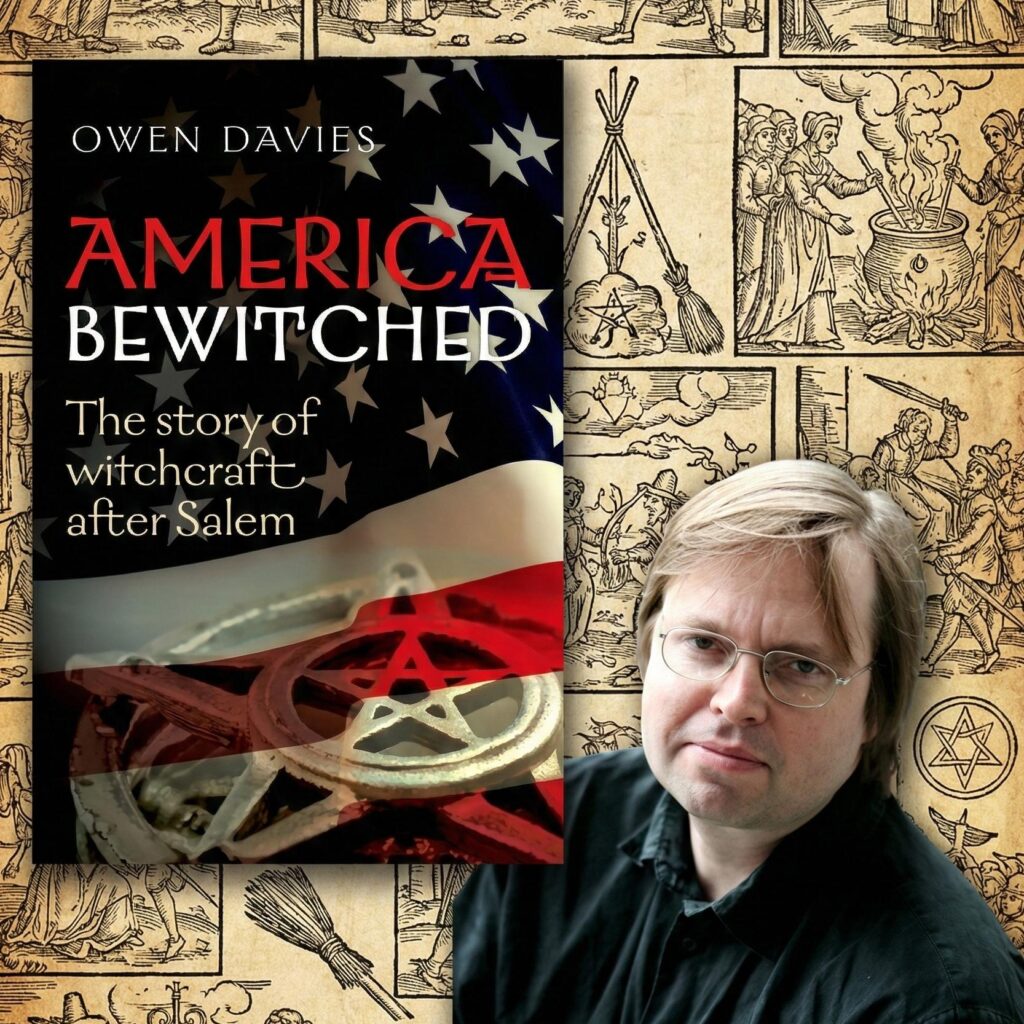
S05E17 – America Bewitched with Owen Davies (pt1)
In part one of our two-part interview with Owen Davies, we discuss the history of witch trials, accusations, murder, and other troubles bubbling up from post-Salem accusations in America. In part two, next week, we will continue the discussion with thoughtful considerations of the meaning of witch and how it can be an identity or an accusation. Be sure and catch both parts of this fascinating chat.
Some related viewing/reading:
A curious case of Black Magic in Norfolk
Blake’s article about the “PA Hex Hollow” murders (Skeptoid #996)
Books by Owen*:
Grimoires: A History of Magic Books
Popular Magic: Cunning-folk in English History
Magic: A Very Short Introduction
Folklore: A journey through the past and present (with Ceri Houlbrook)
The Oxford Illustrated History of Witchcraft and Magic
America Bewitched: The Story of Witchcraft After Salem
*We use Amazon affiliate links for books when available
SEO Transcript
This is not a fully accurate transcript, and was machine generated. It’s here for helping search engines find the episode but not intended to be a faithful transcript of the episode. (But it’s not AWFUL.) Some of the material in this transcript only exists in the Patreon/Premium edition of the show and was excised for the commercial version.
———————
Monster House presents.
This is the ad supported version of Monster Talk.
We’re dependent upon the revenue from these ads and from the support of our patrons at patreon.com forward slash monster talk to continue making this show.
As a disclaimer, your hosts are unable to control what ads you will hear.
And while we have done what we can to avoid ads that are divisive, the system that injects them sometimes ignores our preferences and always seems to ignore our efforts to not interrupt the conversational flow.
While we understand this can be disruptive, we’re trying our best.
Patreon remains the best way to enjoy commercial-free listening to our content.
Plus, you generally get extended coverage of the subject.
We’re working on other ways to consume our content as well, so please stay tuned.
It’s witchcraft.
I’ll say that right now.
You know, there are different factions of that.
West African-born couple have been found guilty of torturing and murdering a 15-year-old boy in a trial bedeviled by witchcraft possession and exorcism.
Nathan Miller is charged with capital murder.
He declined to appear in court.
Authorities say he believed the victims were practicing witchcraft.
It’s actually quite unlike anything we’ve ever seen before.
A giant hairy creature, part ape, part man.
In Loch Ness, a 24-mile-long bottomless lake in the highlands of Scotland, it’s a creature known as the Loch Ness Monster.
Monster Talk.
Welcome to Monster Talk, the science show about monsters.
I’m Blake Smith.
And I’m Karen Stollznow.
I’m so excited that we got to talk with Owen Davies.
His historical research into the history of witchcraft and magical practices have coincided with my abiding wish to better understand this complicated topic.
Witches are so many things to so many people, but there’s so much more to understanding this topic and its impact on history than the trite question of, is magic real?
One can be entirely skeptical of the existence of witches or even the efficacy or reality of magic and still be crushed in the gears of a witch hunt.
In part one of this two-part interview, we’ll be focusing on the content of Owen’s 2013 book, America Bewitched, which is a fascinating and elucidating look at how the United States handled witch accusations after Salem.
If you ever thought that after Salem, America probably realized the shameful miscarriage of justice and its regressive supernaturalism in witches, and moved on to an enlightened future where only the occasional hayseed or superstitious immigrant could possibly fall for such an idea, well, you could be really wrong.
The history of witch belief in America and the horrors unleashed with such accusations extends from Salem all the way up to probably earlier today in an unbroken line of hard feelings, recrimination, financial ruin, and sometimes even murder.
This week we will be looking at that history, and next week we’ll be stepping back just a little bit and looking at the broader persistence of witch belief around the world
Witches as a concept of fear, as a label, as a monster, as a liberating identity, and many other phases.
It turns out that the witch is a lot of things.
Today, we’re welcoming Owen Davies, and he is a British historian and leading academic authority on witchcraft, magic, and related popular beliefs in Europe.
He’s a professor of social history at the University of Hertfordshire, where his research focuses on how ordinary people used magic from cunning folks and grimoires to fortune-telling and folk healing, particularly from the early modern period through the 19th century.
His recent work includes The Illustrated History Art of the Grimoire from 2023, which looks beautiful.
I really need to get that.
And Folklore, A Journey Through the Past and Present from 2025, which he co-authored with Kerry Holbrook.
Currently, he’s the co-lead on the National Folklore Survey for England.
which is a major project launching to capture a snapshot of contemporary beliefs and traditions.
And I also heard that he served as the president of the Folklore Society before being replaced by a hook-handed stranger with a kidney missing and a wig full of spiders.
Is that fairly accurate?
Very accurate, yeah.
We’re here today to talk about witches and specifically about your book, America Bewitched, from 2013.
But talking about witches is so complicated.
We’ve struggled with it here on this show because it seems like a witch is…
a label that can be put on you by someone else, but it might also be a set of beliefs or an identity.
But you’re the expert.
How do you define what a witch is?
Yeah, I mean, you’re spot on.
I mean, the 20th century confused these things a lot because of the rise of witchcraft as a religion where people self-identify as witches or Wiccans or whatever.
But obviously, and I do work and write on that sort of phase in the mid-20th century almost, but…
for me you know the historical definition of a witch is a witch is a malign person it’s a malign person who uses magic um um to cause harm that’s pretty much simple that’s the simple definition that’s that definition works going right back into antiquity in different cultures and civilizations these are these are people who are motivated by spite and envy and use magic in harmful ways
Can I quickly follow up with that?
That actually struck me pretty hard while reading the book because I typically think of witches in these sort of categories, but I don’t typically think of witches as an explanation for a mystery.
And that’s what they often are, it seems like, that someone is having bad luck in particular or some health issues, whatever, and they’re looking for a cause.
And I had never thought about witches as being similar to…
the fair folk as is because by, you know, elves or goblins or whatever for, for the malady, you know, the cow milk comes out curdled, you know, that’s could be the fair folk, but could be a witch could be a bacteria, but they don’t know about that yet.
Yeah.
I mean, witchcraft essentially is an explanation.
It’s an explanation of something which is otherwise inexplicable within the culture in terms of knowledge or ideas and religion, et cetera, et cetera, of any culture.
The point is, it’s an explanation, but it’s an explanation that then leads to a possible remedy because you’ve got someone to blame.
And if you’ve got someone identifiable, then you can go and do something to the person who thinks caused it, and that will make you feel better.
So it’s that kind of very simple thing of, as you say, it works over and over, particularly with ill health.
I’m ill. Maybe someone’s got internal cancer.
It’s not visible or whatever.
And it goes on and on, and they spend all their money on a doctor.
It’s still not cured, and the doctor says it’s this and it’s that, but it doesn’t explain anything.
And you think, well, maybe it’s someone.
Maybe it’s a witch.
Escape ghost.
Yeah, exactly.
But the point is that once you’ve identified someone, then you can either cause them harm magically or physically go and assault them or kill them.
And that will make you feel better.
And fundamentally, that’s it.
And it’s worse.
Obviously, there’s a lot of witchcraft accusations which never go anywhere.
They just end up festering for years, decades.
But in the extremes, as in the book, when you’ve got dozens of people being murdered in America, that’s normally the trajectory.
With your book, America Bewitched, you primarily focus on cases of witchcraft in the post-Salem world.
And so…
following the time of those trials.
So were you surprised to find out how often a lot of these, a lot of other tragic witch encounters ended up in courts or in the mall long after the 1600s?
I mean, I’ve been working on continuation of witchcraft beliefs in Britain and also in France for years.
And, you know, quite a lot of my sources, two main sources, have been folklore collected in the early part of the…
20th century, late 19th century, and also newspapers and newspapers reporting court cases.
And having done massive amounts of systematic newspaper research in the days before digitization.
This is sitting with real newspapers.
The good old days.
Or with microfilm, one or the other.
And anyway.
you know, having done so much of that and British newspapers and French newspapers would report on American cases just as American newspapers report on European cases, you know, as a tidbits of, you know, tidbits of…
titillating, you know, news, superstition strikes again type headlines, you know, France, France, but which, blah, blah, blah.
So I knew there was a lot of material to be found in America.
And obviously the folklore sources bore that out because there were plenty of folklorists in the early 20th century who were picking up continued belief in witchcraft.
So I wanted to try and give it a history because it’s a kind of…
a kind of a frustration with the preoccupation with Salem, one trial, you know, in America.
Salem just dominates everything, even though obviously there were other witch trials at the time in America.
But also what was potentially this huge body of material about continued witchcraft belief and, you know, the headline fact that more people, you know, were killed as witches passed after Salem than were actually executed during the witch trials in America.
And surely that’s an important story for understanding the development of American culture and society.
And there’s a kind of sense to which the focus on Salem is, I think, almost nationally subconscious because it’s the idea that it finished, it stopped.
This is the beginning of the American Enlightenment.
For listeners, I’m nodding vigorously in agreement with it.
Yeah, yeah.
That’s right, exactly.
So it’s very comforting.
Let’s study Salem.
That would be the old days when these strange beliefs were held and tragedy and people accused things.
We can study it with dispassion and step back from it all.
How did that happen?
We’re at the same time, you know.
Why do you think that there is just such a focus on that period?
Do you think it’s got something even to do with Arthur Miller and the crucible?
Yeah, well, that’s part of it, I think.
I think that part of it because that was such a powerful,
piece of literature, mid-20th century literature.
You’re talking about Daniel Day-Lewis and Winona Ryder, right?
I just want to make sure we’re…
I saw the right documentary.
Yeah, that cemented it.
So people, you know, it drew those relationships between, you know…
anti-communism.
But I mean, it continued.
You can see in the American educated history books right from the 19th century right through the 20th century playing with similar ideas about whether it’s the power or the evil power of religion to pervert people’s attitude to each other, etc.
But yeah, it’s just…
It’s just, I think, I mean, I’m not saying, I’m not singling out America for this because, you know, the sort of work I’ve been doing on Britain and France, very few people have been doing any, you know, there’s very few of us doing this sort of stuff because, you know, I know it from my students.
Over 30 years, I might say to a student, why don’t you do your dissertation on 19th century?
There’s loads of material out there.
It’s like, no, no, no, it’s got to be early modern.
It’s got to be the witch trials.
So it’s not just an American thing, but it’s a societal thing whereby…
Witchcraft is still associated with early modern, and that’s what serious history is about.
I’m not sure this is just my imagination or not, but the idea that because there was less technology in that period of time, it was a simpler time, so it’s easier to understand what was going on because there’s a smaller set of attitudes and stuff going on.
But I think that’s nonsense, but I think it’s a popular idea when you’re approaching these things.
It is.
And of course, what studying witchcraft belief in 19th and 20th century America shows is also the extraordinary multiculturalism of America, particularly in the 19th century, when millions are pouring into the country, the Europeans are pouring into the country, and not just Europeans, but mostly Europeans, and they’re all bringing their beliefs with them.
And one of the fascinating things about it is the ways in which different communities from different backgrounds have a shared set of ideas.
And those include indigenous, you know, the indigenous nations and their beliefs in witchcraft as well.
That these people from all over the place actually have these, you know, common belief in the witch figure.
And then you get these sort of fertilization of the different types of anti-witchcraft charms and traditions between different cultures, African-American,
indigenous american european you know they will draw upon them it becomes a pool pooling of cultural knowledge and that to me is absolutely fascinating it’s a fascinating thing of cultural uh exchange i i’m curious about when back to the research approach
When you are primarily using the historical documentation around court cases and newspaper articles, there’s like a built-in sensationalism.
And I think I know the answer to this question just on the way you’ve created the definition for which.
is would we know if there were any positive witches or any you know there’s something something equated to you know cunning folk but i guess the answer i’m already sort of answering my own question based on the definition it can’t be a good witch because witches are bad that’s that’s like definitionally true but i am curious about i guess still where do you go for any
non-sensational witch information.
It’s really difficult, it seems like, from a research perspective.
Any positive attitudes toward this at all would be undocumented, probably.
Yeah, there are no positives because you say we’ll talk about cunning folk.
I mean, there is a term that floats around for five centuries called white witch.
Funny enough, I was just reading a recent paper on Indian
folk magic, which was saying that I had made the term white witch popular, and I hardly ever use white witch, so I’m not sure what that’s coming from.
Anyway, the reason why I don’t use white witch much, even though it’s been used for five centuries, is it was originally an educated term, which basically white witch were those who were seemingly good, i.e.
cunning folk, but in fact were in a pact with the devil.
So they’re white witches, but that’s just a mask, a masquerade.
And the term white witch is hardly used at all in British and American folk culture, folk language, because of that.
I mean, what would be a white witch?
I mean, you do get it used, but that’s kind of a bleeding in, I think, of literary sources that takes place at some point.
This wasn’t in conjunction with us prepping to talk to you, but I’d just come across on YouTube a video.
It was an old BBC clip.
dating back to 1964, and it was a little video called A Curious Case of Black Magic in Norfolk.
Did you end up watching that, Blake?
I did.
And so I don’t know, I don’t think there were well-known reporters or anything that I can recall, but it was interesting.
They were talking about this, all of these voodoo dolls that had been pinned to… Puppets, yeah.
Puppets, yeah, had been pinned to the doors of this old church and just all of these other signs of people practising, you know, just…
various religions related to witchcraft and voodoo and Santeria and things like that.
So that’s clear evidence that…
even in the 20th century with computers and going to the moon, all of these things, it just has not stopped a fear of witchcraft or people practicing it in whatever ways they choose to.
But can you tell us a bit more about the public rise of people like self-identifying Satanists and satanic panic and how that shows the kind of duality of witches in America and, I guess, everywhere?
Yeah, I mean, it’s…
It’s a primarily kind of modern Western thing, you know, religious tradition.
And obviously, you know, the first sort of staging post of it is Wicca.
And Gerald Gardner, who founds it, is a retarded British colonial civil servant who…
Basically, he’s dabbling in Freemasonry.
He’s interested in Golden Dawn, middle class, magical occultism of the early 20th century.
He’s a nudist.
Freemasonry, free love.
He comes from a very straight-laced sort of background.
He was kind of counterculture before counterculture.
It arrived a decade later, really.
But anyway, you know, so he basically invents this.
Ronald Hutton’s written a brilliant book on it, you know, tracing where it all comes from.
It’s all invented, but that’s, you know, all religions are invented.
So, you know, they all have a foundation story.
So he created the foundation story about the coven that he was initiated in.
They had carried on centuries of church persecution, blah, blah, blah.
You know, every religion has these sorts of background stories to how they inform.
Anyway.
But, you know, as with, I’m not going to call Witton’s cult, but as with really religious grouping or modern cult, they all end up splitting and splintering into different other forms of groups with different leaders and government leaders.
So, you know, by the 1970s, you’ve got this, you’ve got a variety of different ways in which people are thinking themselves as witches.
And as you say, you’ve also got the rise of Satanism, although that’s more panic than reality.
There are still people, there are still people in the 1970s.
Anton LaVey’s, you know, that’s a very distinct contemporary sort of type of religion.
Arch, sorry, Arch.
He’s not a real Satanist, you know.
Yeah, it’s like punk.
It’s like, it’s performative.
Cult of personality.
Yeah, yeah.
Exactly, exactly.
So his version of Satanism is not actually about devil worship.
But of course, it gets, everything gets, particularly American evangelicalism, you know.
This is where things develop somewhat differently in the States and in Britain, more in Australia, is the ways in which the evangelical community in America reacted to this.
So you’ve got satanic panics and stuff, and the ways in which then witchcraft gets drawn into the idea of satanic worship, particularly.
Happens in Britain, but it’s the strong evangelicalism of America that turns perceptions into a different way.
I mean, obviously today, I mean, I’ve…
The internet is full of, you know, Christian nationalist Republicans talking about witchcraft still being a problem.
You know, that continues.
I live in the South.
Yeah, well, sorry.
It’s real as anything.
It’s real.
Exactly.
It’s airy and it’s real.
I don’t mean witchcraft.
I mean this inflated fear of a made-up version.
Yeah, yeah.
Exactly.
And, you know, that’s kind of a continuation of what we’re talking about with witchcraft down the centuries, you know.
I’m in Denver, Colorado, and we have botanicas everywhere.
So, Blake, I don’t know if you’ve got any out your way.
No, no, no, no.
What is it?
A botanica.
So it’s kind of like a Hispanic, I guess, apothecary, and you can go there and you can buy.
Oh, okay, like herbal medicine.
Okay, yeah.
Yeah, so definitely folk medicine, but you can also buy candles.
Especially Santeria candles, yeah.
Yeah, yeah, and all kinds of, I guess, oils and things and just various spells and rituals if someone’s exacted something against you or if you want to do a ceremony against someone yourself for legal cases and all kinds of things.
But they’re, yeah, still around.
So, yeah, definitely not necessarily the same thing that people are being accused of doing, though.
No, but again, botanicals are classic resources for a whole range of medical, magical practices and purposes.
Exactly.
And it’s not just the Hispanic community who goes to them.
It’s those of European extraction who are engaged in various forms of occult or spiritual activities as well.
It’s like me.
I like those places.
They’re interesting.
Oh, yeah, and they smell great.
They do.
If they occasionally have a taqueria attached, I’m also interested in that.
We don’t have, yeah, there might be one or two in London like that, but it’s not a thing.
It’s not a thing.
We don’t have this.
size of Hispanic population that have set up and brought that culture with them.
I don’t want to lose track of this follow-up, but when we were talking about the rise of modern Satanists, I was surprised several times while reading your book, things, because, you know, I, I feel pretty well read on the topic, but you know, it’s always exciting to get new, new data, you know?
So, but you mentioned, and I had not had a chance to follow up on this myself, that the,
The numbers of witches who were actually killed during what’s commonly called the burning times is like has a mythical over inflation.
And that was surprising to me because.
I have often heard it described as a misogynistic holocaust.
I don’t want to diminish the significance of the loss of life, but I am curious about the diminishment of the actual numbers.
What do the real numbers look like versus the…
I’ll tell you what, this is…
I’ve given hundreds of talks on witch trials and I’ve taught it.
I stopped teaching it years ago because it got to a point, I think, where myself and other witchcraft historians around 2005, we thought, actually, I think we’re getting through to the public on this whole, you know, all the misnomers, including numbers about witch trials, you know.
And then the internet happened and social media happened and it just, all the misinformation about witch trials just flooded.
And it’s almost impossible to counter it now.
It’s just so much out there.
And then you get books like Federici’s One, which is based, she’s a political scientist, who’s a feminist political scientist, who then has, you know, is a really popular book.
But it’s full of rubbish, full of rubbish about the waste trials.
Anyway, so the actual numbers, if we took Europe, for example, I mean, the American numbers are pretty tight because the trials are limited.
There’s very unlikely to have been any trials that we don’t know about that weren’t recorded.
So those numbers are accurate.
The European numbers, which is where you see the figure of millions, as you say, the second wave feminism, we’re labelling it gynocide and things like that.
This was a holocaust of women, as you’re saying.
And that was based on complete false numbers.
I mean, it’s still terrible numbers, but they’re not millions.
I mean, that figure comes around fairly early on, so late 19th century, that figure.
So these sort of figures start getting bandied around, you know, the millions.
But the actual, if we try and extrapolate from actual sources of knowledge, we’re probably looking at around 40,000 to 50,000 executions, put it that way.
And then obviously trials, if we think about the fact that overall, you know, number of trials, say in Britain, for example, 75% of those brought to trial were not executed.
So the number that’s executed, you can then multiply, you know, a number of times to get to a figure of how many trials there were and how many people were tried.
But again, so 40,000, 50,000 executions, hundreds of thousands of trials, and that’s terrible.
These people are, this is terrible.
These people did not, by and large, did not commit anything.
There are people, some of them, so few of them were conducting harmful magic, but normally harmful magic against witches, you know.
So it’s a tragedy.
But let’s not over-inflate it, you know, because that just leads down further misinformation and misunderstanding.
And it’s still strong because second wave feminism picked up on this in the 70s and promoted this idea of mass, almost like a holocaust of women.
It was not helpful for public understanding of what the actual history is.
Well, yeah, I think that there are still enough concerns for feminists just within the figures, the factual figures that you’ve spoken about and just the internalised misogyny too and women reporting against women.
So I think there’s enough there too.
Yeah.
Yeah.
No, absolutely.
I mean, we are, you know, feminist history brought some really interesting perspectives and certainly some of the latest from 1980s and 90s, which actually historians who work on trial material rather than, you know, reading a few select books on the subject has really brought, you know, some really interesting insights into patriarchal societies and misogyny.
Yeah, for sure.
As drivers.
But it’s a very complex thing.
Again, you know, there’s a whole range of reasons why
women were accused uh and obviously underpinning its patriarchy but there’s all sorts of things to do with everyday society culture neighbors um some some of that is also about patriarchy some of it’s not you know some of it is about in just um you know um the ways in which people interact neighbors interact women or women young women see each other etc etc in different cultures
I was doing some research for something I’m working on and was coming across a lot of cases in the courts about kind of regarding sumptuary laws and women accusing other women of being witches because they were wearing finery that they shouldn’t be wearing.
It was rivalry for people who had more money and gossip and all kinds of personal factors that were coming into it.
And that was just, I think, an easy go-to to…
to blame and to victim blame.
Yeah, well, I mean, I place a lot of emphasis on what might call the spatial environment witchcraft accusations, whereby, you know, you’ve got a lot of women accusing other women in the material I looked at for America for Witches as well.
It’s just the same.
It plays out exactly the same as in France and Britain.
Because in the nature structure of society then, when misfortune happens in the home, whether it’s to do with children or butter making or dairying or whatever it happens to be,
Who were the other people around at that time?
It’s most likely other women.
So if you’re looking for explanations as to why something just happened, you know, why did my butter fail?
Why did my beer fail?
You know, why did my child stick her foot in the fire or whatever happens to me?
oh, so-and-so, didn’t she just come round knocking on the door, blah, blah, blah.
And that’s most, you know, so that’s just another one, another reason.
Literally, I don’t like the way she looked at me.
Yeah, yeah, well, exactly.
Yeah, yeah.
Because I see, I often tell students this, I think you’ve got to get into a mindset of the time where people constantly try to work out why things happened when they did.
And I give them an example of a today where we don’t think like that.
So I say to them, you know, if you break down in your car,
is your immediate thought, hold on, why did I break down just now at 12.01?
Why did I break down at this particular spot?
Right?
And you start looking around you.
You know, you go, oh, I’ve broken down, call the A, get on your mobile phone, call the A.
You don’t think about the where’s and why’s of these things.
But if your cart, you know, cartwheel falls off, it’s a natural thought to go, hold on, why did it fall off there?
Why did it fall off now?
Who’s there I just passed?
You know, what’s the nearest house?
You know, those are just perfectly normal ways of thinking about it, and we don’t think like that anymore.
So, you know, you’re trying to understand these, whether it’s in the early modern period or even mid-20th century America, why these accusations happen.
It’s because they’re thinking in different ways about… Yeah, it’s an epistemology, right?
Yeah, yeah, yeah.
That’s the right word for it, yeah.
Doing the best that they can with the information they have.
Yeah, exactly.
Yeah.
Yeah, yeah, yeah.
So we’re going to do a halftime break here.
There’s not really a break.
I’m just going to cut some parts.
I wanted to have one final question for this section, which is, given…
your insight and understanding of the past, I’m not saying make a prediction, but just like, what’s your gut feeling about where things are headed specifically with which accusations in, in, in the 21st century?
Well, obviously there’s still happening in parts of the world today, um, in different cultures.
So it’s still a major problem.
And obviously there’s, there’s real problems with child witches.
It’s recognized by United Nations.
Um,
Women in particular, again, are being killed in India and parts of Africa in what are basically classic witchcraft accusation type scenarios, community mobs, etc.
So that’s one side that still carries on.
And again, that’s nothing to do with those countries being backward or anything else.
It’s about the nature of the culture.
It’s not about education or any of those things.
Ergo, therefore, I could see it perfectly likely that witch accusations could return to Europe, the West, America, as they obviously are in evangelical circles.
So, you know, I don’t think humans progress.
You know, we can get more and more educated and have amazing science and everything else.
It doesn’t mean we think…
Lots of people don’t think in those terms.
And I think, you know, with environmental collapse, societal collapse, I think it’s perfectly likely that we’d see a resurgence of people accusing others of witchcraft in traditional forms.
Yeah, I don’t see… We haven’t moved beyond the idea of this, and we still have all the same instincts.
As I say, it’s what triggers people to think…
in the ways I’ve just been talking about, in witchcraft ways.
And that’s about a fundamental change, degradation of the sorts of lifestyles we have.
Sadly, I have to concur.
And for our listeners, we’ll continue this conversation next week.
Stay tuned.
Monster Talk.
You’ve been listening to Monster Talk, the science show about monsters.
I’m Blake Smith.
And I’m Karen Stollznow.
You just heard part one of our two-part interview with historian Owen Davies discussing his book, America Bewitched.
I’ll put links to a bunch of Owen’s work in the show notes, and you should grab some of his books.
He’s a great writer, a great researcher, and has done serious and underappreciated work trying to demystify the complicated and legitimately dangerous topic of witchcraft.
Monster Talks theme music is by Peach Stealing Monkeys.
If you’re continuing to enjoy this show, please consider leaving us a five-star review.
It only takes a few minutes, but it has a real impact on helping people find this show.
this has been a monster house presentation what’s that like to live deliciously yes