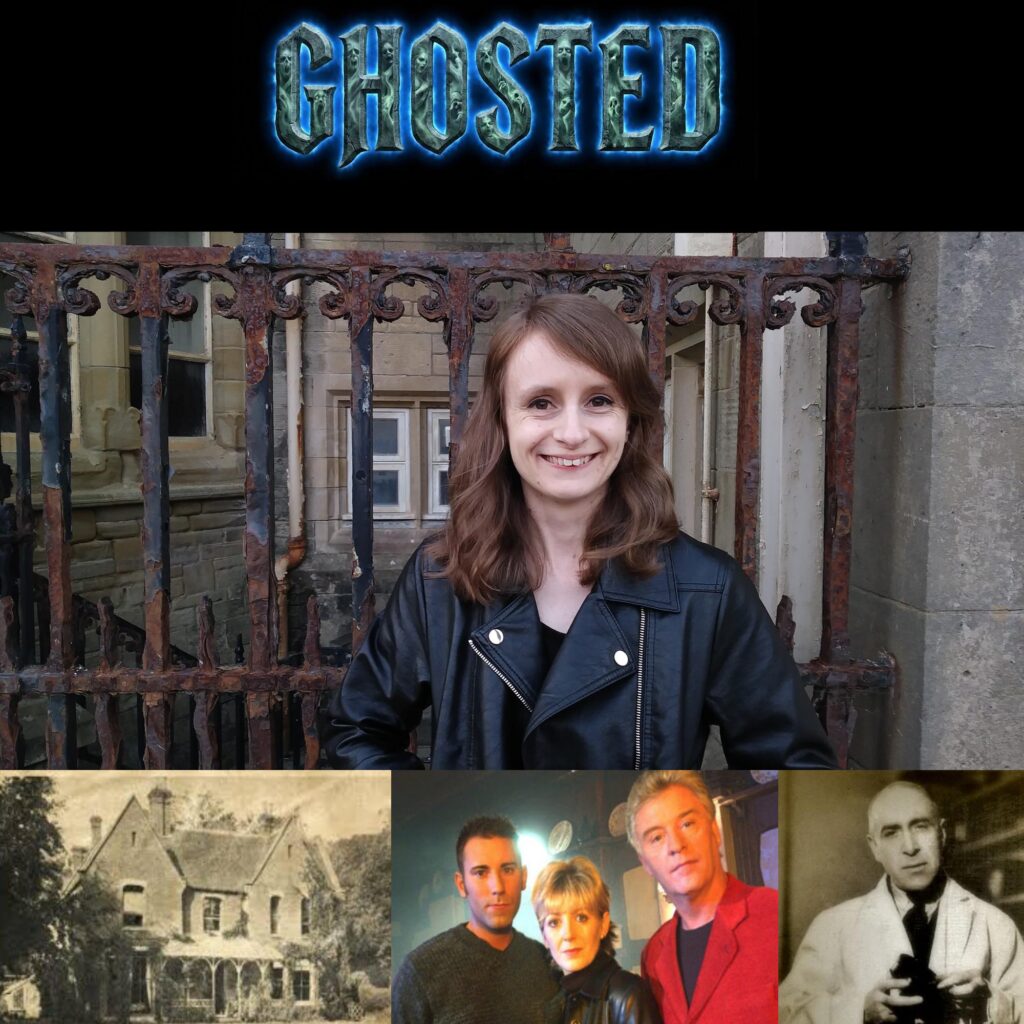
S05E15 Ghosted with Alice Vernon
In this episode we talk with Dr. Alice Vernon about her fascinating look at the history of ghost hunting and psychical research, from the late 19th century to today.
Ghosted: A History of Ghost Hunting, and Why We Keep Looking (Affiliate Link)
Night Terrors: Troubled Sleep and the Stories we Tell About It
Ghostwatch (wikipedia) – (our previous coverage)
The Society for Psychical Research (UK)
The Haunting of Borley Rectory – the text of this critical book appears to be on the Harry Price website.
SEO Transcript
This is not a fully accurate transcript, and was machine generated. It’s here for helping search engines find the episode but not intended to be a faithful transcript of the episode. (But it’s not AWFUL.) Some of the material in this transcript only exists in the Patreon/Premium edition of the show and was excised for the commercial version.
———————
Monster House presents…
This is the ad-supported version of Monster Talk.
We’re dependent upon the revenue from these ads and from the support of our patrons at patreon.com forward slash monster talk to continue making this show.
As a disclaimer, your hosts are unable to control what ads you will hear, and while we have done what we can to avoid ads that are divisive, the system that injects them sometimes ignores our preferences and always seems to ignore our efforts to not interrupt the conversational flow.
While we understand this can be disruptive, we’re trying our best.
Patreon remains the best way to enjoy commercial-free listening to our content.
Plus, you generally get extended coverage of the subject.
We’re working on other ways to consume our content as well, so please stay tuned.
It’s actually quite unlike anything we’ve ever seen before.
A giant hairy creature.
Part ape, part mass.
In Loch Ness, a 24-mile-long bottomless lake in the highlands of Scotland, it’s a creature known as the Loch Ness Monster.
Welcome to Monster Talk, the science show about monsters.
I’m Blake Smith.
And I’m Karen Stolznow.
Alice Vernon’s book, Ghosted, came highly recommended to me late last year through a strange, posthumous connection with Joe Nickel.
That’s to do with some private matters, but because of the way the suggestion came to me, it felt a little bit like Joe himself had a hand in it.
I mean, he didn’t, of course, but I think he would have enjoyed this book very much.
I’ve read quite a lot about this subject, so sometimes I feel a little bit of trepidation when we’re taking up a volume that’s certainly going to cover stuff we already know, but I was delighted with Ghosted.
While the menu was familiar, the recipe was new, and Alice’s prose made the whole meal taste fresh and fulfilling.
You can find a link to her work in the show notes, but let’s waste no more time and just join Alice Vernon for some Monster Talk.
Today, we’re talking with Dr. Alice Vernon, author of Ghosted, A Social History of Ghost Hunting and Why We Keep Looking.
Alice is a British academic author and lecturer specializing in creative writing, 19th century literature, and cultural history.
She’s based at Bristol University, where she teaches creative writing and English and supervises research in areas including horror fiction and narrative practice.
Her research work bridges storytelling, history of medicine, sleep disorders, hallucination, and parapsychology, reflecting a deep interest in how humans narrate strange or liminal experiences, all of which is of interest to our listeners as well.
Oh, yes.
And us.
So you hold a PhD and you have published academic essays on topics such as gothic literature, another topic near and dear to me and us, and the psychological dimensions of storytelling.
And you had a book called Night Terrors, Troubled Sleep and the Stories We Tell About It, which was featured on BBC’s Book of the Week, which is awesome.
This show has been heavily influenced by sleep paralysis.
Blake especially.
I had a very intense haunting, I’m air quoting for the listeners, haunting experience, which was really troubling for a long time until I learned about sleep paralysis and really explained away a good chunk of the mysterious parts of it.
It really shaped you.
But it did.
And today we’re here to talk about your 2025 book, Ghosted.
So welcome to Monster Talk, Alice Vernon.
Thank you.
Thanks for having me.
So while this book is absolutely within topics that you’ve worked on academically, we still like to ask people what made you decide to tackle a book?
Because that’s no small thing, right?
So what was it about ghost hunting that drove you to actually…
Go for the book as the outcome, right?
Well, yeah, I suppose the really boring answer is that it’s part of my job to write books in academia.
But that’s not a very exciting answer.
A better answer is that I think Ghosted really came from my first book, Night Terrors, because I have all of the…
All of the sleep disorders, all at the same time.
It’s wild.
I have some really wild nights.
And I wrote Night Terrors to, I guess, understand that part of my life and kind of intentionally demystify some of it.
Because I used to feel like I was insane and that there was something wrong with me.
And once I started to actually do some research into things like sleep paralysis and hallucinations…
I realized just how common it was.
And so I wrote this book.
And of course, when you start to research things like sleep paralysis and nighttime hallucinations, you realize how similar they are to ghost stories and anecdotes of experiencing ghosts.
And that kind of led me down.
roots of looking at ghost stories and analyzing them from the idea of oh well it could just be sleep paralysis or that kind of thing and i started to look at ghost hunting societies like the society for psychical research and looking at some of the research that they did because they actually did some really groundbreaking research into sleep disorders because they wanted to be able to use them to explain away some ghost stories and anecdotes that they wanted to kind of you know
discount and dismiss so some of their research is really groundbreaking in the late 19th century and so i was thinking about um i guess the follow-up to night terrors and i’d been so interested in things like the society for psychical research and i’d grown up watching reality tv um ghost hunting shows in britain it was most haunted but in america it’s it’s you know ghost adventures and that kind of thing
So ghost hunting has been kind of something that I’ve been interested in.
And it just seemed like a natural progression from Night Terrors because that really looked at ghosts and ghostly experiences as just sleep disorders.
And so I wanted to look at a different side of it of, you know, could any of this actually be real and not actually be a sleep disorder?
So, yeah, that’s where Ghosted came from.
I wanted to say the sleep paralysis stuff is…
so fundamental to understanding so many ghost stories yet.
despite the fact that science is starting to get a kind of a handle on it, a lot of people just don’t know anything about it.
Like it’s, they suffer quietly because they think they’re being haunted or they’re being demon oppressed or any number of explanations.
But knowing that there’s a scientific explanation for those experiences, has that alleviated any of your own suffering through the sleep troubles?
Yeah.
Well, funnily enough, when I was writing Night Terrors, I actually made it all a lot worse because I was focusing on it more.
This is detrimental to my health, but I pressed on regardless.
But it’s interesting because I had so many emails and comments and messages from people who’d read Night Terrors or heard it when it was on BBC Radio 4’s Book of the Week being like, I have this and I didn’t realise it was a thing.
And so it helped a lot of people to…
I guess, to realise that they weren’t alone and that it wasn’t necessarily a ghost and also to give them a way of describing it and kind of explaining to people.
Because I found that that was something that people were saying to me was that they didn’t know how to explain it.
to their partner to their family to their friends whatever without sounding insane um but I had you know written it in a way that still sounded insane but at least they could say this person has it too and she’s written a book about it so uh yeah it’s interesting but what I found um fascinating when I was writing Ghosted was that the whole point of it is about ghost hunting and my sort of journey to try and find a ghost
But all of the things that I experience in sleep are very hallucinatory and weird and strange.
And I wondered if I did actually see a ghost, whether I would be able to trust my own perception because I have a propensity to hallucinate in the middle of the night.
So it was interesting for me to try and come to terms with that part of myself as well that might not actually be a very credible witness.
Yeah, that’s very open and honest.
I think a lot of people just wouldn’t kind of take that tactic in approaching this topic.
So certainly with the title as well, Why We Keep Looking, sounds very sceptical to me.
But you’ve mentioned Most Haunted and you talk in the book about the impact of this show.
This is great poltergeist activity.
That is really creepy.
That was like someone was walking down the steps right behind us.
God, this is a spooky place.
So it wasn’t as popular here in the United States as it was in the UK.
I grew up in Australia, though, where it was popular as well.
Oh, really?
Yes, yes.
So we get everything trickles down to Australia from the UK and the US.
But could you tell us a bit about that story and how in some ways it seems to capture a lot of the whole history of ghost hunting, only writ small?
Yeah, so Most Haunted was a whole cultural phenomenon in the UK around about sort of 2002 to about 2007 was its heyday.
It is still going in various forms.
They sort of moved to YouTube and then I think they’re on some sort of British online TV channel now.
But in its heyday, it was huge.
And it really came from a sort of spoof documentary that the BBC made in 1992
Don’t quote me on that.
It’s 1990, early 1990s called Ghostwatch.
And in America, you may not know the whole saga of Ghostwatch, but it was aired on Halloween night.
I think it was about 1992, 1993.
And it featured very respectable British TV icons.
So there was Michael Parkinson, who was a huge chat show host, a very respectable chat show host, and a couple of others.
There was a children’s TV presenter and another…
TV presenter just being themselves.
So it was Michael Parkinson in a studio and then it was two of these presenters at a house in London that was allegedly being haunted by this poltergeist.
And it was all set as this is happening right now.
This is real and this is happening right now.
And Michael Parkinson keeps cutting back to these presenters and chaos starts to ensue.
pictures are flying off the walls, the cameras start going weird.
It all starts going very much like sort of the Blair Witch Project, really terrifying stuff.
I should just interject quickly to say we did cover this show.
Oh, did you?
We had a British listener who wrote in and said, oh, have you watched this?
Because we talked about, what was it, Late Night with the Devil?
that was the devil yeah yeah yeah companion pieces yeah yes oh yeah and decades on but uh so we did a deep dive into that and we absolutely loved it it was really fantastic so listeners can go back and listen to that as well if they want to anything that’s sort of red dwarf adjacent that’s it yes yeah i was like if i mention red dwarf is anybody gonna know what i’m talking about is that just yeah excellent excellent crowd for sure yeah
Our listeners are, I don’t know if we’re all Anglophiles, but we certainly have inherited a lot of material from England.
Yeah, British comedy, yeah.
The language, just stuff.
Some parts of it.
Yeah, yeah.
That’s good, though.
Yes.
OK, so you can listen back and get the full deep dive of Ghostwatch.
That’s a great summary, though.
Thanks.
So, yeah, I think that’s where Most Haunted came from, because one of the presenters whose name alludes me was from Blue Peter.
And Most Haunted’s presenter was Yvette Fielding, another Blue Peter children’s TV presenter.
And I think that’s where it came from, that they saw Ghostwatch and they thought, well, what if we did this for real, you know?
And so Most Haunted, I started watching it, I think, in about 2006.
So it had been on for a few years and it was infamous in the UK for having lots of screaming.
So Yvette Fielding would just scream.
They’d have these night vision cameras that were very green.
And she would just scream.
And there was all these instances of quite obvious fakery with Most Haunted.
So it started.
I hadn’t actually seen the first episode until I started doing the research for Ghosted.
And I thought, let’s, you know, see where Most Haunted actually came from.
And the first episode is actually quite endearing because it’s so earnest where they’re kind of like, you know, well, if we see nothing, we’re not going to show you anything.
And so they start off in this position of, you know, we’re trying to be genuine.
We’re trying to document whatever we see.
And if we don’t capture anything, we’re not going to make something up.
But as entertainment demands and popularity demands, you can’t make a long lasting series of…
Just people sitting in a dark mansion or manor house or castle somewhere.
Something needs to happen.
Otherwise, it’s not going to be a very successful ghost hunting show.
So I think in some cases they were under pressure to produce phenomena and.
The more phenomena they produce, the more they were expected to produce next time.
So it gets increasingly bombastic.
And there’s tables flying everywhere.
There’s chairs.
There are some episodes where you can quite blatantly hear just some random stock audio of like a child’s giggle being placed over the top.
And, you know, they’re all pretending to freak out about this sound that they’re going to edit in later and things like that.
And they would have a medium.
that would be with them for quite a while.
And the most infamous of the mediums that they had was a man called Derek Okora, who his kind of party piece was to become possessed immediately by whatever ghost was allegedly haunting the place of the week.
Like he would just instantly, just instantly become possessed.
And there’s quite a famous YouTube clip of, I think it was a live show that they were doing.
So normally it was pre-recorded, but they did occasionally do these live, very much like Ghostwatch and Late Night with the Devil-esque format.
And they were filming it live and Derek gets possessed and he starts going, Mary loves Dick.
Mary loves Dick.
Mary loves Dick.
Mary loves Dick.
And he’s going on and on about Mary loving Dick.
And he’s going, she protects Dick.
She protects him.
She covers him up.
And then they think that they’ve gone back to the studio and that the presenter in the studio is now talking, only it’s still on them.
And there’s a pause.
And then they all just burst out laughing.
And they’re all just, you know, it’s all hilarious.
And they go, Mary loves Dick.
That’s hilarious.
And it’s quite an infamous moment in Most Haunted’s history.
The best bit of that was Mary loves Jake.
I cannot stop laughing.
And she protects him.
She covers him up.
But they did get criticised and pulled up officially by what’s known in the UK as Ofcom.
So the sort of ombudsman for TV shows and communications and media and that kind of thing.
And…
of com had received a number of complaints about most haunted as you might expect and it’s interesting because they’d never dealt with anything like that before and you can read the report the report is still up there um for you to access and read and you can see them kind of saying well you know we’ve never really had a tv show like this before is it real is it not real is it for entertainment purposes is it not
Is it like gambling in a way?
Because it’s not reflecting reality.
It was very strange.
And they’re trying to kind of work out what to do with Most Haunted.
And what they decided to do in the end was to force the producers to slap on this disclaimer that said, you know, this TV show is for entertainment purposes only.
And it’s interesting because when they were axed from British TV, they moved to YouTube and they just started kind of making proper episodes of Most Haunted just among themselves.
And they started putting a new disclaimer on that said, this show is definitely not for entertainment purposes.
We stand by the legitimacy of this investigation.
And it’s just the same old, you know, fraudulent…
Edited in audio and things on bits of string being pulled across rooms, things like that.
So, yeah, that’s most haunting.
But the effect that it had, I think, is quite profound because it really inspired all of these international kind of copycat shows like Ghost Adventures.
You can see there’s a whole international list of.
similar shows from the ukraine from brazil these places that even wales we had a welsh language version of uh most haunted yeah it was called oven and it was for kids weirdly it was a children’s it was on children’s tv um for for welsh language uh children and it was called oven which means fear or small
to be scared.
And it was like a group of kids that were just being led round a castle in the middle of the night going on a ghost hunt.
It was wild.
So yeah, it had a really profound effect.
I don’t want to put words in your mouth, but like having read the book, I couldn’t help but be reminded of our own journey through this material.
You cover…
from, well, really more than this, but a lot of your focus is from the Victorian and the spiritualist, rise of the spiritualist in the early 19th century into the 20th century and the ways that scientific inquiry has played out with sort of the foibles of people being people.
Did you see any particular patterns that you thought were notable about…
how this, because each generation of ghost hunters is kind of treading the same ground, but they’re theoretically doing it different ways, but coming to similar conclusions.
So, you know, I don’t know when we put this to bed, but maybe never.
But what did you find?
Did anything strike you there about that sort of cyclical nature of this stuff?
It is very cyclical.
It’s very much the more things change, the more they stay the same with ghost hunting.
I found in one instance, it seems to be that whenever there’s some sort of new groundbreaking technology, spiritualism and ghost hunting rises up again, because it’s as if to say, well, we never thought that photography would ever be real.
And now it is.
So…
Why not take photographs of ghosts?
And we never thought that radio technology could be possible and that we could speak to people thousands of miles away.
And yet it’s possible.
So why can’t we also speak to the dead, you know?
So I found that that was something that recurred often.
When you get a new form of technology, people seem to…
be drawn to try and use it to communicate with the dead in some way which I find fascinating and as well as that I found with moments of mass public grief that seems to be when people turn to ghosts and ghost hunting again so you get the rise of spiritualism in the 1840s is very kind of tied in with various diseases and the civil war and things like that and then you get a sort of
ebb of spiritualism and then it rises again in the first world war um because everybody’s grieving and nobody can come to terms with the most horrific ways in which their loved ones had died in the trenches and i remember as well um even though i wasn’t researching ghosted at the time but i remember when covid was happening that i was seeing in the news lots of reports of people saying
well, I’m stuck at home and now I realise there’s a ghost here as well because I’m actually spending time at home for the first time instead of being in the office, which I found really fascinating as well, was that ghosts seem to spike in these moments of, I suppose, social uncertainty.
It’s interesting that that’s when we become drawn to…
the idea of the afterlife.
Maybe it’s also because we’re considering death and mortality a little bit.
Either, you know, the people that we’ve lost or our own.
That seems to be when we start looking for evidence of ghosts again.
But yeah, it’s definitely, definitely cyclical, I think.
Yeah, that’s really interesting.
And I remember at the time, as you were saying of COVID, just a lot of articles coming out with people saying, yeah, there’s a ghost in my house.
And so, yeah, it’s really interesting.
Whatever your environment is, I think you’re very influenced by that.
But, yeah, that’s so interesting.
But with the struggle between the intellectual need to question honestly and the spiritual need for confirmation that there’s more out there than just this,
How did this play out in your conception of the topic and did your research change your views or confirm them?
Yeah, so I started writing Ghosted as a skeptic.
And I do think I am still skeptical.
But it was going to be a very lighthearted book because I’d grown up watching Most Haunted and Most Haunted is ridiculous as a TV show.
And so it was going to be kind of like, oh, look at these people hunting ghosts.
Isn’t this all silly?
And I started doing research and I started to find out things about the First World War
and the way that spiritualism really had a grip on society, particularly British society.
And there were all these books that were being written about this utopian spiritualist afterlife, and a lot of them are really sad.
The books around that time about ghosts and ghost hunting…
are absolutely bonkers and ludicrous, but that makes them all the more upsetting in some ways because they’re often written by grieving people saying, oh, I’m now in touch with my dead son who died in France or, you know, whatever.
And it’s, you know, it’s helping me process my grief.
There was one that I read where she’d been having these seances that she thought was putting her in touch with her dad’s son.
And because of that, she stopped dressing in mourning clothes and she kind of…
became social again and she started talking to people and doing things and and going out um a little bit more and so it was helping her to process her grief and that really changed my entire perspective of ghosts and ghost hunting and how important it is as a a way of dealing with grief but also of just a kind of a social activity as well because ghost hunting is very social i think um and i found that when i actually went on a ghost hunt
That it was really fun and I wasn’t expecting it to be as fun as it was just to experience a historic building late at night in a very different way.
You know, in the UK, we have things like the National Trust and it’s all very sedate when you go and look around a historic building and it’s all very lovely and there’s tea and scones and it’s all great.
And this was just a very different way of experiencing history was to kind of have this kind of immersive perspective of who might be haunting this place and what their life might have been like and, you know, trying to capture them in some way.
It was really fun.
So…
Yeah, I went from being a harsh sceptic to a more understanding sceptic, I think, which I think is good.
I think that’s important.
It enabled me to understand why people ghost hunt, that it’s not just something that’s really silly and, you know, a wild goose chase.
It is actually quite fundamentally important to…
what it means to be human, I guess, what it means to live and be mortal, I suppose.
Yeah, I think, I don’t want to put words in Karen’s mouth, but over the course of doing this show, I know I personally have grown far more compassionate about, I was never harsh anyway, but like just more compassionate about experiences.
Yeah, me too.
Yeah, it’s, I think the phrase we’ve been using is,
We approach any of these stories with the presumption of sincerity on the part of the claimant.
You know, sometimes it’s a hoax.
Sometimes someone’s been tricked or fooled or confused.
There’s all kinds of explanations.
But keeping in mind that for many people, these are stories.
With a tremendous emotional weight, whether that’s grief or fear or something else, it’s just it’s they have a lot of weight to them.
So just sort of harshly questioning, is this true or is this not?
is fun when you first start out but it’s overly simplistic um and it’s more complex than that yeah yeah absolutely um yeah i and i thought your book did a really great job of tackling these questions but keeping that humanity uh as a as a core value i think throughout the entire narrative um but it’s funny that you mentioned that though because the um not haha funny but um
Along those same lines, one of the other things I’ve been toying with in my…
I’m exploring this idea around monster flaps.
These periods we have an ecosystem where suddenly lots and lots of stories are happening about something, whether it’s a ghost or a monster or UFOs or something.
We call them flaps, but I think they set up…
of what I’ve been calling an environment of narrative permissiveness.
Like because other people are bringing their stories out, suddenly people who might normally be afraid to talk suddenly feel like it’s okay.
And I think to some extent, these TV shows and similarly the spiritualism in the war, those created that sort of environment where…
We’re all thinking about these things all the time if we are not completely beaten down by regular life stuff.
At some point, what happens after this?
Where did Aunt Bessie go after she died?
These questions matter.
But being able to talk about that often means subjecting yourself to ridicule when you have ideas that don’t fit in with other people’s views.
And spiritualism especially…
I mean, there were wild disagreement ideas.
And I think I loved how you tackled the idea of multiple people talking about what happens next.
What is Summerland?
What’s going on there?
And they’re doing it like journalists or scientists or any number of things.
But the stories don’t agree.
And I thought you handled that very well.
Do you want to talk about some of those disagreements or disparity?
Because I thought that was, I don’t want to read the chapter out, but it’s, I’m going to just put this way.
It’s good.
It’s like, have you covered Summerland in an episode?
Because, you know, I don’t.
I don’t think we have.
I hadn’t come across it at all.
Like I had an approximate knowledge of quite a lot of the stuff that I was going to talk about.
And I was just kind of researching to fill in the blanks.
And I started to come across this Summerland and I’d never heard of it before.
And it’s a huge chapter of sort of ghost hunting history and spiritualist history.
And so Summerland, I guess, was the spiritualist answer to the Christian afterlife.
So spiritualism had some roots in Christianity, but it was so much more based on evidence and proof and science as well.
You know, there’s a lot of science in spiritualism and how it operated.
And I think they wanted…
an answer to heaven, sort of ideas of Christian heaven.
So they came up with this utopian afterlife called Summerland, which existed as a physical plane somewhere in the cosmos.
So it was quite linked to developments in telescopes and astronomy as well, as people were starting to kind of chart the universe a little bit more.
Again, with that…
new development in science they were like oh well you know we’ve got all this stuff above us and around us there’s probably somewhere up there where we go when we die and so they seem to agree on that they seem to agree that summerland existed in the cosmos somewhere in space somewhere in the milky way and then it all gets very muddled um and summerland really became popular
in the immediate aftermath of the first world war and i think it was because the idea of where these sons and brothers and husbands were dying was so horrible to comprehend you know it was muddy and chaotic and disgusting and just blood and guts everywhere
And I think it was unbearable to think of their loved ones dying in that situation and their last moments being in that environment.
And so you get a lot of books written sort of between like 1914 and about 1925 of the soldiers that had died and then were coming back in seances.
and giving these lavish descriptions of what this utopian afterlife looked like.
And yeah, they were all competing and all, you know, contradictory.
So there was one where this man had lost his brother in the war and he was managing to somehow astrally project himself into Summerland and be with his brother and kind of help his brother adjust to being in Summerland.
And they go on this very long walk that’s almost like through the stages of Earth’s history.
So at one point they’re being chased by pterodactyls.
And I’m like, does this mean that the dinosaurs went to heaven?
I don’t know, which is wild to me.
And then you get these books where…
They’re talking about these beautiful birds that are just local to Summerland and don’t exist anywhere else.
There’s another guy who talks about there being a zoo in Summerland, which I find mad.
He says something like, it’s not a very good zoo because all the animals can just magically phase out of their cages and they’re just running around and scaring people.
It’s like, well, why would people be scared if they’re already dead?
You’re not going to be scared of a lion coming.
Old habits die hard.
Yeah.
I know.
But there’s the one kind of prior to the First World War that was written by WT… Well, written.
I’m doing air quotes again.
Written by an Irish journalist called WT Stead, and he died in the Titanic disaster.
And then his daughter was doing a seance, and allegedly he came and talked to her about his idea of Summerland, which he called the Blue Island, where…
Everything is blue.
So you get all these different ideas.
Interestingly, though, when he was alive, he kept saying to people, I’m going to drown to death.
I feel it.
I know it.
I’m going to drown to death.
And he wrote this story about how the steam liner went down in the Atlantic or something.
And he talks about death.
I think at one point he wrote because he was a spiritualist and he wrote this article about what it is to what it means to die and go over.
And he said something like that.
It’s like being lost at sea and you find yourself in the waters of the Atlantic.
And I was like, but that’s how he died.
And it’s like he predicted it somehow, which I find really weird.
But, yeah, allegedly.
He contacted his daughter through a seance and he was like, write this down.
This is a great book.
And he told her all about this afterlife called the Blue Island.
And that’s where he was.
They seem to agree that it was in the cosmos and it was a utopian afterlife.
It was very socialist.
There was no idea of.
class or of money um everybody had a job or a role to do and so everybody’s kind of working together in summerland and it’s all very nice and everybody has everything that they could possibly need um but yeah you start to get these details which are so wild and so weird and contradictory and you think well if that was true why isn’t it featuring in this book that there is this beautiful green and purple bird called a grelon you know that you get in some you
this one book so yeah it’s a very interesting chapter of spiritualist history yeah that is interesting a british heaven where there’s no classism yeah or tea i would not want to go there yeah
So linked to the idea of spiritualism, you have a chapter on haunted houses and I would be remiss to not mention Harry Price.
You talk about him in the book.
He really features prominently.
And we often discuss him and Bally Rectory.
It’s a favourite story of ours and his weird mix of scepticism and showmanship as well.
He’s such a controversial figure.
Could you help us?
a little bit to unpack why.
Yes.
How do you feel about Harry Price before I offend anybody?
I’m very skeptical about it.
Okay, good, good, good.
Entertaining, disappointing.
Absolutely.
He was a character, wasn’t he?
Yeah, so I started to encounter Harry Price more and more.
And the more research I did, the more I was like, actually, I hate this guy, you know, really just.
And I’ve been to his archive in Senate House Library in London.
And it’s really interesting because there’s his stuff and then there’s quite a lot of stuff that was donated by his rival, Eric Dingwall.
And there’s so much gossip and so much drama.
And it’s kind of, you know, are you team Harry Price or team Eric Dingwall?
But yeah, so Borley Rectory and Harry Price, he loved publicity and he was a serial hobbyist, I think is how I describe him.
It’s like, you know, he’s just a professional hobbyist.
He has no job.
He’s just wealthy and he just does what he wants with that money.
And, you know, the story of Borley Rectory has been kind of done to death.
But what I found really interesting and that I don’t think has really been written about and talked about that much is, is that rivalry with Eric Dingwall and…
Also with Harry Price’s secretary and friend, air quotes again, Molly Goldney, whom I really started to read about when I looked into those archives, because there’s quite a lot of letters between Harry Price and Molly Goldney, but also between Molly Goldney and Eric Dingwall, because Molly and Eric were really good friends.
You know, they were kind of like brother and sister.
in that relationship that they had.
And in their letters, they’re just gossiping about Harry Price all the time.
There’s a really great letter from Molly to Eric where she’s talking about the publication of The Most Haunted House in England, which was Harry Price’s first book about Borley Rectory.
And I’m going to misquote this, but it’s so brilliant.
She says something like, I have not read it because I haven’t found anybody to borrow it from.
And it is not worth the paper that it is not worth the price.
It’s not worth the paper that it’s printed on.
So delicious.
Yeah.
Yeah.
But then she was like, you know, she was his secretary and she was like directly helping him.
And, you know, she did a lot of work with him, not just on Borley Rectory, but also in his investigation of Helen Duncan, the medium Helen Duncan.
And yeah, so Molly and Eric and another man called Trevor Hall really started to question what…
harry said had gone on in borley rectory and they take both of his books and they take you know some of the um material that he um had sent to them and also molly had gone to borley rectory as well she’d gone and done a vigil there and she was like well yeah nothing happened it was there’s nothing going on there and about eight or so years after harry price’s death they wrote um the haunting of borley rectory
which was a book that was supposed to be an expose of both of Harry Price’s books, but also just of Harry Price in general.
And it was so scathing.
And, you know, they’re pulling apart everything.
They’re showing how his whole militaristic system of having all these investigators come and having these shifts in the building.
You know, the way that they were conducting their investigations was just completely meaningless and that there was no continuity to anything.
There was no quality assurance in anything that they were doing.
There was no kind of proper scientific rigor to anything.
They talk about that photograph, the famous photograph of the flying brick, which was selectively cropped so that you miss out the person throwing the brick.
It was really, really scathing, so much so that one of their friends who was in this whole circle of ghost hunters around the first half of the 20th century, one of their friends wrote to them and said about a week before the book was going to be published, he’d read an advanced copy of it.
And he said, please, can you not publish this book because it’s going to really upset Harry’s widow.
And then they did it anyway.
They had no qualms.
But it took them about eight years after Harry Price had died to then be like, aha, now we’re going to expose him.
Take that.
Yeah, but it’s interesting because I don’t think it had the impact that they wanted it to have because everybody knows Harry Price and everybody knows Borley Rectory, but nobody really knows Eric Dingwall.
And I really don’t think anybody knows about Molly Goldney, although I’ve come to love her.
I think on every podcast and every kind of interview that I’ve done, I’ve been like, let me tell you about Molly Goldney because she needs to be remembered, I think.
She’s very interesting as this kind of figure behind Harry Price.
Just…
tutting quietly at everything that he’s doing yeah so telling yeah yes yeah yeah i think that’s kind of where i really started to get a bit suspicious of harry price and then actually be like no i don’t like this guy because his his letters to molly goldney are really awful some of them he’s just like oh um because he was president of the ghost club for a while which was a big
ghost hunting society in britain it’s the oldest one and he was president of it for a while and he writes her this letter where he’s like oh i’m organizing a dinner for all of the members can you do it for tomorrow and everybody needs a three-course dinner thanks harry and he’s like yeah no wonder wow i have wow yeah
fits in with what we know about him so yeah i mean also you know i i don’t want to diagnose the dead but a little narcissistic you know just uh yeah just just a tad yeah yeah i think she she uses a phrase at one point where she calls it like the price publicity mill oh yeah yeah yeah well the personality
He’s a he’s a topic for his own show, for sure.
And we’re going to be coming back to Borley because that’s a case we both love.
We always do.
Yeah.
But I.
So.
At the end, your book left me thinking a lot about this, but these methods of inquiry, as you mentioned at the start of the interview, as technologies change, people have tried to use new technologies to engage with this material.
Where do you think things are heading in the 21st century?
I have a lot of thoughts about what I’m seeing with LLMs and that sort of stuff.
I’m just really curious as to where you think things are headed.
Yeah, my brain instantly went AI because I think that is going to pose such a problem to the nature of evidence and proof.
How can we trust any photographic evidence or any audio evidence when it is so easy to generate an AI photo that looks like a realistic ghost photograph?
So I think that’s really going to…
be problematic for people who rely on generating, you know, YouTube video, doing YouTube videos and being ghost hunters for audiences and that kind of thing, because anything that they produce, anybody can say, you know, oh, that was AI generated, things like that.
So I think that’s going to be a real problem.
You know, are we ever going to be able to…
create genuine proof of ghosts when you can’t believe anything that you see uh you know in a digital format these days i find that really interesting but the other thing as well is i wonder if things like llms are going to fundamentally change the grieving process as well and maybe that will
impact our experience of ghosts you know i know that um there are these weird startups there’s one called seance ai where it will create a chat bot of a dead loved one you can just keep chatting to them because that’s fine that’s normal um god so yeah i wonder if that’s going to sort of change how we grieve and actually you know maybe we won’t
be as inquisitive about ghosts in the afterlife because it’s the afterlife kind of meaningless when you can just chat to your loved ones via a chat bot.
So I find that really interesting.
But in terms of kind of…
ghost hunting in general and for ghost hunters, I think what will happen is that it will become a much more sort of intimate and closed hobby or occupation or whatever you want to call it, because I think people will stop…
putting stuff on YouTube and putting stuff on TikTok because it will just kind of become slightly meaningless in terms of generating proof.
I think people will just do it for themselves.
And I think the only proof that will be worth anything will be individual proof because I don’t think there will be any point in trying to convince anybody that ghosts are real because of this photograph I’ve taken.
I think it will just have to be, you know, well, I’ve taken this photograph and I now believe in ghosts and that’s good enough.
for me.
So I think, yeah, AI is going to be a real problem.
And I’m interested to see what happens with that and where the, where the conversation goes with it.
Yeah.
So are we, and I don’t think it’s going to go anywhere.
I think it’s certainly just going to continue to evolve and change, but Alice, we’ll have to start wrapping things up, unfortunately, but we’ve really enjoyed talking with you and you’ve written a wonderful book and like to urge our listeners to go out and grab a copy of Ghosted.
Yeah.
And so we just want to finish with our final signature question that we ask all of our guests when they come on the show for the first time.
And so that is, what’s your favourite monster?
Instantly, Godzilla.
It’s got to be Godzilla.
Classic choice.
Do you remember when you first started seeing Godzilla around and began noticing him?
Yeah, I think, well, unfortunately, I think it was with that terrible Matthew Broderick Godzilla film.
Unfortunately, I think that was the first time I encountered Godzilla.
But I love dinosaurs.
I’m obsessed with dinosaurs.
I think dinosaurs are just the coolest.
But they’re not technically a monster, whereas I think Godzilla is like, you know.
A monstrous…
I think so, yeah.
A dinosaur.
They call that… Maybe the ones in Summerland, maybe they’re…
Yes!
Is Godzilla in Summerland?
Of course, and he can just teleport around.
Yes!
They call that Broderick one, the monster people, Godzilla in name only.
So you’ll see it G-I-N-O in the fan pages, which is really funny.
Yeah.
I like the movie.
It’s fun.
It just kind of doesn’t fit in with the rest of the Godzilla ecosystem.
Godzilla minus one, though.
Wow.
Yeah.
Yeah.
mind blown it’s the best yeah i think that’s where my like i’ve always been interested i’ve always liked godzilla but i think when i watched that i was like oh this is the first one i cared about the people like i was like i can feel something taking over like suddenly i have this very intense interest in godzilla now nice well the sequel’s coming i just saw the poster for it yeah so oh really yeah okay
Oh, there we go.
It’ll be very exciting.
My son, my son is a complete Godzilla nut and he’s it’s, we may see something from that in the summer.
This, this, this.
christmas um one of the listeners sent me a um a cryptid themed uh advent calendar so i did like a everyday opening but i but i also received a godzilla advent calendar and i i didn’t have the energy to try to do both right but i think what i might do is christmas in july and then do the advent godzilla this summer that might be it’s what he would want it is it is so
Well, Alice, thank you so much for taking the time to talk to us and our audience today.
Yes, thank you.
That was fun.
It’s been really good, so thank you.
Monster Talk.
You’ve been listening to Monster Talk, the science show about monsters.
I’m Blake Smith.
And I’m Karen Stolznow.
You just heard an interview with Alice Vernon about her new book, Ghosted, a history of ghost hunting and why we keep looking.
Alice is also the author of Night Terrors, Troubled Sleep and the Stories We Tell About It, which deals with the topic of sleep paralysis.
Links to her work are in the show notes.
There you’ll find links to our Patreon page, as well as a donate button if you’d like to just make a one-time contribution.
A great way to support the show is to buy books from our Amazon wishlist.
These are books that directly help with our monster research.
We love used books very much, so don’t feel compelled to buy new ones.
And we’re also very fond of Kindle editions because of their easily searched content.
And without spending any money at all, you can support and raise the profile of the show by leaving a positive review at iTunes or wherever you get your podcasts.
Positive reviews help keep us visible in iTunes, which is a great way to help us find new listeners.
Finally, remember to share episodes you really like with your friends and family.
You can help make Monster Talk the nightlight that keeps monsters away from someone you love.
Monster Talk theme music is by Pete Stealing Monkeys.
Lucy, the show’s pod kitty, says hello.
Well, it’s more of a squeak, but she’s turning into a little tween, and so pretty soon a real meow is inevitably on the way.
This has been a Monster House presentation.
The best bit of that was Mary loves Dick.
But me, I could not stop laughing.
And she…