Regular Episode
209 – Strange but True
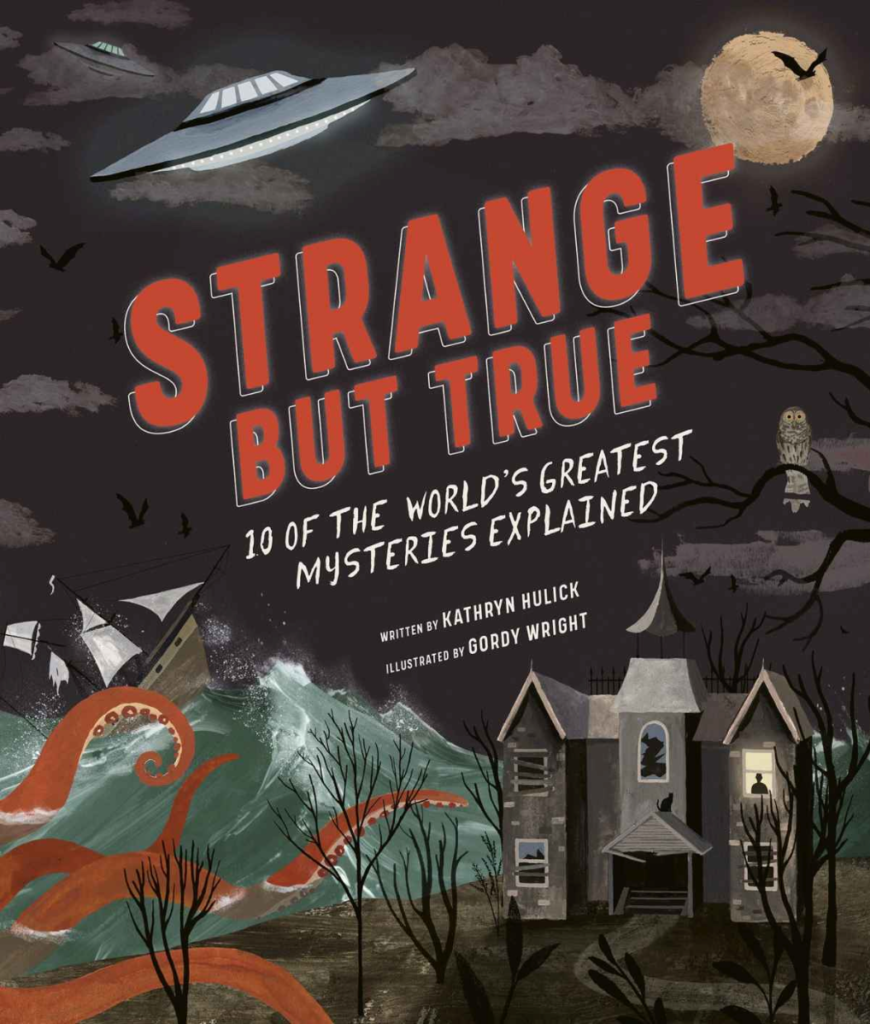
The book’s ulterior motive, as Kathryn cheerfully admits, is skepticism. Each of ten chapters opens with a short dramatic narrative — fiction or near-fiction depending on your priors — before pivoting to a rigorous look at what science and critical thinking actually have to say. The target audience is roughly ages 10 and up, with a freshman-in-high-school reader clearly in mind. Adults have been showing up at her book signings too, which, as Blake and Karen note, tracks perfectly with the Monster Talk demographic.
🔬 Stealth Skepticism: Making Critical Thinking Fun
Kathryn grew up a true believer — convinced she would develop psychokinetic powers after reading Roald Dahl‘s lesser-known 📚 The Wonderful Story of Henry Sugar 💵, which she mistook for nonfiction as a child. That backstory shapes the book’s empathetic tone: rather than positioning science as a buzzkill, she frames it as something that deepens mystery rather than dissolving it.
The book’s introduction lays out a toolkit of skeptical concepts — Occam’s razor, source evaluation, the difference between correlation and causation — before readers dive into the dramatic chapters. Kathryn’s editor kept pushing for more narrative drama; Kathryn kept pushing back to make sure readers wouldn’t finish the book more credulous than when they started. The introduction was the compromise. At live events, she has kids identify a mystery from their own lives and sketch out a plan to investigate it — essentially running a mini scientific method exercise in a library.
👻 Australia’s Most Haunted House: Monte Cristo Homestead
Wanting global geographical variety, Kathryn settled on the Monte Cristo Homestead in Junee, New South Wales — a Victorian-era mansion about five hours inland from Sydney, reputed to be Australia’s most haunted house. (Her first choice, the Forbidden City in Beijing, was ruled out on the grounds that its ghost lore involves the murdered concubines of the imperial court — a touch much for a middle-grade audience.)
The homestead was built by Christopher William Crawley, who made his fortune by purchasing land ahead of a railway extension through the town. Kathryn interviewed Lawrence Ryan, who grew up in the house after his family bought the long-derelict property. The mythology surrounding the house includes a baby dropped down the stairs by a mistreated nanny, a maid either pushed from or jumping off a balcony, and a stable boy burned to death in his mattress. Kathryn is careful to note that most of this history comes from family oral tradition rather than independently verifiable records — a useful model for young readers of how provenance matters.
Lawrence’s family experienced the usual repertoire of haunted-house phenomena: lights streaming from unelectrified windows, a picture that refused to stay on one wall, footsteps on the balcony, and a spectral old man spotted at the end of a child’s bed. The house now operates ghost tours and offers overnight stays.
🧟 Zombi vs. Zombie: A Distinction Worth Making
The zombie chapter is a highlight. Kathryn — drawing on an interview with Elizabeth McAlister of Wesleyan University — uses the spelling zombi (without the final e) to distinguish the Haitian folkloric figure from the flesh-eating pop-culture zombie. The Haitian zombi is not a predator; it is a person enslaved without their will, stripped of agency rather than appetite. McAlister contributed an authentic zombi bottle — a vessel a bokor (sorcerer) uses to contain a deceased person’s soul — which appears as an illustration in the book.
On Wade Davis‘s famous tetrodotoxin hypothesis (popularized in 📚 The Serpent and the Rainbow 💵), Kathryn goes the extra step that many books skip: she acknowledges the subsequent scientific literature showing that the toxin concentrations found in purported zombie powder samples were far too low to produce the claimed effects. Blake also notes the folk tradition that feeding a zombi salt will free it — a detail that turns up, he points out, in an episode of Kolchak: The Night Stalker.
🏔️ Dyatlov Pass: Nine Hikers, No Good Answers
The Dyatlov Pass incident is the chapter Kathryn originally planned to lead the book with, on the grounds that it touches nearly every paranormal theory ever devised: Yeti, aliens, Soviet weapons testing, infrasound-induced panic, and government cover-up. In February 1959, nine experienced Soviet hikers died on the eastern slopes of the Ural Mountains after slashing their way out of their tent from the inside and walking into sub-zero temperatures in various states of undress. The pass was subsequently named after the group’s leader, Igor Dyatlov.
Kathryn walks through the major theories:
– Avalanche: plausible as a perceived threat, but the tent was not buried.
– Animal attack: no non-human footprints were found at the scene.
– Soviet weapons test: consistent with some blunt-force injuries and the reported glowing orbs, though the orb sightings may not have been on the same night.
– Infrasound: 📚 Dead Mountain 💵 by Donnie Eichar argues that the unique shape of the nearby mountains could have generated low-frequency standing waves — but Kathryn couldn’t find convincing evidence that infrasound actually drives people to panic and flee. (Blake draws a parallel to Michael Persinger‘s “God Helmet” research — a compelling idea that hasn’t held up well under replication.)
Kathryn’s own conclusion leans toward cascading human error: a small initial mistake — a perceived threat, a moment of confusion, one person stepping outside — compounding rapidly in extreme cold and darkness until hypothermia made clear thinking impossible. Blake adds a pointed note on taphonomy: the missing tongue, soft tissue, and other features that fuel paranormal speculation are consistent with animal scavenging and post-mortem processes, not with anything supernatural.
🌐 Ten Topics, One Toolkit
The full roster of mysteries covered in the book spans Atlantis, the Bermuda Triangle, haunted houses, zombies, Dyatlov Pass, and Malaysia Airlines Flight MH370, among others. Kathryn drew inspiration partly from the Mysteries of the Unknown Time-Life book series — a set Blake and the team fondly remember for its irresistibly dramatic TV commercials — and partly from combing skeptical podcasts and recent case literature. Her publisher pushed for the classics (Bermuda Triangle, Atlantis); she pushed for the lesser-known (Dyatlov Pass, MH370). Both sides won a few.
Illustrations throughout the book are by Gordy Wright, whose work Blake singles out for special praise — particularly the renderings of William Mumler‘s spirit photographs, which capture the eerie quality of the originals without reproducing them directly.
📚 Further Reading
– 📚 Strange but True: 10 of the World’s Greatest Mysteries Explained 💵 by Kathryn Hulick, illustrated by Gordy Wright
– 📚 Dead Mountain: The Untold True Story of the Dyatlov Pass Incident 💵 by Donnie Eichar
– 📚 The Serpent and the Rainbow 💵 by Wade Davis
– 📚 They Knew Too Much About Flying Saucers 💵 by Gray Barker (Audible recommendation this episode)
– 📚 The Frighteners 💵 by Peter Laws (alternate Audible recommendation)
🔗 Related Links
– Dyatlov Pass Incident — Wikipedia
– Zombi in Haitian Folklore — Wikipedia
– Monte Cristo Homestead — Wikipedia
– Taphonomy — Wikipedia
– God Helmet (Persinger) — Wikipedia
– Mysteries of the Unknown (Time-Life series) — Wikipedia
Note: ads inserted into the distributed audio alter the timestamps in unpredictable ways, so timing references in these notes are approximate.
Download MP3 (right-click, Save As)
We are joined by author Kathryn Hulick, author of the new book Strange but True: 10 of the World’s Greatest Mysteries Explained. The book introduces 10 weird topics covering everything from Atlantis to Zombies and meshes it all with skepticism and critical thinking. It’s a great way to introduce a curious teen to the strange and unusual while arming them with the right tools to examine the questions critically.
Topics include haunted houses, zombies, the mystery of Dyatlov pass and more.
Find Kathryn on twitter @KHulick.

Blake Smith
0