211 – Screaming Skulls
💀 What Is a Screaming Skull?
The core legend is remarkably consistent across dozens of cases: a skull — usually linked to a violent or unjust death — resides in a prominent spot within a home (mantelpiece, windowsill, wall niche). It serves as a guardian and good-luck charm so long as it stays put. Attempts to remove, bury, drown, or destroy it bring on poltergeist activity, livestock deaths, and general household catastrophe. In some versions the skull is indestructible; in others it finds its own way home like a particularly grim homing pigeon. The Society for Psychical Research investigated at least one case in the 1930s and apparently attested to its reality — though Blake notes that removing a skull from its house and waiting for the screaming seems like an imminently testable hypothesis, and the consistent refusal to test it is, as he puts it, rather telling.
The legends cluster almost exclusively in rural England — not Scotland, not Ireland, not the Celtic fringe generally — and most are set firmly outside living memory, typically attributed to the 17th or 18th century. A folklorist named David Clark catalogued roughly 32 such legends across England in a 1999 dissertation. The earliest written account Blake and Karen could locate is from John Collinson‘s 1791 The History and Antiquities of the County of Somerset, which describes the skull of Theophilus Broome (more on him below). The tradition seems to have gone viral — in a Victorian newspaper sense — sometime between 1870 and 1900, when screaming skull stories flooded English print culture.
🏚️ The Famous Cases
Bettiscombe Manor, Dorset — Probably the most famous case. The skull here is traditionally identified as belonging to an enslaved person of African or Caribbean descent brought to England by Azaria Pinney, who had traveled to the West Indies in the 17th century. The legend holds that the person died on the estate having begged to be returned to his homeland; the skull’s refusal to stay buried is read as the expression of that final, denied wish. A 1960s anthropological examination reportedly concluded the skull was far older — possibly 2,000–5,000 years old — and of ancient British origin, though Blake notes the evidence for this claim is entirely secondhand and no modern DNA analysis appears to have been published.
Dickie of Tunstead Farm, Tunstead Milton, Derbyshire — One of the few skulls with surviving photographic and postcard evidence. The identity of “Dickie” is disputed: one version names a soldier called Ned Dickinson who returned from war to find his farm stolen by murderous cousins and was beheaded for his trouble; another version says Dickie was a woman, surname Dickinson, killed by her sister over a shared romantic interest. The skull reportedly sat on a windowsill at the farm and can still be found in historical photographs and Victorian postcards.
Wardley Hall, Manchester — Home to what is very likely a genuine historical relic: the skull of Saint Ambrose Barlow, a Catholic priest executed in 1641 by hanging, drawing, and quartering during the Protestant persecution of Catholics under the post-Reformation English state. His head was publicly displayed after execution, but it is believed that Catholic sympathisers secretly recovered it and brought it to Wardley Hall, where it reportedly remains today, housed in a wall niche behind glass. Blake takes a moment to note for American listeners that the Catholic–Protestant conflict in English history was, for centuries, a matter of literal life and death — not merely doctrinal disagreement. A separate, wilder tale also circulates about Wardley Hall involving a drunken swordsman who picked the wrong fight and had his head thrown off a bridge.
Burton Agnes Hall, Yorkshire — One of the few screaming skull sites open to the public, though the skull itself is not on display; it has been bricked up somewhere in the building. The skull is associated with Anne Griffith (also called Katherine Anne Griffith, or “Owd Nance”), youngest of three sisters, who in 1620 was fatally attacked by highwaymen while her beloved new manor house was still being completed. On her deathbed she reportedly begged her sisters to keep her head in the house forever. They buried her whole in the churchyard instead, whereupon her ghost made itself thoroughly unpleasant until the vicar consented to have her disinterred — at which point, the story goes, the skull was already conveniently separated from the body and ready for relocation. Karen notes there is no documentary evidence Anne Griffith actually existed as a historical person.
Theophilus Broome, Higher Chilton Farm, Chilton Cantelo, Somerset (c. 1670) — The skull described in Collinson’s 1791 account. Broome reportedly requested before his death that his head be kept at the nearby farmhouse rather than buried with his body. Attempts to inter the skull were reportedly met with “horrid noises portentive of sad displeasure,” and the sexton who last tried broke his spade in two. This skull is reportedly still viewable — by appointment only.
Other cases mentioned include two skulls at Warbleton Priory, East Sussex; two skulls associated with Calgarth Hall, Windermere, Cumbria; and the skull of St. Ambrose Barlow at Wardley Hall (above). Karen estimates there may be dozens of cases, many of which have simply vanished over time.
📖 The Literary Skull
The fictional tradition around screaming skulls is anchored by F. Marion Crawford‘s 1908 short story The Screaming Skull, published in his collection Wandering Ghosts. The story is narrated by an old sailor who keeps a skull in a hatbox in his bedroom closet, plies his visitor with rum while telling the tale, and gradually reveals his own ambiguous guilt in the murder to which the skull is connected. Crawford’s story appends a note suggesting it was inspired by real events. Blake calls it a classic by some measures, a snoozer by others, and thinks it would be vastly improved with Bruce Campbell, a flying skull, and a Evil Dead 2-style splat-stick treatment.
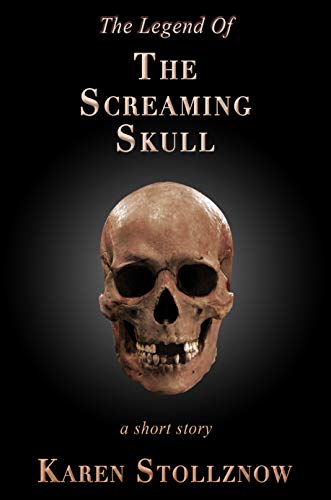
Karen has written her own short story in this tradition — 📚 The Legend of the Screaming Skull 💵 — currently available as a Kindle short story, with plans for an eventual anthology collecting her folklore-inspired fiction.
🎬 The Screaming Skull on Screen
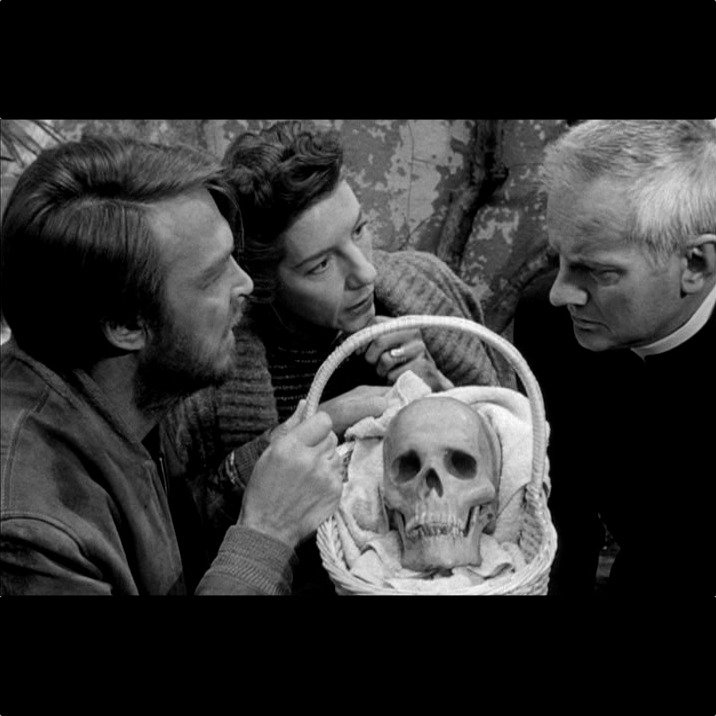
The 1958 film The Screaming Skull takes the legend in a notably different direction: a man uses a strategically placed skull to gaslight his new wife, having already dispatched wife number one under suspicious circumstances. Blake is charitable about filmmakers’ efforts as a rule, but concedes the film is not good. It is, however, available in a far more tolerable form as a Mystery Science Theater 3000 episode. Blake reads from cast member Bill Corbett‘s own assessment of the experience, which includes the observation that making someone watch The Screaming Skull even once “is specifically outlawed by the Geneva Convention.” The film also memorably promised free burial services to any audience member who died of fright — an offer voided in Utah, Florida, and Arizona.
🔍 Skeptical Notes
Blake and Karen observe several patterns worth noting. The skulls consistently belong to figures of lower social status — enslaved people, executed Catholics, murdered farmhands — while the houses that keep them are manor homes and stately estates. This maps neatly onto what Colin Dickey described in 📚 Ghostland 💵: ghost stories as repositories of cultural shame and unresolved historical violence. The folklore’s self-sealing structure — you can’t test it because testing would invoke the curse — insulates every case from falsification. Most skulls have either disappeared or were never independently documented. In the few cases where skulls do exist and have been examined, the results have not matched the legend (Bettiscombe’s skull appears ancient rather than colonial-era). Karen notes that individually, each case would require its own forensic investigation to resolve — and there is very little incentive for current homeowners to invite that scrutiny.
📚 Further Reading
– 📚 The Legend of the Screaming Skull 💵 by Karen Stollznow (short story)
– 📚 Ghostland: An American History in Haunted Places 💵 by Colin Dickey
– 📖 Wandering Ghosts by F. Marion Crawford (includes “The Screaming Skull”)
– 🎬 The Screaming Skull 💵 (1958)
🔗 Related Links
– Bettiscombe Manor (Wikipedia)
– Dickie’s Skull, Tunstead Farm (Wikipedia)
– Saint Ambrose Barlow (Wikipedia)
– Wardley Hall (Wikipedia)
– Burton Agnes Hall (Wikipedia)
– F. Marion Crawford, “The Screaming Skull” (full text, Wikisource)
– Mystery Science Theater 3000 (Wikipedia)
– RiffTrax (the ongoing project of the MST3K alumni)
Note: ads inserted into the distributed audio alter the timestamps in unpredictable ways, so timing references in these notes are approximate.
Download MP3 (Right-Click, Save As)
Today Karen and Blake discuss “Screaming Skulls” – a surprisingly common yet particularly English kind of haunting. Karen has a new short story based on this legend.

Multiple Examples:
- Bettiscombe manor, Bettiscome, Dorset
- Dickie – Tunstead Farm, Tunstead Milton, Derbyshire
- Skull of St Ambrose Barlow – Wardley Hall, Manchester (1641) – Catholic relic
- Skull of (Katherine) Anne Griffith – Burton Agnes Hall, Yorkshire (1620) “Owd Nance” –
- Skull of Theophilus Broome – Higher Chilton Farm, Chilton Cantelo, Somerset (1670)
- Two skulls – Warbleton Priory ruin, Rushlake Green, Heathfield, East Sussex
- Two skulls – Calgarth Hall, Windermere, Cumbria
Possibly dozens more and many have disappeared over time.
1895 book with a chapter on various Screaming Skulls.
Allegedly, Lord Byron had a skull he used to drink from as a part of occult rituals. It, or a copy of it, was sold at auction in 2017 and was expected to fetch a tidy sum.
Patreon supporters can see attachment (PDFs) for various newspaper stories featuring an assortment of Screaming Skull tales.
F. Marion Crawford’s famous short story on the topic.
The 1958 film The Screaming Skull. (streaming on Amazon, higher quality)
The Mystery Science Theater 3000 take on The Screaming Skull.
A nice little “documentary” about The Screaming Skull of Theophilus Broome.