Regular Episode
#156 – MAGIC: SEX, DRUGS AND ROCKET PROPULSION
Note: this episode was recorded around the time the CBS series based on 📚 Strange Angel 💵 was announced. Listener discretion is advised — the subject matter includes adult themes.
🚀 Rocket Science on a Shoestring: The JATO Breakthrough
Before Parsons was an occultist in the public imagination, he was a genuine pioneer in rocketry — largely self-taught, never completing a formal degree. Working through the Guggenheim Aeronautical Laboratory at Caltech (GALCIT) alongside colleagues including Theodore von Kármán, Parsons and his group were among the few in America taking rocketry seriously at a time when the field was publicly associated with pulp science fiction rather than legitimate science. The JPL itself was deliberately named “Jet” Propulsion Laboratory because “rocket” was considered too fanciful a word for public relations purposes.
The group’s critical breakthrough came when Parsons observed roofers mixing asphalt pitch and adapted the technique to produce a composite solid rocket fuel that cooled evenly without cracking — solving the reliability problem that had made their early rockets dangerously short-lived. The resulting JATO units could boost aircraft off short runways, carrier decks, or out of dogfights, and earned the group serious military contracts. Jerry notes the painful irony: Parsons’ cowboy approach to experimentation — sloppy notes, coffee-can chemistry, multiple lab explosions — ultimately cost him his place at JPL. His FBI file cites poor scientific practice, not occultism, as the reason for his dismissal, though Parsons himself preferred the more romantic explanation of religious persecution.
A contemporary: Robert Goddard, widely considered the father of American rocketry, was working in New Mexico at the same time but kept his research so closely guarded that no productive collaboration developed — and Parsons’ group eventually surpassed him.
🔮 Thelema, the Agape Lodge, and Aleister Crowley
Parsons’ introduction to Thelema came through a chance encounter with one of Crowley’s books at a friend’s house. He fell in with a Los Angeles circle of Crowleyites who had established an Agape Lodge of the OTO at what became known informally as “the Parsonage” — a mansion on Orange Grove Avenue that Parsons had subdivided into apartments and turned into a commune for misfits, artists, scientists, and occultists.
Crowley, by then aging, broke, and chronically ill in England, entered into a warm correspondence with Parsons and saw in him both a genuine magical talent and — frankly — a pipeline to Hollywood money. Jerry characterizes Crowley at this stage as roughly fifty-fifty between sincere true believer and cynical fundraiser. Crowley’s earlier attempt to perform the Abramelin operation at Boleskine House — summoning his Holy Guardian Angel — had famously failed, and his devotees believed this failure was what had made him the Great Beast. Crowley had also written a novel on the subject, 📚 Moonchild 💵, which Jerry suggests bears more than a passing resemblance to Arthur Machen‘s The Great God Pan.
Thelema’s philosophical core — radically individualist, Nietzsche-inflected, rooted in the primacy of Will — is discussed in the context of why it attracted a self-made scientific maverick like Parsons. Jerry also notes that by the 1930s and 40s, Crowley was more cultural curiosity than genuine scandal; the real stigma around occultism in America came later, in the era of the Satanic Panic.
✨ The Babalon Working and the Arrival of Marjorie Cameron
The ritual centerpiece of Parsons’ magical career was the Babalon Working (spelled B-A-B-A-L-O-N in Thelemic tradition) — a series of sex-magic ceremonies conducted in early 1946, partly in the Mojave Desert, intended to manifest the Thelemic goddess Babalon — the Scarlet Woman — in human form. Parsons documented the working in Liber 49, which Jerry describes as reading like a dry scientific text: complex, repetitive, and unmistakably written in Parsons’ own voice rather than channeled from antiquity. Parsons himself admitted he was largely improvising.
When Parsons and his ritual partner returned from the desert to the Parsonage, they encountered a striking red-haired woman, Marjorie Cameron, already present at the house. Parsons declared the ritual a success: he had summoned his Scarlet Woman. He fell immediately and passionately in love with her, and she became his second wife. Cameron was, in Jerry’s telling, a genuinely remarkable figure in her own right — an artist of startling, visionary intensity whose work Jerry describes as “the trippiest, coolest” art he’s encountered. The Cameron Parsons Foundation preserves her legacy.
🛸 L. Ron Hubbard: The Con Within the Cult
Into this already-strange milieu arrived Lafayette Ron Hubbard — a minor science fiction writer recently discharged from the Navy (having reportedly convinced himself the Japanese had invaded an island off the Oregon coast, earning a diagnosis of “war nerves”) who showed up at the Parsonage referring to himself as “Captain Hubbard.” The two men formed an immediate and intense bond. Hubbard became Parsons’ partner in the Babalon Working, serving as scribe while Parsons performed the ritual.
The friendship curdled into one of the great betrayals in occult history. Hubbard began a relationship with Betty Northrup (Sarah Elizabeth Northrup) — Parsons’ live-in girlfriend and the younger sister of his estranged wife Helen. Together, Hubbard and Betty convinced Parsons to hand over roughly $20,000 — nearly his entire savings — to purchase boats in Florida that they claimed to intend to sell back in California. They had no such intention. Parsons tracked them to Florida, reportedly performed a magical storm ritual that he believed forced their boat back to shore, and ultimately settled a lawsuit for a mere $2,500. Hubbard married Betty (bigamously, as he was still married to his first wife), and the two sailed off toward Dianetics and Scientology. Hubbard later claimed, for the record, that he had been a government agent infiltrating the Agape Lodge to protect the defense industry from communist Satanists.
Jerry notes with some admiration that Crowley had seen it coming: in letters, he called Betty a “vampire” and a “hellcat” and predicted she would be Parsons’ downfall. He was correct.
💥 The Death of Jack Parsons: Accident, Suicide, or Assassination?
On June 17, 1952, an explosion destroyed the makeshift laboratory Parsons had set up in his carriage-house laundry room. He was found by tenants with catastrophic injuries — an arm gone, severe head trauma — and died within hours. He was 37. His obituary in the Pasadena Independent memorably described him as a man who had “led a double existence: a down-to-earth explosives expert who dabbled in intellectual necromancy.”
Jerry walks through the competing theories:
– Government assassination: Cameron and some friends believed the CIA or similar agency had him killed. Jerry is skeptical: the U.S. government of that era was not reliably capable of keeping such operations secret, and Parsons had already been edged out of the defense industry and knew nothing of current programs worth protecting.
– LAPD revenge: Parsons had earlier helped expose a ring of corrupt cops who used a car bomb to commit murder. Some theorize the bomb came from beneath his house. Jerry finds no compelling evidence for this.
– Israeli intelligence: Parsons was in negotiations to help Israel’s nascent rocket program. Jerry notes that Israel does conduct targeted killings — but killing a man they were actively trying to hire makes no sense.
– Suicide: Parsons’ flair for drama makes this seem out of character for such an unglamorous method. Jerry doubts it.
– Accident: Jerry’s own conclusion. Parsons was by this point a heavy drinker working in a hurry — rushing a pyrotechnics order for a Hollywood film before leaving for Mexico — mixing fulminate of mercury in a converted laundry room. He had already contributed to multiple lab explosions at Caltech. Accidents happen, especially to overconfident chemists working fast under financial pressure.
🎨 Cameron’s Legacy
Marjorie Cameron (she went exclusively by her surname) outlived Parsons by more than four decades, dying in 1995. After his death she moved through the Los Angeles and New Mexico art scenes, befriended filmmaker Kenneth Anger (who had a connection to the Thelemic community and whose Hollywood Babylon books documented a parallel stratum of LA strangeness), and maintained a presence on the fringes of the occult art world. Her 1964 exhibition The Transcendental Art of Cameron was the high-water mark of her public career. Jerry describes her self-portrait Cameron with the Black Egg — depicting herself in Agape Lodge regalia holding an egg symbolizing the birth of Babalon — as simply astonishing. Someone in the transcript memorably called her “the typhoid Mary of the occult world.” The Whitney Museum has mounted exhibitions of her work. Jerry considers her overdue for a proper retrospective catalog.
🌐 Pop Culture Afterlife
Parsons spent decades as an internet-era cult secret — known mainly through Crowley forums and the odd occult website — before exploding into mainstream consciousness. Jerry notes several pop-culture threads that draw on his story or mythology:
– The podcast Rabbits (also referenced as Tanis in the episode) draws on an apocryphal text attributed to Parsons.
– Twin Peaks tie-in books (the companion volumes released alongside the revival series) weave the Babalon Working into the show’s mythology in significant ways.
– The CBS series based on 📚 Strange Angel 💵 was in production at time of recording.
– JPL has rehabilitated Parsons’ scientific reputation; he has a crater on the Moon named after him, and artifacts from his work are displayed at the Smithsonian.
– Jerry also mentions Dean Radin‘s then-new book arguing for the reality of magical will — evidence that the idea Parsons devoted his life to is far from dead, however skeptically the hosts receive it.
📚 Further Reading
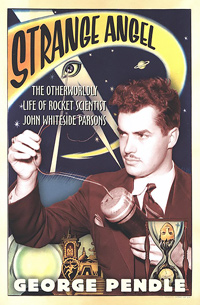
– 📚 Strange Angel: The Otherworldly Life of Rocket Scientist John Whiteside Parsons 💵 by George Pendle
– 📚 Sex and Rockets: The Occult World of Jack Parsons 💵 by John Carter (foreword by Robert Anton Wilson)
– 📚 Moonchild 💵 by Aleister Crowley
– 📚 Light Magic for Dark Times 💵 by Lisa Marie Basile
– 📖 The Coming Race by Edward Bulwer-Lytton (the fictional source of the Vril mythology)
🔗 Related Links
–
Note: ads inserted into the distributed audio alter the timestamps in unpredictable ways, so timing references in these notes are approximate.
Warning: The subject matter of this episode may not be suitable for children. Listener discretion is advised.
The history of magic and science converged in the explosive life of Jack Parsons. By day he was a pioneer in the field of rocket propulsion whose work helped win WWII. By night he performed magic rituals and hoped to invoke powers which would change the world. Researcher Jerry Drake joins us to tell the astonishing story of Jack Parsons, a man whose short life seemed to intersect with some of the most intriguing figures in pop-culture, religion and science, but whose career contributions seemed on the verge of being forgotten until very recently. Parsons is the subject of a new CBS television series, based on the book Strange Angel.
Of Interest
- Cameron Parsons Foundation
- The art of Marjorie Cameron
- Article on the Trippy Art of Marjorie Cameron Parsons
Music
- Intro Music: Spire by Twilight Tipi
- Monstertalk Theme: Monster by Peach Stealing Monkeys
MTArchivist
0