Regular Episode
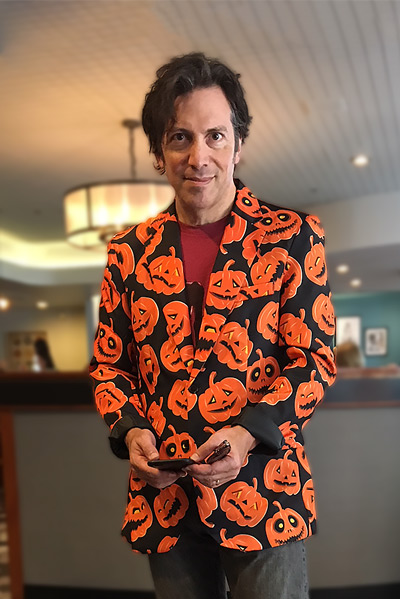
#157 – AN INTERVIEW WITH RICHARD HATEM (PART I)
This is less a debate than a genuine getting-to-know-you conversation — personal backstories, philosophy of belief, and the thorny question of what “skepticism” actually means when the phenomenon is something as slippery as high strangeness. Part two arrives next week; Patreon supporters get early access.
🎬 Turning an “Unfilmable” Book into a Movie
Hatem traces his path to The Mothman Prophecies back to the mid-1990s, when he was early in his career and fixated on a storytelling problem: virtually every Hollywood supernatural film begins with genuinely unsettling strangeness — he cites 🎬 The Changeling 💵 and Poltergeist as prime examples — but then obligingly resolves everything into a tidy plot. The ghost wants revenge. The monster can be destroyed. Real paranormal accounts, he observed, never work that way: something weird happens, there’s no explanation, and that’s the end of the story.
When he picked up the Illuminet Press paperback of Keel’s book — the one with the Frank Frazetta cover painting — he thought he’d found his movie. Then he read it and realized the problem: the book is a “box of amazing cool things, but none of them fit together.” No protagonist with a clear arc. No resolution. As Blake puts it in his intro, the protagonist is a passive observer and at the end you know nothing more about why any of it happened. For Hatem, that was both the challenge and the key: the film’s invented emotional spine — a man processing grief through the lens of inexplicable phenomena in Point Pleasant, West Virginia — is meant to honor the feeling of genuine strangeness rather than explain it away.
👻 What Real Ghost Stories Actually Look Like
A recurring theme in the conversation is the gap between cinematic hauntings and the accounts that investigators actually collect. Hatem’s idealized “honest” ghost movie would follow a rational person who sets up cameras, calls a priest, tries everything sensible — and ends the film knowing no more than they did at the start. Blake and Karen enthusiastically agree, pointing to 🎬 The Ring 💵 as the rare film that plays with this idea (before inverting it at the last moment).
Karen illustrates the point with a personal story from a ghost tour at the North Head Quarantine Station near Sydney Harbour — an Ellis Island–style facility with a long history of smallpox and cholera quarantines and consequently rich ghost-story traditions. Her group heard what sounded unmistakably like a phantom party: glasses clinking, laughter, music. The room was dark and empty. Her best hypothesis: sound carrying across the water from the mainland peninsula. Hatem responds that he loves the explanation precisely because it’s testable — recording equipment, acoustic modeling, wind direction data could in principle confirm or rule it out.
☢️ Carbon Monoxide, Cold Reads, and Isolating the Phenomena
The discussion pivots to Carrie Poppy‘s well-known personal story — she experienced what felt like a classic haunting that turned out to be a carbon monoxide leak. (Poppy and Ross Blocher host the podcast Oh No, Ross and Carrie; she delivered a TEDx talk on the experience.) Hatem takes this as a model for honest investigation: use findings like this to eliminate explainable cases, then focus harder on whatever remains unexplained.
Blake shares his own extended “haunting” — sleep paralysis episodes and exploding light bulbs in an apartment in Bahrain, which followed him back to Georgia because he’d shipped the same defective bulk-discount bulbs home. It wasn’t until Michael Shermer appeared on television discussing sleep paralysis that Blake had a framework for isolating the individual phenomena rather than treating the whole package as a single supernatural event. The one element he still can’t fully account for: a self-described psychic who walked into his apartment and announced she “sensed a presence” — though, as he notes, her husband (who knew the whole story) had almost certainly briefed her in advance. Classic hot read territory.
🌀 The Third Point on the Triangle: Keel, Fort, and the Open Question
Hatem describes his philosophical position as a “third point on a triangle” — equally skeptical of organized religion (which he sees as rushing to literalize genuinely mysterious experiences) and of what he calls the debunker’s answer (“that’s all nonsense and they’re crazy”). He found his vocabulary for this in Charles Fort and John Keel, particularly Keel’s dictum that belief is the enemy. Remaining genuinely neutral, he argues, is the only position that keeps the conversation honest.
Keel himself comes up as a character study. Hatem met him several times in his late seventies and describes a man who enjoyed his role as an outlaw — his business cards reportedly read “John Keel, not an expert at anything.” By Hatem’s reading, Keel’s arc from his early book 📚 Jadoo 💵 (in which he went looking for the lost world of magic and largely figured out the tricks) to The Mothman Prophecies traces a researcher who kept finding new mysteries when old ones were solved, and ultimately landed somewhere dark: other intelligences exist, they’re smarter than us, and if they want to interfere with human life, they can and do. Hatem connects this to Keel’s self-description as a demonologist — not in a religious sense, but in the sense that UFO encounters, fairy sightings, and demonic visitations may all be the same non-physical phenomenon manifesting in culturally specific forms. Blake draws a parallel to Jack Parsons (whose story MonsterTalk covers in a separate episode), noting that both Parsons and Keel were fundamentally seeking the numinous.
🔬 Paths to Skepticism (and Accidental Atheism)
Both hosts share their personal routes to skepticism. Karen describes growing up writing ghost stories (featuring a ghost named Zuz) and eventually joining the Australian Skeptics, whose framework helped her look for natural explanations without dampening her enthusiasm for the phenomena themselves. Her book 📚 Would You Believe It? 💵 collects paranormal-adjacent experiences from skeptics and atheists — people like Joe Nickell — some explained, some still carrying a question mark.
Blake’s path ran from fundamentalist Christianity in rural Georgia through a decade of private skepticism (not knowing there was a community of like-minded people) to a slow, accretive process of losing his faith by around 2007–2008. The episode’s comic highlight: the story of how he braced himself to come out as an atheist to his mother, only to discover she’d actually called him to ask if he was gay — a question prompted, it eventually emerged, by a vividly real-seeming dream she’d had after a medication change. He came out as an atheist entirely by accident, and is still not entirely sure what his mother concluded.
📚 Further Reading
– 📚 The Mothman Prophecies 💵 by John Keel
– 📚 Jadoo 💵 by John Keel
– 📚 Would You Believe It? 💵 by Karen Stollznow
– 📚 Gef!: The Strange Tale of an Extra-Special Talking Mongoose 💵 by Christopher Josiffe
– 📚 Borderlands: The Ultimate Exploration of the Unknown 💵 by Mike Dash
– 📚 The Trickster and the Paranormal 💵 by George Hansen
🔗 Related Links
– Mothman — Wikipedia overview of the Point Pleasant sightings
– John Keel — biography and bibliography
– Charles Fort — the original cataloguer of anomalous phenomena
– J. Allen Hynek — originator of the “high strangeness” classification
– Sleep Paralysis — the neurological phenomenon behind many “haunting” experiences
– Jack Parsons — rocket pioneer, occultist, and Pasadena neighbor of Richard Hatem
– Fortean Times — the journal of record for anomalous phenomena, discussed approvingly by all three
– Carrie Poppy’s TEDx Talk: “A Scientific Approach to the Paranormal”
Note: ads inserted into the distributed audio alter the timestamps in unpredictable ways, so timing references in these notes are approximate.
In this episode of MonsterTalk, Blake interviews screenwriter Richard Hatem about his work adapting John Keel’s The Mothman Prophecies for the 2002 motion picture. This wide-ranging discussion is broken into two parts. Part two will air next week, but Patreon supporters will have early access through http://patreon.com/monstertalk.
Of Interest
- Richard Hatem on Astonishing Legends (#72)
- Richard Hatem on Astonishing Legends (#73)
- Richard Hatem on Astonishing Legends (#82)
- The Changeling
- The Ring
- The Mothman Prophecies (book)
- The Mothman Prophecies (movie)
- Would You Believe It? (book)
- Carbon Monoxide Ghost (TEDx – featuring Carrie Poppy of Oh No podcast)
- Gef!: The Strange Tale of an Extra-Special Talking Mongoose by Christopher Josiffe
- Borderlands: The Ultimate Exploration of the Unknown by Mike Dash
- JADOO by John Keel
- The Trickster and the Paranormal by George Hansen
- Radio Misterioso with Greg Bishop
- The Gates (written by Richard Hatem)
- Miracles (written by Richard Hatem) –
- Fave Monster: Stick People — Albert Rosales Humanoid Encounters
Music
- Intro music: Whiteness by The Owl
- Monstertalk Theme: Monster by Peach Stealing Monkeys
MTArchivist
0