Regular Episode
#146 – THE TAIL OF THE LIZARD MAN
Blake admits upfront that he’d long resisted covering the Lizard Man of Scape Ore Swamp. Unlike Bigfoot — which can at least gesture toward real primate biodiversity — a bipedal, scaly, seven-foot reptilian humanoid sits in an awkward biological no-man’s-land: too flesh-and-blood to be supernatural, too anatomically implausible to be a straightforward cryptid. Lyle’s book, he concedes, finally gave him enough context — historical, cultural, and investigative — to find the story genuinely worth exploring.
🦎 The Bishopville Sightings: What Was Seen?
The core case dates to July 1988, when a teenager named Christopher Davis reported a terrifying encounter on a rural road near Bishopville, South Carolina. Changing a flat tire near Scape Ore Swamp late at night, Davis said he spotted a figure crossing the fennel grass in the moonlight — upright, brownish-green, apparently scaly, with three-fingered clawed hands and a distinctly reptilian appearance. The creature allegedly lunged at his car and clung to it as he sped away.
Davis came forward only after his father read a newspaper account of a separate incident: a local couple had reported their car mauled by an unknown animal near the same swamp. Sheriff Liston Truesdale — who handled the case with notable seriousness — investigated both incidents, took Davis’s formal statement, and had him draw a sketch of the creature. Those records still exist, which Lyle notes is unusually good documentation for a cryptid case. Davis also passed a polygraph examination.
Subsequent sightings offered wildly inconsistent descriptions. A family encounter in the 1990s, for instance, produced multiple independent accounts — separated and recorded by Sheriff Truesdale — that all described a large, upright, hair-covered creature, prompting at least one witness to use the word “Sasquatch.” Whether this represents a genuinely different creature, a misidentified Bigfoot, a mangey animal seen under poor conditions, or simple witness variation is left open.
🕵️ Hoaxes, Copycats, and the Anatomy of a Rumor
With national media attention (including a live Good Morning America broadcast from the swamp and coverage on the CBS Evening News) and a one-million-dollar reward offered by a Columbia radio station for capture of the creature, Bishopville attracted the inevitable hoaxers. One man presented scales on his car as evidence — they turned out to be fish scales, a ruse Sheriff Truesdale dispatched quickly. The man admitted he just wanted to “keep the legend alive.”
Decades later, the hoaxer’s brother claimed the original Davis encounter itself had been staged — that his sibling had been running around the swamp in a mask. Lyle points out the implausibility: the alleged hoaxer wasn’t even from the area, and the claim conveniently fails to account for any of the subsequent sightings over the following years. Two separate individuals also claimed, through back-channel stories, to have been responsible for the Davis encounter — which, mathematically, can’t both be true.
The broader point Lyle makes is one worth internalizing: a claim of hoaxing is still just a claim. People attach themselves to sensational stories for attention, much like the many individuals who have confessed to being Jack the Ripper. Unverified hoax claims deserve the same scrutiny as unverified monster sightings.
Fabricated three-toed footprints — stamp-like, unconvincing, almost certainly kids having fun — also entered the record. Lyle is candid: those prints should simply be excluded from serious consideration of the case.
🌿 Related Creatures: Scripted Monsters and Swamp Folklore
Lyle situates the Bishopville Lizard Man within a broader tradition of gill-man and reptile-man encounters across North America. Comparable cases discussed include:
– The Loveland Frog of Ohio — a police-reported encounter with a small, amphibious humanoid that Lyle regards as less evidentially robust than the Bishopville case.
– The Thetis Lake Monster of British Columbia — a scaly humanoid allegedly emerging from a lake, later investigated by Daniel Loxton for Junior Skeptic, who traced the likely source of the story.
– A 1958 encounter near the Santa Ana River in California, where a man named Charles Wetzel reported a creature with a beaked, reptilian face running across the road — a description that emerged just four years after Creature from the Black Lagoon hit theaters.
– A pre-1988 Kentucky report fielded by Bigfoot researcher Charlie Raymond, in which an isolated rural witness described seeing a creature with reptilian skin and webbed fingers cross his backyard at night — well before any Lizard Man publicity could have influenced the account.
Blake coins the term “scripted” for creatures whose descriptions seem to have been shaped by prior exposure to movie monsters — a useful critical framework when evaluating reports that emerge shortly after a culturally prominent film.
🦕 The Biology Problem: Could a Lizard Man Exist?
The conversation turns, briefly but substantively, to evolutionary biology. Lyle references the Dinosauroid — a speculative model published in 1982 by paleontologists Dale Russell and Ron Séguin, who extrapolated what a Troodon-like dinosaur might have evolved into had non-avian dinosaurs survived the end-Cretaceous extinction. The resulting hypothetical creature — upright, large-brained, humanoid — offers a thin but not entirely absurd scaffolding for imagining a flesh-and-blood reptilian biped.
Blake draws the distinction between the Bishopville creature (a possible, if extremely implausible, flesh-and-blood animal wandering a swamp) and the conspiracy-oriented reptilian shapeshifter hypothesis associated with David Icke — a separate intellectual tradition involving subterranean civilizations, government infiltration, and beings who can pass as human. The Bishopville Lizard Man has no UFO correlations, no shapeshifting, and no apparent political agenda. As Blake puts it, it’s “the sleazy cousin” — low-power, swamp-dwelling, and innocent of grand conspiratorial ambition.
🎬 The Gill-Man on Film: Swamp Monster Cinema
Lyle compiled a list of swamp and reptile-monster films for the book, which MonsterTalk reprints in full below. In the episode, he highlights a few personal favorites:
– 🎬 Creature from the Black Lagoon 💵 — Lyle’s all-time favorite swamp monster movie, and the cultural template against which nearly all subsequent gill-man sightings must be measured.
– 🎬 The Alligator People 💵 — a Louisiana-set film in which a man transforms into a swamp creature, highly recommended by Lyle.
– 🎬 Humanoids from the Deep 💵 — the Roger Corman production that Blake notes features Doug McClure (a perennial Simpsons target), and which Lyle describes as cheesy but genuinely creepy.
– 🎬 The Shape of Water 💵 — Guillermo del Toro’s then-recent gill-man love story, which both hosts and Lyle were enthusiastic about at the time of recording.
The TV series Land of the Lost (1974–1977) also comes up warmly, with its Sleestak — reptilian humanoids in an alternate dimension — occupying a fond place in both Blake’s and Lyle’s monster-loving childhoods. Blake notes that Walter Koenig wrote episodes for the series, which surprises Lyle.
📚 Further Reading
– 📚 Lizard Man: The True Story of the Bishopville Monster 💵 by Lyle Blackburn
– 📚 The Beast of Boggy Creek: The True Story of the Fouke Monster 💵 by Lyle Blackburn
– 📚 Beyond Boggy Creek: In Search of the Southern Sasquatch 💵 by Lyle Blackburn
– 📚 Monstro Bizarro: An Essential Manual of Mysterious Monsters 💵 by Lyle Blackburn
🦎 Lyle Blackburn’s Swamp Monster Film List
– 🎬 Creature from the Black Lagoon 💵 (1954)
– 🎬 Revenge of the Creature 💵 (1955)
– 🎬 The Creature Walks Among Us 💵 (1956)
– 🎬 The Alligator People 💵 (1959)
– 🎬 The Monster of Piedras Blancas 💵 (1959)
– 🎬 The Hideous Sun Demon 💵 (1959)
– 🎬 The Horror of Beach Party 💵 (1964)
– 🎬 Curse of the Swamp Creature 💵 (1966)
– 🎬 The Reptile 💵 (1966)
– 🎬 Graveyard of Horror 💵 (1971)
– 🎬 Zaat 💵 (1971)
– 🎬 Night of the Cobra Woman 💵 (1972)
– 🎬 Sssssss 💵 (1973)
– 🎬 Track of the Moon Beast 💵 (1976)
– 🎬 When the Screaming Stops 💵 (a.k.a. The Loreley’s Grasp, 1976)
– 🎬 Screamers 💵 (1979)
– 🎬 Humanoids from the Deep 💵 (1980)
– 🎬 Conan the Barbarian 💵 (1982)
– 🎬 Bog 💵 (1983)
– 🎬 The Legend of Gator Face 💵 (1996)
– 🎬 Lizard Baby 💵 (2004)
– 🎬 Land of the Lost 💵 (2009)
– 🎬 Creature 💵 (2011)
– 🎬 Lizard Boy 💵 (2011)
– 🎬 The Amazing Spider-Man 💵 (2012)
– 🎬 Lizard Man 💵 (2012)
🔗 Related Links
– Lizard Man of Scape Ore Swamp (Wikipedia)
– Loveland Frog (Wikipedia)
– Thetis Lake Monster (Wikipedia)
– Dinosauroid — the 1982 Russell & Séguin speculative model (Wikipedia)
– Honey Island Swamp Monster (Wikipedia)
–
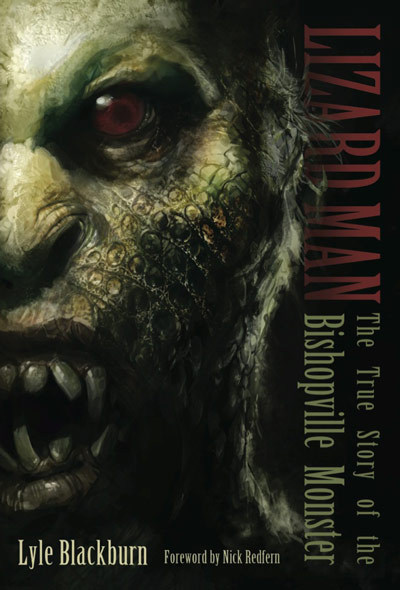
In this episode of MonsterTalk, we creep narratively into the swamps of South Carolina as we talk of the strange lizard man who is alleged to live in the swamps outside Bishopville. Lyle Blackburn leads our expedition as he recounts the story as told in his book Lizard Man: The True Story of the Bishopville Monster. Lyle previously joined us for episode 106: What The Fouke? The Beast of Boggy Creek.
Of Interest
- 2015 Lizard Man Hoax story
- Lost Tapes episode on Lizard Man (Season 2, Episode 2)
- Destination Truth (Season 3, Episode 14)
List of Swamp Monster Movies (courtesy Lyle Blackburn)
- Creature from the Black Lagoon (1954)
- Revenge of the Creature (1955)
- The Creature Walks Among Us (1956)
- The Alligator People (1959)
- The Monster of Piedras Blancas (1959)
- The Hideous Sun Demon (1959)
- The Horror of Beach Party (1964)
- Curse of the Swamp Creature (1966)
- The Reptile (1966)
- Graveyard of Horror (1971)
- Zaat (1971)
- Night of the Cobra Woman (1972)
- Sssssss (1973)
- Track of the Moonbeast (1976)
- When the Screaming Stops a.k.a. The Loreley’s Grasp (1976)
- Screamers (1979)
- Humanoids from the Deep (1980)
- Conan the Barbarian (1982)
- Bog (1983)
- The Legend of Gator Face (1996)
- Lizard Baby (2004)
- Land of the Lost (2009)
- Creature (2011)
- Lizard Boy (2011)
- The Amazing Spider-Man (2012)
- Lizard Man (2012)
Music
- Monstertalk Theme: Monster by Peach Stealing Monkeys
MTArchivist
0