Regular Episode
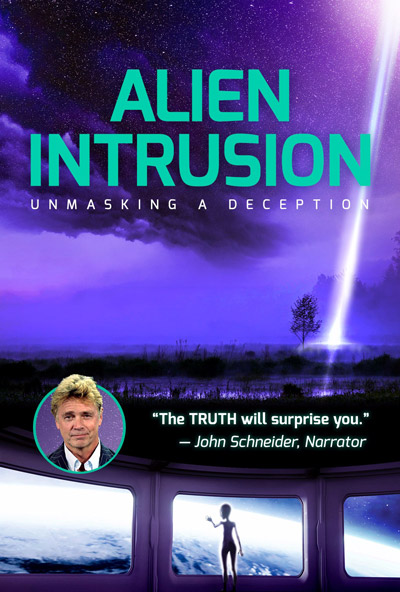
#147 – ALIEN INTRUSION AND THE ULTRATERRESTRIAL HYPOTHESIS
The episode uses the film as a jumping-off point for a wide-ranging conversation about the Ultraterrestrial Hypothesis (UTH), the work of John Keel and Jacques Vallée, the sociology of religion, and what Jeb has been calling the Paranormal Unified Field Theory (PUFT): the observation that UFOs, Bigfoot, dogmen, ghosts, fairies, and other paranormal phenomena are increasingly treated as facets of a single interconnected mystery rather than separate topics.
👽 The Film: A Bait-and-Switch in a Multiplex
Alien Intrusion: Unmasking a Deception was produced by Gary Bates of Creation Ministries International (CMI), the Australian creationist organization that had a notable falling-out with Ken Ham‘s Answers in Genesis in 2006. The film was narrated by John Schneider — known to an older audience as Bo Duke from The Dukes of Hazzard, but introduced in the film by his more sci-fi-friendly credit as Clark Kent’s father on Smallville — a detail the panel reads as a deliberate attempt to appeal to genre fans.
Joe and Natasha attended a screening in Austin where a portion of the small audience walked out in anger at discovering the film’s religious agenda midway through. Blake’s screening sold out two auditoriums — almost entirely pre-organized church groups. The first IMDb review, they note, is titled “I feel LIED TO,” with the relevant words in all caps.
The film’s structure: approximately the first half marshals mainstream physics arguments against the extraterrestrial hypothesis (faster-than-light travel, vast interstellar distances) — arguments the panel notes could have been produced by CSICOP. Having dispatched the nuts-and-bolts ETH, the film pivots: if the craft aren’t physical, what are they? Its answer is demons. The second half focuses heavily on abduction testimony, delivered over melancholy piano music in what the panel describes as an extended appeal to emotion, concluding that invoking the name of Jesus Christ is the most effective defense against alien abduction.
👿 Keel, Vallée, and the Demon-Haunted Ultraterrestrial
John Keel — journalist, author of 📚 The Mothman Prophecies 💵 and 📚 Operation Trojan Horse 💵, and the figure most associated with coining the term “ultraterrestrial” — is extensively quoted in the film via proxy: author Nick Redfern, who appears throughout as a kind of stand-in for Keel’s ideas. Keel described himself as a “demonologist,” not in any theological sense, but in the sense that his investigations pointed toward a world populated by trickster entities older than humanity itself — beings that lie, manipulate, and occasionally seem to consume people, spiritually or otherwise. As Blake puts it: “John Keel basically suggests we all are living in a horror novel.”
What the film cherry-picks from Keel, Joe notes, are the passages useful to a Christian demonological reading — while quietly setting aside Keel’s suggestion that the ancient Israelites were being tricked by these entities, or that the Ark of the Covenant was essentially a machine built to alien specifications.
Jacques Vallée — computer scientist, early UFO statistician, and the real-world inspiration for Claude Lacombe in 🎬 Close Encounters of the Third Kind 💵 — is the other intellectual anchor of the PUFT. His 1969 book 📚 Passport to Magonia 💵 catalogued “close encounter” occupant reports alongside medieval and early-modern European fairy lore, arguing they were facets of the same recurring phenomenon. Keel reached similar conclusions independently. Together, their argument — that these entities are native to Earth, predate humanity, and are neither extraterrestrial nor supernatural in any conventional religious sense — is precisely what makes the UTH so easily adaptable to a demonic framework.
📖 Nick Redfern, the Collins Elite, and Final Events
Redfern’s 2010 book 📚 Final Events 💵 is explicitly cited in the film. In it, Redfern recounts (without personally endorsing) the claims of a source he identifies as a priest named Ray Boeche, a former Nebraska MUFON state director, who described a shadowy government group called the Collins Elite. According to this account, the group concluded that UFO phenomena are demonic in nature — that abductions are spiritual attacks, and that humans are essentially a “farm” for entities that consume souls. Some members allegedly wanted to fight this threat through spiritual warfare; others wanted to weaponize it. Jeb notes that elements of this narrative connect to Jack Parsons, co-founder of the Jet Propulsion Laboratory and a devoted follower of Aleister Crowley and the Ordo Templi Orientis, whose social circle also included a pre-Scientology L. Ron Hubbard.
Also appearing in the film: Norio Hayakawa, long associated with the Dulce underground base legend — a piece of UFO mythology centered on an alleged secret facility beneath Archuleta Mesa in northwestern New Mexico, rumored to be the site of a human-alien pact gone catastrophically wrong, complete with a “hell level” of experiments and a subsequent alien double-cross. The panel notes the theological resonances are, shall we say, not subtle.
⛪ Is Ufology a Religion? A Scholarly Digression
Joe and Natasha bring the tools of religious studies to bear. Natasha introduces sociologist Peter Berger‘s concept of the sacred canopy — religion as a system for categorizing and ordering an overwhelming flood of experience — and suggests the PUFT functions similarly: all anomalous phenomena become intelligible under a single explanatory umbrella. Joe notes that in religious studies, “religion” is a second-order category (something scholars construct, not something that exists independently in the world), and that what counts as religion has real political stakes — he cites a local example of someone arguing Harry Potter constitutes a religion while Islam does not, in order to game constitutional protections.
Gary Bates, the filmmaker, actually defines his terms on screen: he identifies religion as a system that answers the questions of origin, purpose, and afterlife — and by that definition, he argues, ufology qualifies. The panel finds this more intellectually honest than most creationist media.
The conversation also touches on the Raëlian Movement (too weird for the International UFO Museum and Research Center in Roswell, but welcomed by the Alien Resistance storefront church directly across the street), Heaven’s Gate as an example of ufologized Christianity, and the abduction researchers John Mack, Budd Hopkins, and David Jacobs — all three of whom, Jeb reports, apparently declined to publicize the recurring claim among abductees that invoking Jesus ended their experiences.
🔀 Hybridity, Skeuomorphism, and Improvisational Apocalypticism
Jeb frames the film as a case study in cultural hybridity — the process by which traditions blend in the interstitial spaces between established categories, often with deliberate agency rather than passive drift. Joe prefers the term over the older “syncretism” precisely because hybridity implies intention: you can see these Christians reading Keel and Vallée, deciding what’s useful, and quietly setting aside whatever doesn’t fit.
Jeb introduces the concept of skeuomorphism (a term he recalled after the recording) to describe how elements transfer from one medium or tradition to another even when they’re no longer functionally necessary — like expecting the biblical book of Ezekiel’s vision of wheels-within-wheels to appear in an ancient-astronaut-derived framework, only to find it conspicuously absent because calling it demonic would be theologically awkward.
Michael Barkun’s concept of improvisational apocalypticism — the tendency in fringe belief systems to assemble doctrine flexibly from whatever materials are at hand — comes up as a descriptor for what CMI is doing. Unusually, the panel notes, the film is not particularly apocalyptic in tone: it doesn’t frame UFOs as a sign of imminent end times (as Hal Lindsey did in earlier evangelical UFO commentary) but instead accepts Keel’s premise that these encounters are a permanent, normal feature of human existence — which the panel reads as an index of how thoroughly Keel and Vallée’s framework has permeated even Christian ufology.
🔬 The Null Terrestrial Hypothesis
Blake closes the episode with a statement of his own position. He coins the phrase Null Terrestrial Hypothesis for the skeptical alternative: that the phenomena attributed to ultraterrestrials are better explained by misperception, sleep paralysis, hypnagogic states, cultural expectation, and the well-documented unreliability of human perception under anomalous conditions. He invokes Karl Popper‘s criterion of falsifiability: the UTH, by positing entities from another dimension or mode of existence entirely, is structured so that no evidence could ever count against it — making it, in Popper’s sense, not scientific. He compares it to Carl Sagan’s fire-breathing dragon in the garage, from 📚 The Demon-Haunted World 💵. The PUFT may feel like it explains everything; that is precisely the problem.
📚 Further Reading
– 📚 The Mothman Prophecies 💵 by John Keel
– 📚 Operation Trojan Horse 💵 by John Keel
– 📚 Passport to Magonia 💵 by Jacques Vallée
– 📚 Final Events 💵 by Nick Redfern
– 📚 The Demon-Haunted World 💵 by Carl Sagan
– 📚 Paranormal America 💵 by Christopher Bader, F. Carson Mencken, and Joseph Baker
– 📚 A Culture of Conspiracy 💵 by Michael Barkun
🔗 Related Links
– John Keel (Wikipedia)
– Jacques Vallée (Wikipedia)
– Ultraterrestrial hypothesis (Wikipedia)
– Jack Parsons (Wikipedia)
– Dulce Base legend (Wikipedia)
– In this episode of MonsterTalk, we return to discussion of the Ultraterrestrial Hypothesis (UTH) and what seems to be its growing influence in paranormal circles. It’s been used to explain UFOs, mothman, bigfoot, fairies, dogman, ghosts and many other phenomena which defy scientific demonstrability. Now it crops up again in a new film event titled Alien Intrusion which turned out to be a stealth evangelical creationist film which suggests that aliens and UFOs are actually demonic. We are joined by MonsterTalk alum Joe Laycock, Natasha Mikles and Jeb Card to discuss the UTH and Jeb’s Paranormal Unified Field Theory (PUFT) as it relates to this film and the work of John Keel and others.
Music
- Monstertalk Theme: Monster by Peach Stealing Monkeys
MTArchivist
0