224 – Coral Castle
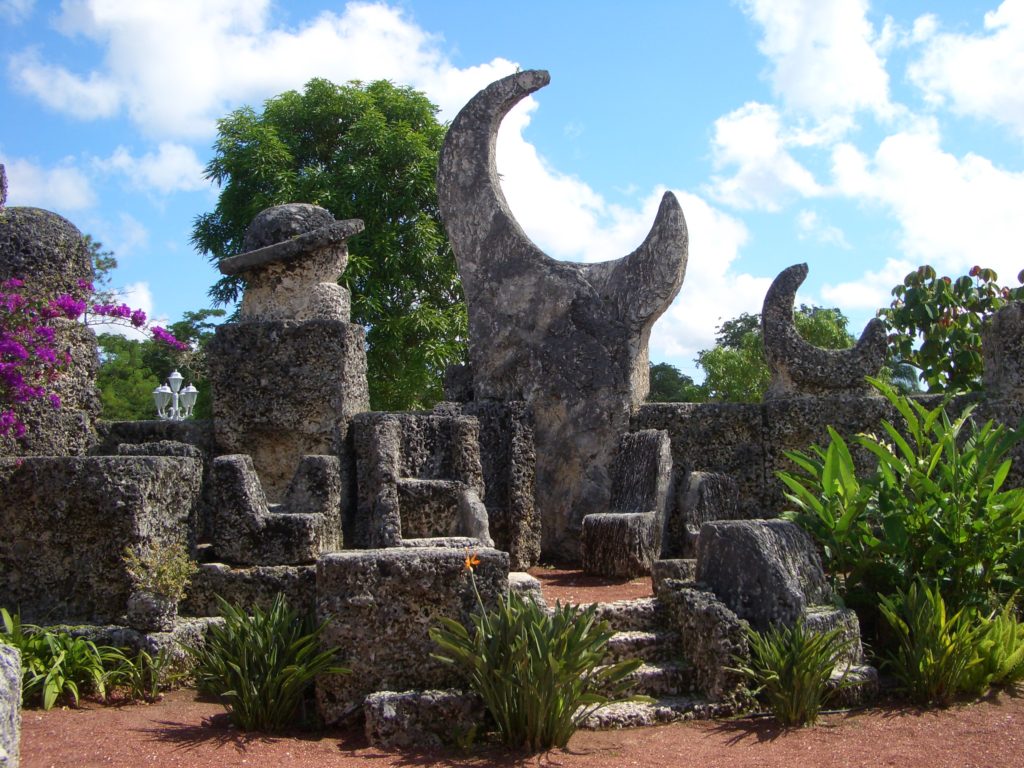
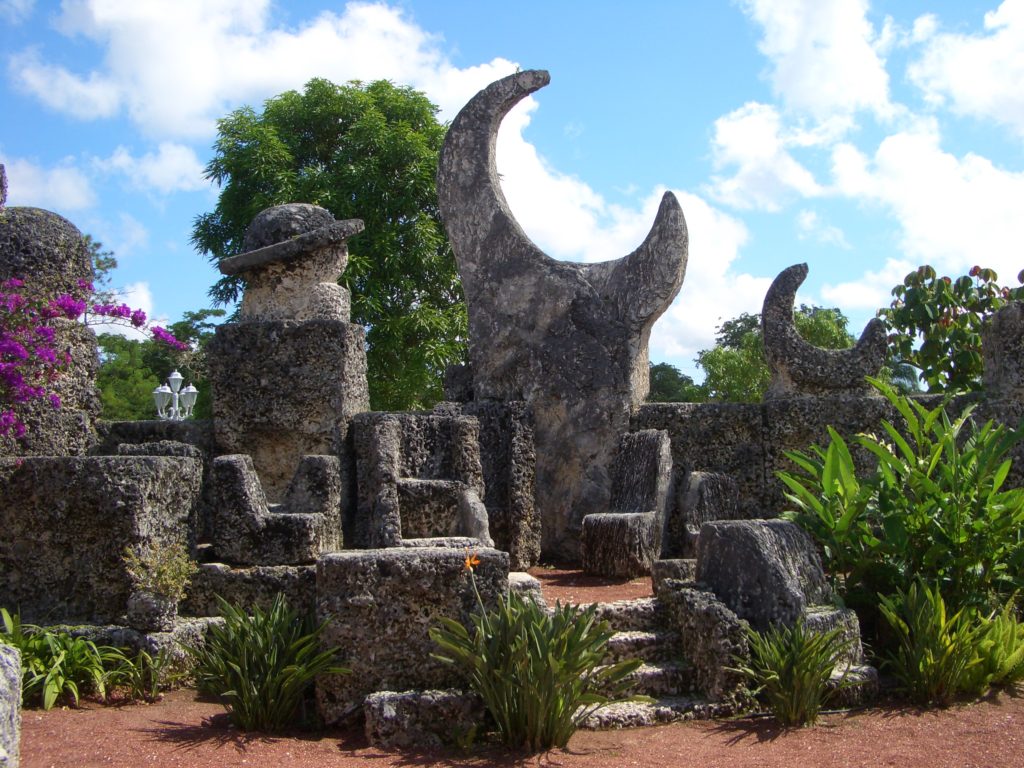
The site was originally called Rock Gate Park by its creator, and the name “Coral Castle” was a marketing invention of later owners. The rock isn’t coral and it isn’t a castle — but it has attracted aliens, ley lines, levitation theories, a Billy Idol song, and at least one very low-budget nudie film. It also has a perfectly mundane explanation, which this episode is happy to provide.
🧱 Ed Leedskalnin and the Building of Rock Gate Park
Edward Leedskalnin was born in Latvia in 1887. The legend attached to him is irresistible: jilted by his teenage sweetheart — usually called Agnes, though her name varies across sources — he emigrated to North America, worked as a lumberjack in Canada and a stonemason across several U.S. states, contracted tuberculosis, and eventually settled in Florida City, where a local farmer named Reuben Moser and his wife nursed him back to health. Ed then purchased roughly ten acres of poor, rocky land — precisely because it sat atop a bed of oolite limestone close to the surface — and spent the next 28 years quarrying and carving it into a sculpture park he charged a dime to enter.
The structures range from one-ton carvings up to a 30-ton monolith, and include a Florida-shaped table, a wall of planets, crescent moons, a sundial, a telescope, roughly 25 stone rocking chairs, and the park’s most celebrated feature: a finely balanced nine-ton gate said to swing open at a child’s touch. Ed lived in a two-story tower on the grounds, sleeping on a harness-strap bed and keeping his tools nearby. He died in 1951, leaving about $3,000 in cash hidden in the tower — apparently the savings of a lifetime of frugal living.
🔧 How He Actually Did It (Spoiler: Physics)
The supernatural claims cluster around one question: how could a slight man — variously described as anywhere from 80 to 120 pounds and five to five-foot-ten, depending on the source — move multi-ton blocks of stone alone? The answer, visible in Ed’s own photographs and in a 1944 newsreel, is straightforward: a block-and-tackle chain hoist suspended from a wooden lifting tripod, combined with log rollers. Matt, who spent summers doing logging work in Colorado and is familiar with this exact equipment, notes that a chain hoist multiplies force through gearing — the same principle that lets a bicycle climb a hill in low gear. Ed had learned the relevant skills as a lumberjack and stonemason before he ever picked up a chisel in Florida.
The mysterious “black box” visible atop the tripod in photographs? It held the tripod legs together and served as the anchor point for the chain hoist shackle. A sign still posted in Ed’s tool shed at the park puts it plainly: he built Rock Gate Park with “an uncanny knowledge of the laws of leverage and balance, engineering and sculpture, and with the aid of simple tools such as metal falls, block and tackle rollers, jacks, wedges, slings, cable ledges and chisels, and above all, infinite patience and a tremendous imagination.”
As for working only at night — Karen, who visited the site in October and found it “stiflingly hot and humid,” suggests a more prosaic explanation than secrecy: South Florida in the daytime is brutal, and there was no air conditioning. Ed reportedly relaxed and read during the day and showed visitors around; the heavy labor happened after dark when it was bearable. The move of the entire park roughly ten miles north (a process that took three years, not overnight) is similarly explained by mundane means — he used a borrowed truck flatbed and his hoisting equipment, and the park was not yet complete when he began relocating it.
🔢 The Mystery Number (It’s His Citizenship Certificate)
Carved into one of the stone sculptures is the number 7129 / 6105195. This has been interpreted as the secret of the universe, the angle of the Great Pyramid, the golden ratio, Agnes’s phone number, and a prediction of Ed’s year of death (1951 appears in the sequence). Karen provides what she calls the definitive answer: the number corresponds to Ed’s alien registration / citizenship certificate number. Displaying it was apparently a common practice among immigrants of the era, in case of inquiries about legal residency. Ed, who was notably proud of his American citizenship, may also have displayed it as a patriotic gesture. The group pauses to appreciate how thoroughly people can mystify a bureaucratic document.
📖 Ed’s Pamphlets and the Novel That Ate the Legend
Ed self-published several short booklets during his lifetime. Mineral, Vegetable, Animal Life and Magnetic Base chronicle his homemade theories about magnets and magnetic currents; a physicist friend of Karen’s found them scientifically incoherent — not even wrong in a period-appropriate way, just idiosyncratic. A third pamphlet, A Book in Every Home, covers his opinions on society and gender relations, including the observation that girls should take smaller steps than boys to avoid bouncing, and his stated preference for a woman “unsoiled the way that mother nature puts her out.” The group is briefly at a loss.
More consequential for the legend is a novel by Joe Bullard titled 📚 Waiting for Agnes 💵 (c. 2000), which its own cover identifies as a novel but which Bullard has promoted on paranormal radio programs including Coast to Coast AM as though it were investigative history. The book links Coral Castle to the Bermuda Triangle, Atlantis, UFOs, reincarnation, time travel, and Nazis — a combination so extreme that the book is reportedly banned for sale on the Coral Castle grounds. Karen believes it is responsible for cementing many of the wilder myths now attached to the site.
Ed also built a hand-cranked homemade AC generator that could power two lights — for as long as he was turning the crank. Matt compares it, unfavorably, to the hand-crank field radios he used during his own military service.
🎬 Coral Castle in Pop Culture
The site punches well above its actual square footage in popular culture. Key appearances include:
– In Search Of (Season 5), hosted by Leonard Nimoy, episode titled Castle of Secrets — the episode that introduced all three hosts to the story and that reportedly inspired Billy Idol.
– The 1944 Universal Pictures short The Fantastic Castle, part of the Person Oddity (1942–1946) one-reel human interest series produced by Thomas Mead and Joseph O’Brien. This newsreel-style short actually shows Ed building the park and using his tools in daylight — useful evidence that the work was neither nocturnal nor inexplicable.
– Nude on the Moon (1961), a low-budget naturism film shot partly on location. The plot involves astronauts discovering a colony of naked women. The group declines to elaborate further.
– The Wild Women of Longo (1958) and Jimmy the Wonder Boy (1966), also filmed on location.
– Billy Idol‘s “Sweet Sixteen” (1986), written after Idol was inspired by In Search Of‘s segment on the site. One version of the music video was filmed at Coral Castle.
– Ancient Aliens and Ripley’s Believe It or Not, predictably.
🪨 Replication and the Wally Wallington Factor
Matt flags the work of Wally Wallington, a retired construction worker who built his own backyard version of Stonehenge using nothing but primitive leverage techniques — no modern machinery — and has documented the process on YouTube. Searching “Wally Wallington” or “Coral Castle solved” on YouTube will surface his demonstrations. The broader point the group makes: people who have actually worked with heavy materials (loggers, stonemasons, military engineers) tend to find the “mystery” of Coral Castle immediately legible, because the tools and methods were once common knowledge. The real puzzle is the cultural amnesia around pre-industrial heavy lifting — not the lifting itself.
📚 Further Reading
– 📚 Haunting America 💵 by Karen Stollznow (includes a full chapter on Coral Castle)
– 📚 Waiting for Agnes 💵 by Joe Bullard (a novel — treat it as such)
🔗 Related Links
– Coral Castle official website
– Edward Leedskalnin (Wikipedia)
– Wally Wallington (Wikipedia)
– Block and tackle — how the physics actually works
– Billy Idol — “Sweet Sixteen” (Wikipedia)
– Winchester Mystery House — discussed by comparison as another lifelong eccentric construction project whose mythology was largely manufactured after the builder’s death
Note: ads inserted into the distributed audio alter the timestamps in unpredictable ways, so timing references in these notes are approximate.
Karen and Blake are joined by Matt Baxter to discuss the mysterious story of Florida’s 20th Century Megalith site – Coral Castle.
Note: More images coming soon – I have to dig them out of my 2019 vacation pictures. -B
Links and Images:
The Coral Castle official park website.
Billy Idol – Sweet Sixteen – official video
Special music included in this episode is the song Night Drive by Rettward von Doernberg – there’s a link in the show notes if you’d like to check that out without us talking over it. It’s a lovely electronic piece mixing world and electronica styles. (world music song) Night Drive
Footage from the 1944 Universal mini-feature was included in the last 3rd of this TV show. (Lots of commercials before you can get to the segment.)
One version of the music-video for Sweet 16 was filmed at Coral Castle – but the only copy I could track down is of really low quality and flickers enough to trigger a seizure.
Animated clip from Coral Castle episode of “Person-Oddity” (1942–1946) human interest documentaries (one-reel) produced by Thomas Mead & Joseph O’Brien:

And here is a tastefully pixelated look at what “Nude on the Moon” – which was a low rent “naturism film” shot on the site: