Regular Episode
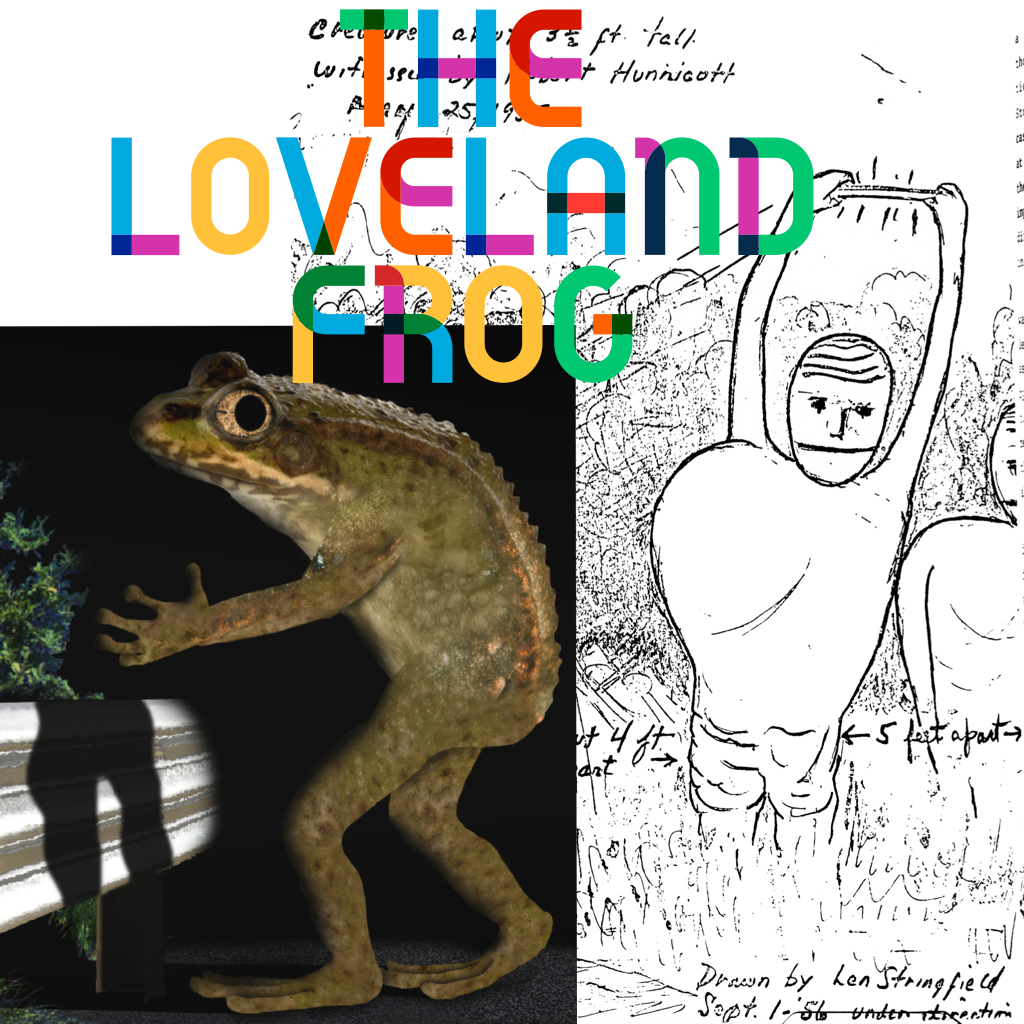
223 – The Loveland Frog
The Loveland Frog sits at a genuinely odd crossroads: it has the local-legend warmth of a hometown cryptid, the humanoid-alien trappings of the UFO-humanoid wave of the mid-1950s, and — as the evidence increasingly suggests — a possible mundane explanation involving an escaped iguana and a boot factory. Blake went back to the primary documents while preparing MonsterTalk’s earlier Kentucky Goblins three-parter, and links to those sources are in the show notes below.
🐸 The Sightings: What Was Actually Reported
The Loveland Frog has accumulated only a handful of documented sightings across roughly six decades.
The 1955 sighting is the murkiest. An anonymous Ohio businessman driving near the Little Miami River late at night reported seeing three short, scaly, bipedal beings with webbed hands and feet standing erect under or beside a bridge. In some versions of the story, one of the beings raised a metal rod and produced a shower of sparks before the witness fled. The report eventually surfaced through Leonard Stringfield, director of the Civilian Research Interplanetary Flying Objects (CRIFO) group and publisher of the newsletter Orbit, making it effectively a UFO-adjacent case from the start. No newspaper record or police report for the incident has been independently verified.
In January 1972, Officer Ray Shockey of the Loveland Police Department was driving carefully on an icy road along the river when he spotted a three-to-four-foot-tall creature with leathery, frog-like skin. It rose onto its hind legs, stared at him, then climbed over a guardrail and disappeared toward the water. Fellow officers reportedly found abrasion marks on the guardrail, but Shockey — a first-year officer — became a source of some ridicule.
Two weeks later, on St. Patrick’s Day 1972, Officer Mark Matthews encountered what he described as a similar creature crouched on a slick road, which lurched upright when he approached to move it. He fired his weapon and the creature again retreated over a guardrail. Matthews later recanted: he said he had seen an ordinary large lizard — probably an iguana — and had embellished the account partly to support his colleague. That recantation came in an interview for a cryptid folklore book, but the book omitted the key passage, leaving Matthews still trying to set the record straight.
The most recent sighting came in 2016, when Sam Jacobs and his girlfriend, out playing Pokémon GO near Lake Isabella in Loveland, photographed and briefly filmed something in the water with a frog-shaped head and glowing eyes. The footage is blurry and dark; Ryan’s best guess is a person in a dry suit with headlamps. The 2016 sighting also prompted Matthews to reiterate, once again, that he had seen a lizard.
🛸 Primary Sources: Where the Story Comes From
Blake traced the 1955 incident back to two key documents. Stringfield first published the account in his CRIFO newsletter Orbit. UFO investigator Ted Bletcher — a prolific researcher who was also a pioneer of New York’s gay theater scene — later investigated the case in 1956 and revisited his notes in the 1970s for a dossier on the Kelly-Hopkinsville encounter. That write-up appeared in Close Encounters at Kelly and Others of 1955, co-authored with Isabel Davis and published by the Center for UFO Studies (CUFOS). The Loveland case appears in an addendum, grouped with a cluster of small-humanoid reports from the same year. Blake has excerpted the relevant section into a PDF linked in the show notes.
The broader 1955 humanoid wave — which includes Kelly-Hopkinsville and a number of anonymous or loosely documented Ohio River Valley reports — gives the Loveland Frog a distinctly ufological flavor that later retellings often strip away, leaving only the cryptid shell.
🦎 The Iguana Hypothesis (Now With More Evidence)
When Ryan wrote the Skeptoid episode in 2014, he tentatively floated a mangy coyote as a possible explanation for the 1972 sightings — partly because surviving an Ohio winter seemed too tall an order for an escaped iguana. Returning to the research for this episode, he found a detail that changes the calculus: a large boot factory operated north of Loveland on the river and likely discharged warm water into it. A cold-blooded reptile keeping close to that thermal refuge could plausibly have overwintered.
Several other details fit:
– Iguanas can drop and regrow their tails — consistent with the first sighting (no tail) and second sighting (partial tail).
– The creature’s sluggish, crouching behavior on an icy road matches a cold-blooded animal struggling with low temperatures.
– Adult iguanas frequently exceed three feet in length and are commonly released by owners who underestimate how large they grow; the species was not unheard-of as a pet in 1970s Ohio.
– Matthews’s own recantation explicitly names an iguana.
Ryan’s current position: the 1955 account is probably folkloric; the 1972 sightings probably involved a real iguana, seen by officers who already knew the local legend and pattern-matched accordingly.
🌊 Folklore, Pop Culture, and the “Scripteds” Problem
Creature from the Black Lagoon was released in 1954 — one year before the first Loveland sighting. Blake raises the concept of “scripteds”: monsters that closely echo recently released films, suggesting pop culture primes witnesses (or storytellers) to report particular creature shapes. Whether the anonymous 1955 businessman had seen the film is unknown, but the timing is conspicuous.
Edgar Slotkin, a folklore professor at the University of Cincinnati, presented a paper on the Loveland Frog at the American Folklore Society‘s 1985 annual meeting, arguing the case has all the hallmarks of living folklore rather than a genuine zoological mystery — cyclic sightings, community reinforcement, local identity investment. His observation that “we’re all the folk” stuck with Ryan as a neat encapsulation of why skeptics shouldn’t feel exempt from the same cultural dynamics. Sadly, when Ryan tried to contact Slotkin while writing the Skeptoid piece in 2014, he learned the professor had died just days earlier; his daughter responded warmly and said the inquiry had brought the family comfort.
🐊 Colorado’s Frog Boy and Other Amphibian Cryptids
Karen notes that she wrote an article for CSI about Frog Boy, a lesser-known cryptid reportedly seen in the 1970s along Interstate 76 near Brighton, Colorado — not far from Loveland, Colorado. Her hypothesis: the Colorado legend may be a transplant from Loveland, Ohio, carried westward around the time of the 1972 sightings. (The Loveland portal theory — that all cities named Loveland are connected by amphibian interdimensional passages — was also proposed and assigned a low Bayesian prior.)
Other amphibian-adjacent cryptid touchstones discussed:
– The Hodag of Wisconsin — a deliberate hoax creature described as having, among other features, the head of a frog; now the mascot of an annual festival in Rhinelander.
– The Kappa, the Japanese water-dwelling creature with a bowl of liquid in its head — one of many cross-cultural “something in the water will pull you under and kill you” traditions.
– The golden toad of Central America, almost certainly extinct but occasionally treated like a cryptid by hopeful observers, in the same vein as the ivory-billed woodpecker or the Tasmanian tiger.
🎭 Pop Culture: From Musical to Frog Town
Hot Damn! It’s the Loveland Frog! was a bluegrass-inflected musical performed at the 2014 Cincinnati Fringe Festival — apparently its only production run, with no recordings publicly available. Ryan would very much like to see it.
Blake recommends the 1988 post-apocalyptic film 🎬 Hell Comes to Frogtown 💵, starring Rowdy Roddy Piper, which combines nuclear wasteland aesthetics, humanoid frog mutants, and a plot that is exactly as unhinged as it sounds. A dramatic reading of the film’s theatrical trailer closes out the episode.
📚 Further Reading
– Ryan Haupt’s Skeptoid episode 473: “The Loveland Frog”
– 🎬 Hell Comes to Frogtown 💵 (1988), dir. Donald G. Jackson & R.J. Kizer
🔗 Related Links
– Loveland Frog – Wikipedia
– Kelly–Hopkinsville Encounter – Wikipedia
– Leonard Stringfield – Wikipedia
– Little Miami River – Wikipedia
– Hodag – Wikipedia
– Golden Toad – Wikipedia
– Kappa (folklore) – Wikipedia
– Creature from the Black Lagoon (1954) – Wikipedia
– Science…Sort Of podcast
Note: ads inserted into the distributed audio alter the timestamps in unpredictable ways, so timing references in these notes are approximate.
Ryan Haupt joins us to discuss the strange case of “the Loveland frog.”
Links:
Hot Damn! It’s the Loveland Frog!A musical based on the Loveland Frog
Hell Comes to Frogtown (1988) post-apocalyptic movie with Rowdy Roddy Piper
Ryan Haupt podcast Science…Sort Of
Full version: CUFOS doc on KY Goblins (includes Loveland Frog)
Full version: CRIFO 1955 (Leonard Stringfield)
Blake Smith
0