Uncategorized
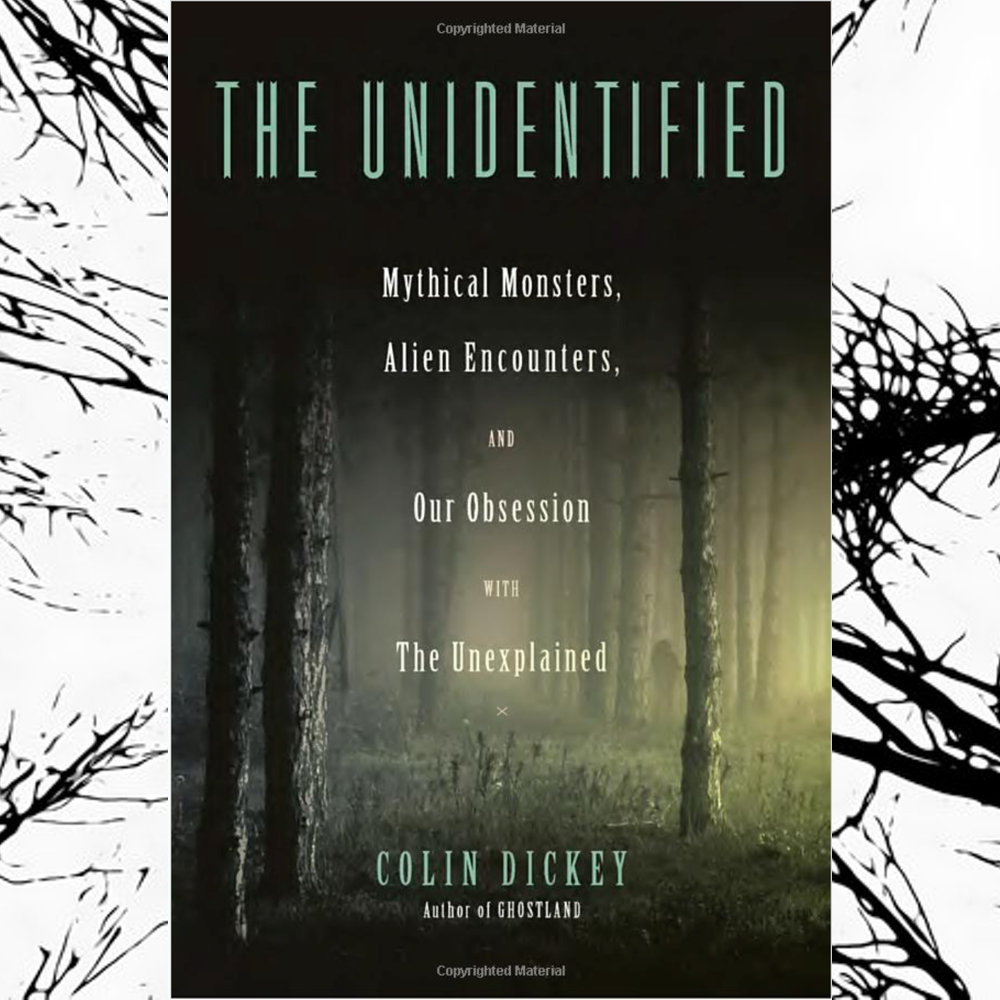
217 – The Unidentified
Download as MP3 (right-click, save as)
The book began life as a sprawling look at conspiracy theories, shed roughly 90,000 words across multiple drafts, and emerged as a cultural history of cryptids, UFOs, lost continents, and the liminal frontier spaces where they tend to live. If Ghostland was secretly about architecture, The Unidentified is secretly about wilderness — or more precisely, about the psychic work that “wild” and “uncharted” spaces do for a civilization that keeps running out of them.
🏔️ Mount Shasta and the Geography of the Weird
Colin’s research took him on a road trip through what he and Blake describe as “the geography of the weird” — places that sit just at the edge of the familiar, where civilization gives way to something less mappable. Mount Shasta, California, is exhibit A. Colin found a town with more crystal shops than bars, a mountain of jaw-dropping beauty, and locals who needed almost no prompting to share their stories.
One encounter stood out: a Bay Area man who made the four-to-five-hour drive several times a year, loading his car with jugs of glacially filtered Sacramento River headwaters — the only substance, he assured Colin, capable of keeping 5G at bay. Colin is careful not to mock: the ritual of acquiring the water, he suggests, may itself do something real for the person acquiring it, even if the metaphysics are on shakier ground. The broader point, drawn out across the book, is that these “unstable isotope” spaces — Sedona, Shasta, Area 51 — have energy that comes almost entirely from the people projecting onto them.
🌊 Atlantis, Colonialism, and the Disappearing Frontier
One of the book’s more provocative arguments concerns the relationship between colonial expansion and the hunger for lost continents. Ignatius Donnelly — Minnesota speculator, manifest-destiny booster, founder of the failed town of Nininger, and author of the first modern book on Atlantis — serves as Colin’s key exhibit. The argument: colonialism requires a mythologized “frontier,” an uncivilized beyond waiting to be claimed. By the early 20th century, that frontier had been fully occupied, colonized, and domesticated. Atlantis filled the vacuum — a frontier that can never be colonized, never have a McDonald’s, always just out of reach. Bigfoot, Colin suggests, performs a similar function: if he’s out there in the redwoods, the frontier isn’t fully gone yet.
📰 Charles Fort and the Damned Facts
Charles Fort is a linchpin of The Unidentified. Fort spent his days at the New York Public Library reading scientific journals and newspapers and collecting anomalous reports that mainstream science had quietly shelved. His first published book, The Book of the Damned (1919), argued not for a specific paranormal theory but for a kind of principled refusal to discard inconvenient data. Colin, via science fiction writer and anomalous-literature collector Jack Womack, frames Fort’s actual intellectual contribution as something genuinely difficult to practice: holding an unexplained event in mind without immediately reaching for either a skeptical debunking or a credulous pseudoscientific embrace.
The canonical Fortean example discussed here is the Kentucky Meat Shower of March 1876, in which chunks of flesh — a couple of inches across — rained down over a roughly hundred-square-foot patch of Mrs. Crouch’s farm in Bath County. It was documented in scientific journals. Brave townspeople tasted it. A microscopist concluded it was either horse meat or human infant (those being his available reference samples). The leading explanation — vultures lightening their load mid-flight — is noted but contested: no eyewitnesses reported a large flock overhead, and the quantity of meat implies a lot of birds.
The last known physical specimen resides at Transylvania University in Lexington, Kentucky — one of the oldest universities in the country — in the custody of art history professor Kurt Gohde. Colin makes the point that the meat shower’s enigma is partly a function of its timestamp: today, cell phones and DNA testing would resolve it immediately. The mystery is, in part, the 19th century.
🛸 The Maury Island Incident and the UFO Origin Story
Blake raises the Maury Island UFO incident as a litmus test for ufology credulity — and Colin agrees it reads as an obvious hoax. What makes it worth studying, per Colin’s conspiracy-theorist-theorist friend Jason Brown, is that despite (or because of?) its hokiness, the case contains in embryo virtually every major trope of what UFO culture would later become: Men in Black, mysterious plane crashes with destroyed evidence, memory wipes, and a cameo by Kenneth Arnold himself.
Arnold also gets his own moment here: his famous 1947 sighting over Mount Rainier described bat-wing-shaped objects moving like saucers skipped across water — a simile for their motion, not their shape. Within 24 hours, telephone-game journalism had converted the metaphor into a shape, and the flying saucer was born. Colin finds the mistranslation almost poetically apt: the saucer image is strange enough to stick in the mind precisely because nobody would invent it.
🛸 Flying Saucer Cults and Cognitive Dissonance
The conversation moves to contactees and the question of whether a new religion was emerging from postwar UFO culture. Colin points to Dorothy Martin (pseudonymously renamed Marion Keech in Leon Festinger‘s landmark study 📚 When Prophecy Fails 💵), who in 1955 believed she was receiving automatic transmissions from a being on Venus warning of a coming flood on December 21st — with UFOs standing by to evacuate the faithful. When the date passed uneventfully, Martin and her followers doubled down, giving Festinger the raw material for the concept of cognitive dissonance. Colin notes that Martin reads as structurally identical to a 19th-century Spiritualist medium: automatic writing, a female figure at the center, affective “sensitivity” coded as spiritual gift. Only the cosmology changed.
🦶 The Patterson-Gimlin Film and the Psychology of Belief
Colin describes the Patterson–Gimlin film as “an obvious hoax” — a conclusion he reached partly through primatological analysis suggesting the creature’s cranial ridge implies a vegetarian gut anatomy that the figure’s body simply doesn’t have, and partly through the film’s mixing of male and female traits. He draws a parallel to the surgeon’s photograph of the Loch Ness Monster: both are almost certainly fabricated, and both carry a strange aesthetic power — grainy, moody, melancholic — that made them cultural lodestones regardless of their authenticity.
Blake notes that M.K. Davis‘s stabilized animated-GIF version of the PGF, rather than settling the debate, seemed only to deepen the interpretive divide: skeptics saw a person walking across a field; believers saw a more clearly real creature. Colin cites Kevin Young’s 📚 Bunk 💵 for a useful frame: once a belief is doing genuine psychological work for someone, the facts are necessary to know but not sufficient to dislodge it.
🪶 Cultural Appropriation and Cryptozoology
One of the episode’s sharper moments comes when Blake reads from the book — a quote from Clyde Tallio (Snixahila), an Indigenous scholar, who describes cryptid hunters as “white interlopers who don’t understand the histories or what they mean.” The critique is specific: cryptozoologists selectively mine Indigenous oral traditions for anything that resembles a Bigfoot sighting while dismissing talking coyotes, foxes, and bears as irrelevant mythology. It’s a form of cultural appropriation, Colin argues, but a peculiar one — not costume appropriation but narrative appropriation, a translation of story into forensic empiricism that changes its function entirely. Blake notes this has been reconfiguring his thinking about cryptozoology for some time.
📚 Further Reading
– 📚 The Unidentified: Mythical Monsters, Alien Encounters, and Our Obsession with the Unexplained 💵 by Colin Dickey
– 📚 Ghostland: An American History in Haunted Places 💵 by Colin Dickey
– 📚 When Prophecy Fails 💵 by Leon Festinger, Henry Riecken, and Stanley Schachter
– 📚 Bunk 💵 by Kevin Young
– 📖 The Book of the Damned by Charles Fort
🔗 Related Links
– Kentucky Meat Shower (Wikipedia)
– Maury Island Incident (Wikipedia)
– Patterson–Gimlin Film (Wikipedia)
– Charles Fort (Wikipedia)
– Ignatius Donnelly (Wikipedia)
– Dorothy Martin / Marion Keech (Wikipedia)
– Cognitive Dissonance (Wikipedia)
– Transylvania University (Wikipedia)
– Kenneth Arnold UFO Sighting (Wikipedia)
Note: ads inserted into the distributed audio alter the timestamps in unpredictable ways, so timing references in these notes are approximate.
Author Colin Dickey is back with another fantastic book – this time it’s taking a look at the culture of the weird including UFOs, doorways to Atlantis, cryptozoology, and jarring Fortean events. The Unidentified is available in paper, and audio via audible.
Colin’s previous episode was #149 and covered his fantastic book Ghostland.
Discussed in this episode:
Mt. Shasta – the doorway to the hollow earth and Atlantis
The stabilized PGF film of Bigfoot
Ignatius Donnelly (father of Modern Atlantis nonsense)
The patch campaign on Kickstarter from “The Monsterologist” George Coghill still has patches available and they’re gorgeous.
Details on the patch give away are here.

Blake Smith
0
Tags :