216 – Cane Toads
Download this episode (Right-Click, Save As)
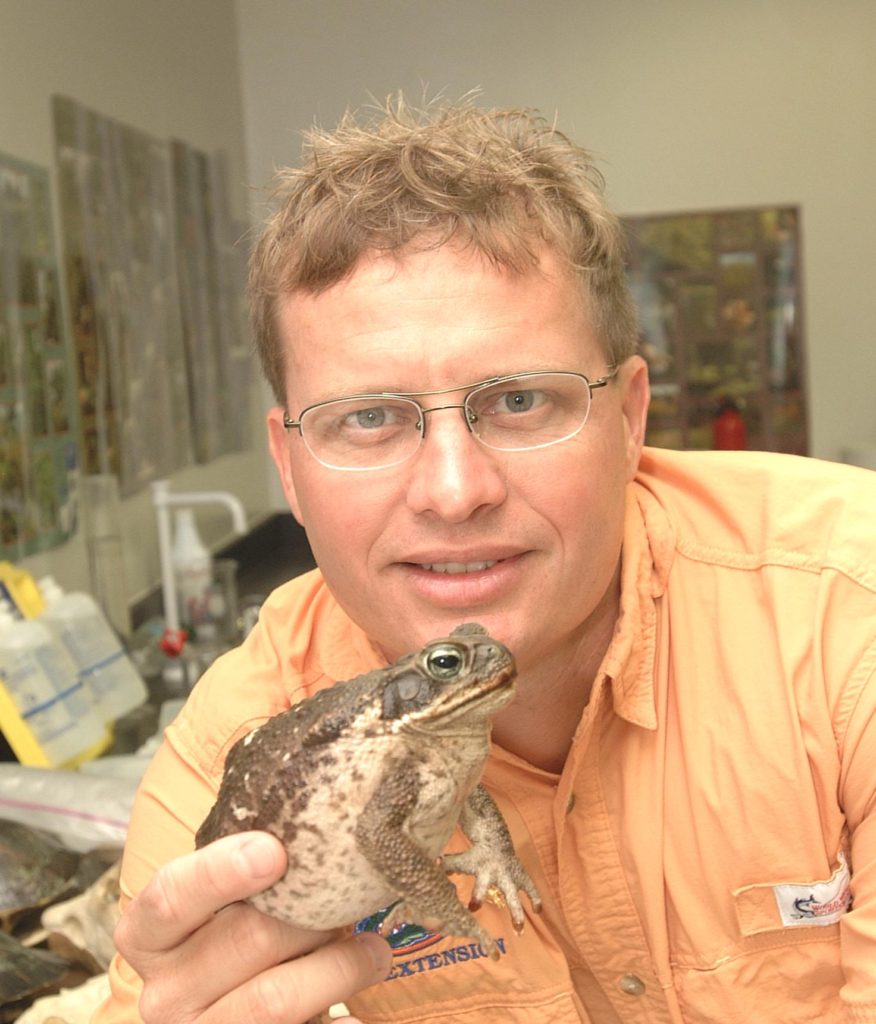
Karen, who grew up in Australia, is intimately familiar with these warty behemoths. Blake, a native of the American South, notes that the cane toad may be inching toward his home state sooner than anyone would like. Dr. Johnson’s lab studies non-native and invasive herpetofauna in Florida, and he describes cane toads as “little monsters I’m very fond of — but it’s a love-hate relationship.”
🐸 Toads, Frogs, and the Bufonidae Family
Dr. Johnson walks us through a common source of confusion: the difference between toads and frogs. The short answer? There isn’t one, taxonomically speaking. All toads are frogs, but not all frogs are toads — just as all newts are salamanders but not all salamanders are newts. Cane toads belong to the family Bufonidae, and are characterized by their stout bodies, relatively dry (though still permeable) skin, and — most distinctively — their enormous parotoid glands, the large lumpy structures on their shoulders that secrete bufo toxin.
Australia has native frogs but no native toads in the Bufonidae family, and no native salamanders — a gap in evolutionary experience that has made the continent uniquely vulnerable to the cane toad’s arrival. Dr. Johnson also gives a brief tour of the three main amphibian groups: the frogs (Anura), the salamanders (Urodela), and the worm-like caecilians (Gymnophiona).
☠️ The Toxin: Poison, Not Venom
The cane toad’s chemical arsenal is worth understanding carefully. The toxin is a poison (must be ingested or contact mucous membranes) rather than a venom (actively injected). Every life stage — eggs, tadpoles, juveniles, and adults — is toxic, with adults being the most dangerous. The parotoid glands must be placed under pressure to squirt the viscous secretion, though a highly stressed toad can ooze it passively. Dr. Johnson notes — from personal experience at a public lecture — that the glands can project several feet when squeezed unexpectedly.
Effects on animals that bite or ingest a toad can range from drooling and convulsions to death. Dogs are a common casualty in both Florida and Australia. For humans, direct skin contact is relatively low-risk, but the toxin causes intense bitterness (Dr. Johnson confirms this from a self-conducted taste test with a native southern toad), temporary blindness if it reaches the eyes, and reportedly hallucinogenic effects in higher doses — enough that cane toad toxin has at times been classified as a controlled substance in Queensland.
🌏 The Australian Introduction: A 1930s Disaster in Slow Motion
Cane toads are native to Central and South America (ranging into extreme southern Texas). They were introduced to Queensland, Australia in 1935, transported via Hawaii, with the intention of controlling cane beetles (Dermolepida albohirtum) devastating the sugar cane industry. The plan failed comprehensively: cane toads are generalist predators, not specialists, and were rarely in the right place at the right time to encounter the grubs they were meant to eat.
A large female can lay up to 30,000 eggs in a single clutch. From their initial release sites near what is now Gordon Vale, south of Cairns (Dr. Johnson has visited the commemorative mural there with students), the population has since spread across a range comparable — if you superimpose Australia over the continental United States — to moving from North Carolina all the way to the Dakotas and down toward Georgia. Population estimates for Australia: millions, possibly billions. Nobody really knows.
The toads at the leading edge of the invasion front have evolved over generations to be faster and longer-legged dispersers than those in long-established areas — a grim demonstration of rapid evolution in real time. Cattle watering troughs and excavated tanks across Australia’s arid interior have functioned as stepping stones, accelerating the spread.
🦎 Ecological Impacts: Quolls, Crocs, and Corvids
The carnage among Australia’s native fauna has been severe. Species with no evolutionary history of encountering a toxic prey item simply don’t recognize the danger. Documented casualties include quolls (small carnivorous marsupials), freshwater crocodiles, and several species of frog-eating snakes. In Florida, by contrast, the ecological impact appears far more limited — likely because local reptiles and mammals evolved alongside related Bufonidae species and have some pre-existing physiological or behavioral resistance.
Some animals have adapted. Corvids — crows and ravens — have learned to flip toads onto their backs and consume the non-toxic ventral surface and organs, bypassing the shoulder glands entirely. Research by Dr. Rick Shine and his colleagues at the University of Sydney has documented both the ecological damage and some grounds for cautious optimism: Australian researchers have experimented with conditioned taste aversion to train native predators — in captivity and potentially in the wild — to avoid toads. Natural selection may also be gradually favoring less aggressive attack behaviors in populations that have coexisted with toads for multiple generations.
A surprising finding from Dr. Johnson’s own lab: a Virginia opossum (Didelphis virginiana) that wandered into a cane toad acoustic lure trap in Florida proceeded to eat the captured toad — whole, no belly-flip technique required — with no apparent ill effects.
🪤 Trapping, Control, and Humane Euthanasia
Dr. Johnson describes the current best-practice approach for homeowners who encounter cane toads in Florida or Australia. Hand capture (using a plastic bag turned inside out), followed by refrigeration for a few hours to slow metabolism, and then 24 hours in a freezer, constitutes a humane euthanasia method consistent with veterinary guidelines. Alternatively, applying a topical anesthetic — the same benzocaine-containing gels used for toothache relief or sunburn — to the toad’s skin before freezing provides additional sedation.
In Australia, a commercially marketed anesthetic spray called HopStop has been developed specifically for this purpose. Dr. Johnson’s lab has also tested a sophisticated acoustic lure trap produced by the Australian company Acta, which uses a recorded cane toad mating call and an LED light on a solar-powered timer to attract females after dark — with impressively low rates of non-target capture.
The lesson Dr. Johnson returns to throughout: vertebrate generalist predators make terrible biological control agents. The cane toad introduction, like the introduction of kudzu to the American South in the same decade, stands as a cautionary tale about the gap between ecological optimism and ecological reality.
📺 Documentaries
Two documentaries are discussed — both shown by Dr. Johnson in his invasion ecology courses:
– 📺 Cane Toads: An Unnatural History (1988) — directed by Mark Lewis; the cult classic that introduced the world to a little girl on the Tablelands near Cairns and her dinner-plate-sized pet toad named Dairy Queen. Also available on Curiosity Stream.
– 📺 Cane Toads: The Conquest (2010) — Lewis’s follow-up, featuring many of the same characters a generation later. Currently available on YouTube; UK DVD release only for physical media.
📚 Further Reading
– 📚 Cane Toad Wars 💵 by Rick Shine — the definitive popular-science account of the Australian invasion and the research efforts to understand and combat it
🔗 Related Links
– Cane toad in Australia — Wikipedia
– Rhinella marina (Cane Toad) — Wikipedia
– Dr. Steven Johnson — UF Department of Wildlife Ecology & Conservation
– Biological Pest Control — Wikipedia
– Invasive Species in Australia — Wikipedia
– Quoll — Wikipedia
– Kudzu in the United States — Wikipedia
– Parthenogenesis — Wikipedia
Note: ads inserted into the distributed audio alter the timestamps in unpredictable ways, so timing references in these notes are approximate.
In this episode, we talk with Dr. Steven Johnson of the University of Florida about invasive species and specifically focus on the cane toad. This incredibly robust and prolific toad excretes poison fluid from glands on its back and has been introduced from its native habitat into several locations around the world, most notably (and destructively) in Australia.
Mentioned in the episode
There are two notable documentaries about the cane toad:
Cane Toads: An Unnatural History (1988) – Available through Curiosity Stream if you have that service. (And on YouTube at the time I post this)
Cane Toads: The Conquest – which looks to only be available as a UK DVD
(but is also on YouTube as I post this)

Cane toad near Queensland, AU

Lovecraftian kudzu horrors…
