Regular Episode
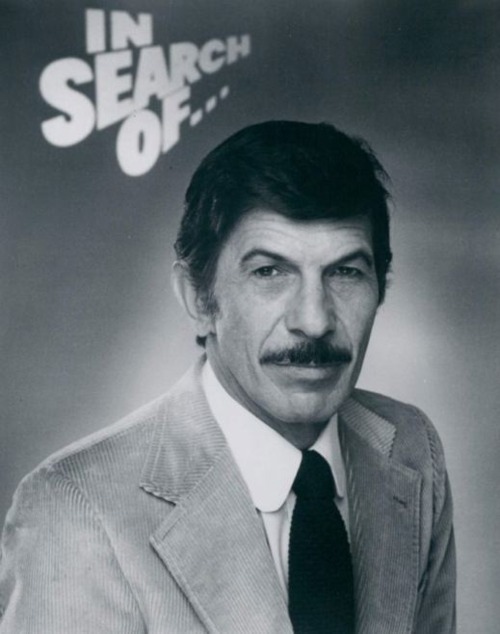
200 – In Search Of…
Blake also announces a new companion podcast, In Research Of…, co-hosted with archaeologist Dr. Jeb Card, in which they revisit each original episode of In Search Of… and add the scientific context the producers chose not to include.
🛸 Origins: From Ancient Astronauts to Leonard Nimoy
The lineage of In Search Of… runs directly through the ancient astronaut craze of the early 1970s. In 1968, Erich von Däniken published 📚 Chariots of the Gods? 💵, which inspired a German documentary film of the same name. TV producer Alan Landsberg acquired the footage, re-scripted it, and hired Rod Serling — already beloved for The Twilight Zone and Night Gallery — to narrate the resulting 1973 TV special, In Search of Ancient Astronauts. The special’s ratings success led to two follow-ups: In Search of Ancient Mysteries and The Outer Space Connection (1975).
When Serling died during heart surgery in 1975, the franchise needed a new voice for the full series it had earned. Nimoy, already known as Mr. Spock from Star Trek, was the first choice — his association with science, logic, and the analytical gave the show an air of credibility that pure entertainment hosts couldn’t have provided. Blake notes that the first season was a low-budget affair, mixing real scientists (biologists, astronomers) with fringe-belief advocates in a way that gave viewers no clear signal about who was which — a kind of televisual false balance predating the term. Every episode opened with the now-famous producer’s disclaimer: “This series presents information based in part on theory and conjecture. The producer’s purpose is to suggest some possible explanations, but not necessarily the only ones, to the mysteries we will examine.”
📺 Format, Fashion, and the Nimoy Effect
Early episodes featured Nimoy in a stark studio — evoking the dark gallery sets of Night Gallery — with location shoots becoming more frequent as the series matured. Listeners who put out a call on Facebook for discussion topics overwhelmingly requested one subject above all others: Nimoy’s evolving wardrobe. Wide lapels, safari suits, houndstooth blazers, cravats, epaulets, corduroy, and a generous application of polyester mark the early seasons; a full pornstache (Blake’s term: “a Mark Spitz pornstache”) arrives around season four and divides fans to this day.
Nimoy’s involvement deepened over the run — he had previously performed a one-man stage show on Vincent van Gogh, and the series eventually dedicated an episode to van Gogh. His connection to the franchise’s origins was not accidental: he had appeared as an actor on Night Gallery and directed at least one episode there, giving him a prior working relationship with Serling’s world. After In Search Of…, Nimoy went on to direct several Star Trek feature films and the 1987 hit Three Men and a Baby. The 2016 documentary 🎬 For the Love of Spock 💵, directed by his son Adam Nimoy, mentions In Search Of… only briefly — a slight that Blake finds baffling given the show’s cultural footprint.
In Australia, the series aired under the title Great Mysteries of the World, with a different opening sequence, different theme music (attributed by fans online to Gustav Mahler‘s Fifth Symphony), and a local producer introduction — yet Nimoy’s voiceover still referred to “tonight’s episode of In Search Of,” leaving young Karen puzzled about which show she was actually watching.
🎵 The Sound of the Uncanny: Rinder and Lewis
Much of the show’s lasting atmospheric power comes from its score. The incidental music was composed by Lauren Rinder and W. Michael Lewis, who layered early synthesizer textures into something genuinely unsettling. No standalone album of the interstitial cues was ever released; the official In Search Of Orchestra LP was recorded in the duo’s other signature style — disco — which, while commercially logical (Rinder and Lewis were wildly successful disco producers), disappointed fans hoping to own the spooky electronic soundscapes from the show.
Blake speculates — only half-jokingly — that the widespread use of “woo-woo” as shorthand for paranormal credulity may derive directly from the synthesizer soundscape that Rinder and Lewis established. The show’s sonic aesthetic preceded the broader synthesizer moment: Cosmos (1980) with Vangelis was still years away, and the Moog synthesizer had barely reached the consumer market.
🏰 Favorite Episodes and the Coral Castle Pilgrimage
Blake and Karen trade favorite episodes and personal memories. Karen’s standout is “The Castle of Secrets,” the episode covering Coral Castle in Homestead, Florida — built by Latvian immigrant Ed Leedskalnin in the 1920s and 1930s out of hundreds of tons of coral rock. Legends of levitation and anti-gravity surrounded its construction; the mundane reality is that Leedskalnin, who had a masonry background, used simple tools and tripods. He eventually moved the entire structure roughly 11 miles to its current location. Karen has since made the pilgrimage in person and notes the episode also inspired Billy Idol‘s song “Sweet Sixteen.” Other episodes discussed include the Anastasia Romanov claimants episode, the ghost episode featuring paranormal investigator Hans Holzer (whose medium work on the Amityville Horror case is also touched on), the Oak Island Money Pit episode, and a season-four episode on the Honey Island Swamp Monster — a location Blake and Karen visited together, where the swamp tour operator told them the whole thing was a hoax.
The Bigfoot episode from season one is of particular note to MonsterTalk listeners: the clip of Nimoy’s narration that opens every episode of this very podcast is drawn from it.
📡 Legacy, Revivals, and the Paranormal TV Flood
In Search Of… is widely credited with bursting open the market for paranormal factual television. Shows like Unsolved Mysteries, Sightings, and the Arthur C. Clarke series followed in its wake, and the format’s DNA runs through everything from ghost-hunting reality shows to Ancient Aliens. Blake and Karen debate whether the show was a precursor to reality TV — the scripted-but-interview-heavy format, the dramatic recreations, the parade of colorful characters (a woman convinced she was a reincarnated British monarch; the man and wife who claimed she was Anastasia Romanov) feel, in retrospect, very familiar.
A 2002 revival hosted by Mitch Pileggi (Assistant Director Skinner from The X-Files) restructured the show into a multi-segment format reminiscent of Ripley’s Believe It or Not. A 2018 reboot hosted by Zachary Quinto — who played Spock in J.J. Abrams’ Star Trek films — takes a more hands-on investigative approach; at the time of recording, a second season had been picked up by the History Channel. Blake also notes a fondness for the In Search Of parody sketch “Bullshit or Not?” in the 1987 anthology comedy 🎬 Amazon Women on the Moon 💵, in which Henry Silva investigates whether Jack the Ripper was, in fact, the Loch Ness Monster.
Both Blake and Karen note that rewatching the original series is a corrective to memory: the show is more balanced than many people recall, routinely including genuinely skeptical scientists alongside true believers without quite pitting them against each other. It is, as Blake puts it, “definitely more balanced than modern shows of this vein.”
📚 Further Reading
– 📚 Chariots of the Gods? 💵 by Erich von Däniken — the book that launched the ancient astronaut wave that ultimately produced In Search Of…
– 📚 The Skeptics’ Guide to the Universe 💵 by Dr. Steven Novella et al. — the audiobook excerpt read by Novella in this episode describes the formative influence of In Search Of… on his path to skepticism
– 📚 The Beast of Boggy Creek 💵 by Lyle Blackburn
– 🎬 For the Love of Spock 💵 — documentary directed by Adam Nimoy
– 🎬 Amazon Women on the Moon 💵 — includes the “Bullshit or Not?” parody of In Search Of…
🔗 Related Links
– In Search Of… (TV series) — Wikipedia
– Leonard Nimoy — Wikipedia
– Rod Serling — Wikipedia
– Coral Castle — Wikipedia
– Edward Leedskalnin — Wikipedia
– Hans Holzer — Wikipedia
– Oak Island Money Pit — Wikipedia
– Honey Island Swamp Monster — Wikipedia
– Skeptoid podcast — Brian Dunning
Note: ads inserted into the distributed audio alter the timestamps in unpredictable ways, so timing references in these notes are approximate.
A look back at the highly influential television show In Search Of… which was hosted by Leonard Nimoy. Features remembrances from Steven Novella, Lyle Blackburn, Matthew Baxter, and Brian Dunning.
Along with archaeologist Jeb Card, I’m launching a new show called In Research Of… which will revisit this original series and add some explanations the producers chose not to include. (Link to show on iTunes.)
In Search Of… had 6 seasons in its original run and you can currently (as of this posting) view them all on YouTube.
Thanks to everyone for supporting us to reach 200 episodes! Karen and I are excited about producing many more.
Blake Smith
0