#198 – The Grotesque 10
If you want to know what’s staring down at you from the peaks and archways of some of America’s most storied universities, this is the book that will make you look up.
🏛️ Why American Colleges Went Gothic
Matthew explains that the adoption of Gothic architecture on American campuses was — at its core — a financial and reputational strategy. In the mid-19th century, American colleges lacked the cultural prestige and endowments they enjoy today. By reviving the architectural vocabulary of medieval European institutions like Oxford and Cambridge, American schools created an unspoken association with centuries of learning — projecting, as Matthew puts it, “an air of tradition and permanence.” That projected gravity translated into elevated status and, in turn, larger donations and endowments.
Blake notes that even relatively young campuses in the American South pulled off the effect convincingly — buildings that look 200 years old, built well within living memory. Matthew compares the theatrical artifice to Walt Disney World: nobody actually believes medieval stonemasons built a castle in a Florida swamp, but the atmosphere works on you just the same, and the schools aren’t hiding when the buildings were constructed.
🗿 The Ten Campuses
The book covers ten institutions across the country, each selected because Matthew had something substantive to say about its carvings — not merely because they looked neat:
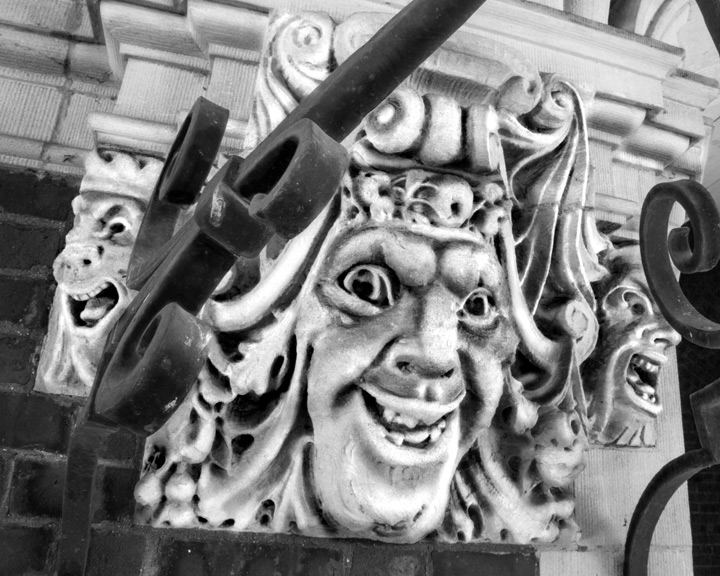
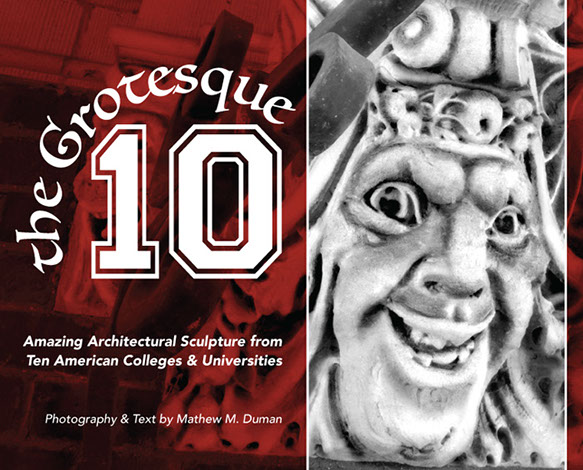
– University of Pennsylvania (Pennsylvania) — the cover image features a grotesque over four feet tall, mounted in a tunnel of the residential quadrangle, flanked by iron bars meeting at a lantern directly in front of its face.
– Northwestern University (Illinois)
– Duke University (North Carolina) — Matthew sent Duke president Richard Broadhead a copy of his Yale book to establish contact, which led to access to archival descriptions of the residential quadrangles.
– Princeton University (New Jersey)
– Washington University in St. Louis (Missouri)
– Trinity College in Hartford, Connecticut — Matthew had to coordinate with the college’s public relations office to photograph the chapel interior; their only stipulation was that the school always be identified as “Trinity College in Hartford, Connecticut.”
– University of Chicago (Illinois)
– City College of New York (New York) — sometimes called the “Hogwarts of New York.”
– Bryn Mawr College (Pennsylvania)
– Yale University (Connecticut) — Yale opened two new residential colleges in the Collegiate Gothic style just before the book went to press, giving Matthew an entirely fresh set of grotesques to photograph, including a sculptural series at the new colleges depicting the history of the written word: stone tablet, scroll, medieval book, printed book, and modern electronic tablet.
⚗️ The Grotesque Graveyard at City College
One of the book’s more surprising finds involves the original grotesques at the City College of New York. The carvings installed around 1904–1905 were made of terracotta and coated with a thick glossy glaze — a finish nobody liked, so the college had them sandblasted. Unfortunately, sandblasting micro-fractured the glaze, allowing moisture to penetrate. Freeze-thaw cycles did the rest, and by the 1960s and ’70s grotesques were literally falling off the buildings. In the 1980s the college removed them all, recast replacements in more durable material, and put the originals into storage.
Matthew tracked down the old carvings via a Google Maps deep-zoom of the Spitzer School of Architecture building, where he spotted a cluster of pale blotches along one wall. In person: roughly 60 original grotesques dumped in the grass beside a parking lot — a genuine grotesque graveyard, one car bumper away from the frame of his panorama shot.
🔥 Notre Dame and the Fragility of Stone Memory
The conversation briefly touches on the 2019 fire at Notre-Dame de Paris, which had occurred shortly before this episode was recorded. Matthew was devastated — Notre-Dame is, for him, the iconic Gothic cathedral, the one that comes to mind the moment someone says the words. He notes that from what he had read, many of the stone grotesques survived with limited damage (stone doesn’t burn, though heat and acidic smoke can still cause harm), and that the plan was to remove, store, and reinstall them during reconstruction. The cathedral’s grotesques and gargoyles are, in Matthew’s framing, messages from the past traveling through time — which makes their potential loss feel like something more than property damage.
✒️ M. R. James, Pew Ends, and a Very Old Pun
The pew-end carvings inside Trinity College’s chapel prompt a digression on M. R. James — the antiquarian ghost-story writer whose work is saturated with exactly this kind of church furniture. Blake mentions James’s story The Stalls of Barchester Cathedral, in which carved wooden figures on cathedral stalls play a quietly sinister role. Matthew notes that James (1862–1936) was a lifelong Cambridge and Eton academic — a provost, archivist, and cataloguer of old manuscripts — and that his birth-to-death span almost exactly brackets the era when Collegiate Gothic was flourishing in America.
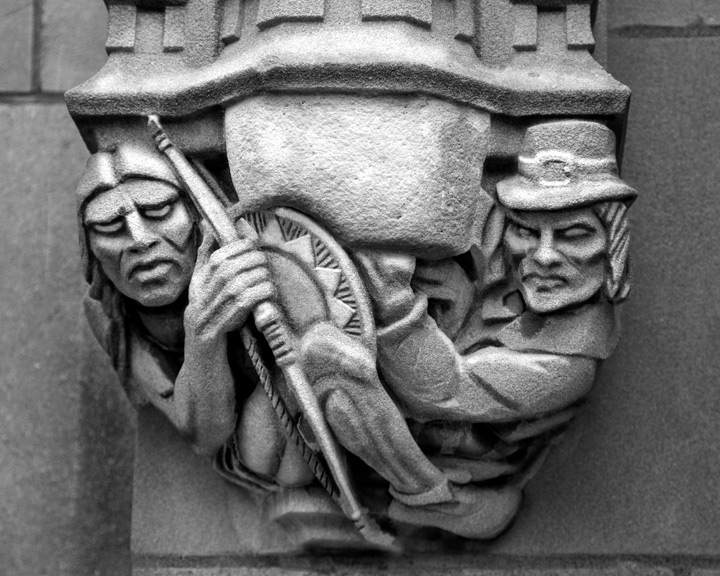
The Trinity College chapel also yields the episode’s best pun, carved in stone. The chapel’s primary donor was William Mather, a descendant of Cotton Mather (who, along with Increase Mather, bore significant responsibility for the Salem witch trials). William Mather once quipped that his family, upon arriving in the New World, “fell upon their knees in prayer — and then fell upon the aborigines.” His pew end depicts exactly that scene: Pilgrims kneeling on the Massachusetts shore, the Mayflower at anchor in the background, and — in the middle ground, small enough to miss — a settler with a gun chasing a Native American. Insightful and damning, carved into a church pew in the 1930s.
📚 Further Reading
– 📚 The Grotesque 10 💵 by Matthew M. Duman
– 📚 The Frighteners 💵 by Peter Laws (Blake’s Audible pick for the month)
🔗 Related Links
– Gargoyle (Wikipedia) — architectural and historical overview
– Grotesque (architecture) (Wikipedia)
– Bench Ends and Poppy Heads — the technical terms for carved church pew decorations discussed in the episode
– Davenport College, Yale — the Georgian-fronted, Gothic-faced residential college discussed in the episode
– Sterling Memorial Library, Yale — the Gothic cathedral-style library Blake visits when he needs to think
– Environmental DNA (eDNA) — the technique used in the Loch Ness water-sampling study Blake mentions toward the end of the interview
Note: ads inserted into the distributed audio alter the timestamps in unpredictable ways, so timing references in these notes are approximate.
In a follow-up to our episode on Gargoyles, photographer and author Mathew M. Duman has produced a new book visiting ten American campuses with gothic architectural and artistic features to document them for your edification and delight. Check out his book, The Grotesque 10 at his website.
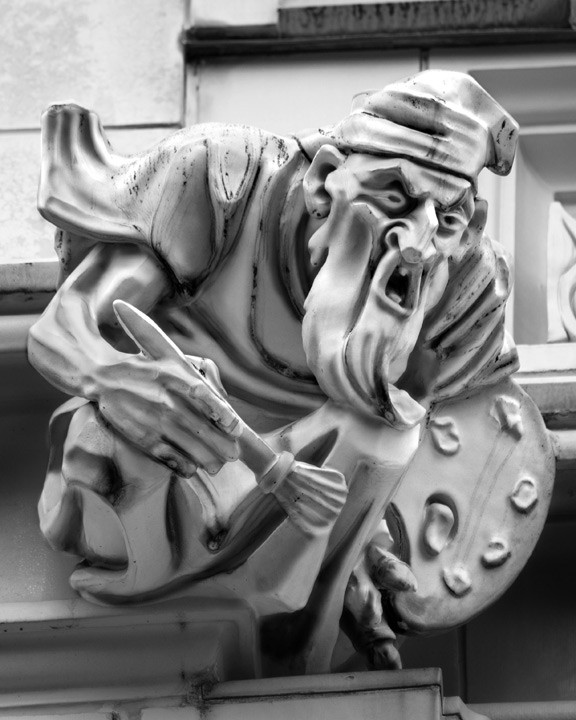
The old Detroit Free Press building I mentioned is undergoing renovation (along with lots of Detroit buildings) and will become a mixed-use property, perhaps re-opening in 2020. Several of the exterior sculptures are visible in this Flickr series.
During our interview, we talked about the term for the sculptures on a church bench. Some of these are called Bench Ends, and others are called Poppy Heads. I thought I should include that detail here.
You can check out my new show The Horror Podcast here.
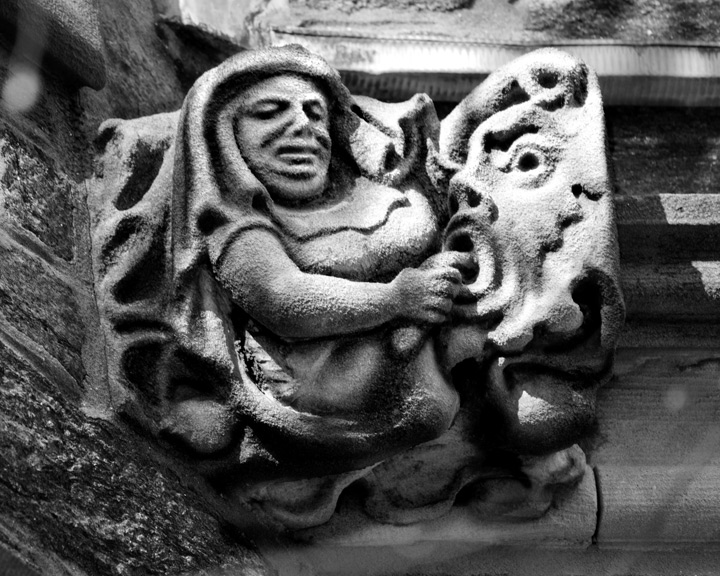
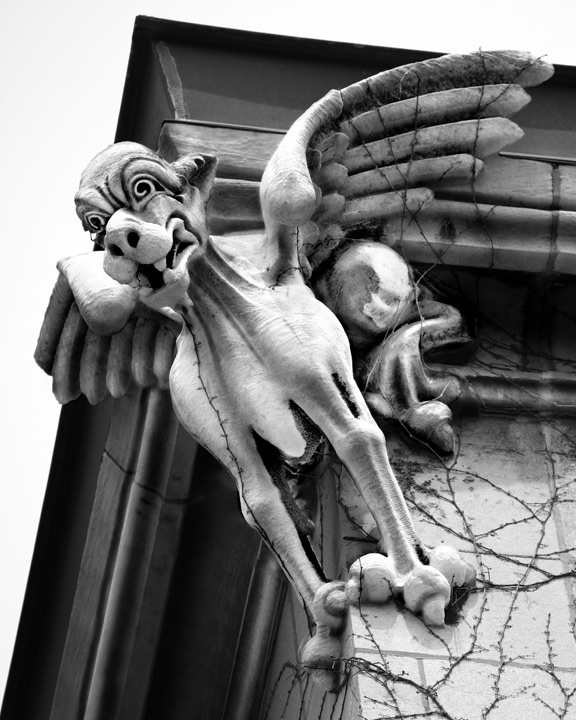
Some samples from The Grotesque 10: