Regular Episode
#162 – KRAMPUS IN JULY
🐐 What Does the Krampus Actually Look Like?
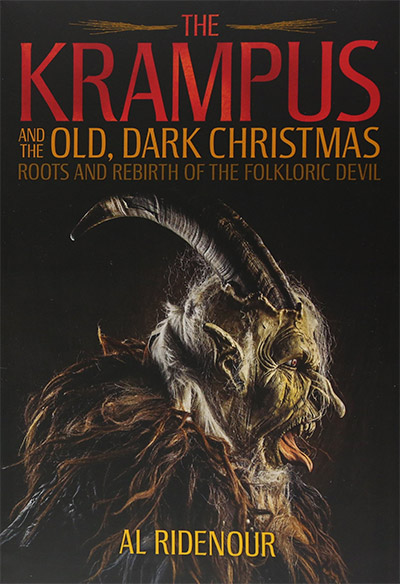
Ridenour draws a useful distinction between two versions of the creature. The postcard Krampus — the image most familiar to American audiences — is essentially a refined stage-devil: dark-furred, two-horned, carrying a basket for snatching naughty children, and looking a bit like a folkloric Mephistopheles. These lithographs began circulating in the 1870s–1880s, created by urban artists who had never attended an actual alpine Krampus run.
The costume Krampus of the living tradition is something altogether more bestial: long-furred (traditionally made from the pelts of alpine goats), multiple horns, oversized carved wooden masks, and a belt of bells designed to produce a startling, cacophonous entrance. Ridenour finds the real-world costume version more genuinely daunting. The Krampus is also emphatically not a singular entity — “it’s not Dracula, it’s vampires” — and the correct German usage is der Krampus, with Krampusse as the plural (though Ridenour charitably permits “Krampuses” for American audiences).
🎄 St. Nicholas Day, House Visits, and the December 6th Tradition
Contrary to popular American assumption, Krampus is not a Christmas creature. He is associated with St. Nicholas Day on December 6th. The traditional practice — still surviving in parts of Bavaria and the eastern Austrian Alps — involves a small group called a Pass: St. Nicholas accompanied by six or seven Krampuses conducting house visits. Nicholas performs a scripted verse, evaluates the children’s behavior (kids traditionally had to recite a Bible verse or poem), rewards the good, and then whistles — a signal for the Krampuses lurking outside, bells jangling, to come storming in.
Ridenour emphasizes the geographic specificity: this is not a German-wide tradition. Berliners regard it as a rustic southern peculiarity, much as Americans might stereotype Appalachian customs. The heartland is Bavaria and the eastern Austrian Alps, particularly the Gastein Valley and cities like Salzburg and Graz.
🏃 Krampus Runs: From House Visits to Full-Contact Sport
From the house-visit tradition evolved the Krampuslauf (Krampus run) — rowdy processions that Ridenour traces in character back to Saturnalia and the carnivalesque public mischief of the Middle Ages. By the 1910s–30s, organized parades were forming in larger cities; by the 1980s–90s, venues like Salzburg and Graz were erecting crowd barriers between spectators and costumed participants.
The most extreme surviving variant is found in Matrei in East Tyrol, where the tradition is so physically intense that Krampus masks deliberately omit horns to prevent injury. Participants reconstruct a mock alpine farmhouse kitchen — the table behind which children traditionally sheltered — and costumed Krampuses charge out to overturn it, then proceed to rip the shirts from willing adult challengers and hurl them into the snow. Ridenour notes that a participant was hospitalized some years ago. His advice: don’t go unless you’re specifically into it.
Alcohol, he reports diplomatically, has historically been “a factor,” though stricter troops now expel members who drink before a run. The payment of drink or food to visiting performers connects the tradition directly to wassailing customs across Europe.
🧙 Frau Perchta, Bloody Thomas, and the Boogeymen of the Saints
One of the book’s more surprising revelations: Krampus is only one of several monstrous alter egos attached to the Catholic liturgical calendar. Frau Perchta (also spelled Berchta) is an older female figure associated with Epiphany (January 6th) — her name derives from an old Bavarian phrase meaning “the shining night,” a term for that feast day. She presides over domestic order, spinning, and the discipline of female children and house servants. A 1700s woodcut Ridenour discusses shows her as a hump-backed, wart-nosed crone — a basket of stolen children on her back, a distaff in hand — anticipating the Krampus postcard imagery by over a century. Her German folk name, Butzenberger, shares the same etymological root as the English “boogeyman” and the Appalachian “booger man.”
Similarly, Bloody Thomas haunts St. Thomas Day (December 21st) — derived, Ridenour argues, from the sight of blood-spattered butchers slaughtering winter livestock — and an evil Lutzelfrau (ugly Lucy) shadows St. Lucy’s Day. The Krampus, in this framework, is essentially the bad Nicholas: a devil bifurcated from the saint, rather than a saint turned evil outright.
The conversation broadens into the syncretism of Christian and pre-Christian traditions — Ridenour prefers “hybridized” to “hijacked” — and the evolving concept of witchcraft, from a creature of a different ontological species (unkillable by ordinary means, hence silver bullets) to the more familiar early-modern figure codified by texts like the Malleus Maleficarum.
🎭 The Cacophony Society, SantaCon, and Krampus in Los Angeles
Ridenour’s path to organizing Krampus events in Los Angeles runs through the Cacophony Society, the San Francisco–based prankster collective that also gave birth to Burning Man and the original SantaCon (variously called “Santa Rampage” or “Santarchy”). After SantaCon outgrew its anarchic origins and became a traveling mob scene, Ridenour and a friend named Al Guero channeled that energy into the first Los Angeles Krampuslauf in 2013. The event has since grown to close off a street in downtown LA, complete with St. Nicholas arriving aboard a steam car and three dozen costumed Krampuses administering switch-swats to willing spectators. Participants are briefed on the rules beforehand — no strikes to the chest or face, the most common actual injury being a scratch to the eye.
📚 Further Reading
– 📚 The Krampus and the Old Dark Christmas 💵 by Al Ridenour (Feral House)
– 🎬 The Witch 💵 (discussed approvingly as folk horror done right)
🔗 Related Links
– Krampus — Wikipedia
– Frau Perchta — Wikipedia
– Feast of St. Nicholas (December 6th) — Wikipedia
– Krampusnacht — Wikipedia
– The Cacophony Society — Wikipedia
– Baba Yaga — Wikipedia
– Lupercalia — Wikipedia
– Bone and Sickle Podcast
Note: ads inserted into the distributed audio alter the timestamps in unpredictable ways, so timing references in these notes are approximate.
On a hot Summer day it’s nice to cool off and contemplate the hairy, horned winter monster of the Alps known as The Krampus. In MonsterTalk # 162, Blake interviews Al Ridenour, author of The Krampus and the Old Dark Christmas. Al is also the host of the folklore and pop-culture podcast Bone & Sickle.
Notes
Music
- Monstertalk Theme: Monster by Peach Stealing Monkeys
MTArchivist
0