Regular Episode
#139 – WITCHES, PLEAS
The conversation ranges widely — from the overlooked distinction between the village cunning woman and the diabolical witch of the witch crazes, through the role of the printing press and the Malleus Maleficarum, to the self-appointed terror of Matthew Hopkins and the very modern parallels that witch-hunt dynamics still draw.
🌿 Cunning Folk vs. The Monstrous Witch
Deborah draws an important distinction that popular culture tends to collapse: the cunning people — cunning men and cunning women — were broadly tolerated community figures who offered traditional medicine, fertility charms, and (suspiciously conveniently) the recovery of lost property. The culturally monstrous witch, by contrast, was a figure constructed largely from the top down: by inquisitors, by anxious Protestant authorities, and by neighbors looking for someone to blame.
The Lancashire Witches trial of 1612 illustrates how blurry that line could become. The case seems to have grown from a bitter feud between two families led by matriarchs known by their nicknames, Chattox and Demdike. Both women appear to have been cunning women on the edge of society — hardly the powerful, cauldron-commanding figures of legend. Twelve people were tried; most were executed. The post-Reformation religious climate of Lancashire, where Protestant authorities were actively hunting Catholic recusants, poured fuel on what might otherwise have been an unremarkable local quarrel.
⚖️ The Church, the Canon, and the Long Road to the Stake
One of the episode’s more surprising historical points: for centuries, the official position of the Catholic Church was that witchcraft had no real efficacy. The Canon Episcopi — practiced as canon law from at least the 11th century — held that believing in the literal power of witches was itself theologically suspect, since it granted the devil a power that belonged to God alone. A letter from the era of Charlemagne reportedly told Harald III of Denmark he was not permitted to burn women for causing hailstorms, because the damage was to their souls for consorting with evil, not to the actual weather.
That skeptical ecclesiastical position eroded slowly, through the machinery of heresy law, until inquisitors had worked out theological mechanisms by which the devil could — with God’s permission — cause real-world harm. The result was a legal and ideological infrastructure that could be, and eventually was, weaponised.
The Malleus Maleficarum (1487) — the Hammer of Witches — arrived hot on the heels of the Gutenberg press (c. 1440). Blake and Deborah note the book’s peculiarly nerdy internal logic: its authors wrestled seriously with questions like how a man’s intellect could survive translation into a wolf’s smaller brain (answer: the devil wraps the man in an “aerial semblance” of a wolf, or simply implants false memories afterward). The Malleus was formally condemned by the Catholic Church but proved enormously popular with Dominicans and inquisitors. A skeptical counterpoint arrived a century later in Reginald Scot‘s The Discoverie of Witchcraft (1584), though speaking up required the protection of powerful allies.
🔥 The Anatomy of a Witch Craze
Deborah pushes back on the popular assumption that witch crazes belong to the ignorant Dark Ages. They peaked in the 16th and 17th centuries — the birth pangs of modernity, during the massive societal upheaval of the Reformation and its aftermath. Her framework for what triggers a craze:
– A powerful elite that identifies a threat and pursues it industrially, from the top down.
– Economic stress: failed harvests, the Black Death’s aftermath, capital concentration, and vagrancy laws that left the poor as liabilities rather than recipients of church charity.
– Clash-of-civilizations pressure (the Spanish Inquisition as Catholic Europe pushing back against Islamic Spain; Ottoman advances into Eastern Europe).
– The perverse incentive of confiscating the accused’s goods — one inquisitor reportedly complained there were no rich people left to prosecute.
The Witches of Warboys case (1589–1593, Cambridgeshire) mirrors Salem in miniature: a daughter of the wealthy Throckmorton family fell ill, accused a poor local woman named Alice Samuel, and the accusations spread through the household via what looks, in retrospect, like a contagion of hysterical attention-seeking. Alice Samuel, her daughter, and her husband were all executed.
🔍 Matthew Hopkins and the Witchfinder’s Economy
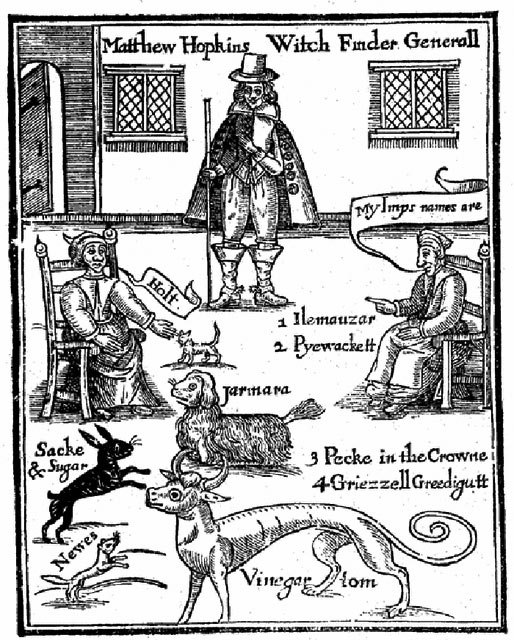
Matthew Hopkins, self-styled Witchfinder General, is responsible for a dramatic spike in English witch executions during the 1640s — England’s total before Hopkins was estimated at around 500; Hopkins and his associate John Stearne accounted for a disproportionate share in a very short time. He operated without any legitimate royal commission, thriving in the legal vacuum of the English Civil War. His methods included needle-pricking (finding insensitive spots on the body as supposed proof of a devil’s mark) and prolonged sleep deprivation — a form of torture whose inefficacy, Deborah and Blake note pointedly, is well established and remains relevant today.
The famous illustration associated with Hopkins depicts the accused Elizabeth Clarke surrounded by her familiars, including the memorably named Pyewacket, Grizzell Greedigut, and Sacke and Sugar. Deborah notes that the hare appearing in that woodcut resonates directly with the hare in The VVitch — a piece of folklore that survived intact from trial records to Robert Eggers’s screenplay.
🧙 Margaret Murray, Wicca, and Modern Witches
Margaret Murray‘s 📚 The Witch-Cult in Western Europe 💵 (1921) argued that European witchcraft represented a surviving pre-Christian fertility religion systematically persecuted by the Church. Deborah notes that Murray was an accomplished Egyptologist who somewhat overreached her expertise here — the historical evidence simply doesn’t support a continuous organised religion. Yet the book’s romantic appeal was enormous, feeding directly into the Wicca movement and modern neo-paganism. Deborah offers a generous take: the desire to give a new religion an ancient pedigree is understandable, even if historically unfounded, and many practicing Wiccans are perfectly aware of their tradition’s actual modern origins.
Witch hunts, the hosts close by noting, are not merely a historical metaphor. In countries experiencing the kinds of stresses Deborah describes — governance failures, economic inequality, religious factionalism — literal witch hunts still occur and people still die.
🎬 Witch Movies Worth Your Time
The episode wraps with a listener-friendly rundown of recommended witch films. Here are the titles discussed and mentioned:
– 🎬 The VVitch 💵 (2015, dir. Robert Eggers) — praised for its authentic folkloric detail and its portrait of Puritan religious shame
– 🎬 Häxan 💵 (1922, dir. Benjamin Christensen) — Deborah’s vintage pick; a Swedish-Danish silent docudrama on witchcraft history
– 🎬 Rosemary’s Baby 💵 (1968, dir. Roman Polanski)
– 🎬 The Blair Witch Project 💵 (1999) — best watched after the companion pseudo-documentary Curse of the Blair Witch, which aired on the Sci-Fi Channel before the film’s release
– 🎬 Blood on Satan’s Claw 💵 (1971)
– 🎬 The Devil Rides Out 💵 (1968, dir. Terence Fisher; based on Dennis Wheatley‘s novel)
– 🎬 Burn, Witch, Burn! 💵 (1962, aka Night of the Eagle)
– 🎬 Night of the Demon 💵 (1957, aka Curse of the Demon)
– 🎬 Black Sunday 💵 (1960, dir. Mario Bava)
– 🎬 Witchfinder General 💵 (1968, aka The Conqueror Worm, dir. Michael Reeves; starring Vincent Price as Matthew Hopkins)
– 🎬 Season of the Witch 💵 (1972, aka Hungry Wives, dir. George Romero)
📚 Further Reading
– 📚 The Witch-Cult in Western Europe 💵 by Margaret Murray
– 📚 The Discoverie of Witchcraft 💵 by Reginald Scot (1584)
– 📚 Malleus Maleficarum 💵 by Heinrich Kramer (trans. Montague Summers)
– 📚 The Devil Rides Out 💵 by Dennis Wheatley
🔗 Related Links
– Lancashire (Pendle) Witches, 1612
– Witches of Warboys
– Matthew Hopkins, Witchfinder General
– Canon Episcopi
– Malleus Maleficarum
– Dame Alice Kyteler (Ireland, 1324)
– Margery Jourdemayne, the Witch of Eye (executed 1441)
– Gilles Garnier, werewolf trial (1573)
– Jean Grenier, werewolf trial (1603)
– Peter Stumpp, werewolf trial (1589)
– Cunning Folk in Britain
– Wicca
– The Skeptic (UK)
Note: ads inserted into the distributed audio alter the timestamps in unpredictable ways, so timing references in these notes are approximate.
Just in time for Halloween, we begin our multi-episode coverage of “magic” by taking a look at the witch in Western European culture with the editor of The Skeptic, Deborah Hyde (@Jourdemayne). In a wide-ranging conversation we talk about the alleged powers of witches, the difference between the more benign figure of the Cunning Woman and the culturally monstrous figure of the witch as viewed during Witch Crazes and Witch Hunts.
Mentioned in the episode
- Deborah last visited us in episode 108, Skeptics Talking About Monsters.
- QED Con
- The Lancashire Witches
- Werewolf Trials vs. Witch Trials
Witch movies you might enjoy
- The VVitch (2016)
- Haxan (1922)
- Rosemary’s Baby (1968)
- The Blair Witch Project (1999) — but watch the pseudo-documentary first, Curse of the Blair Witch
- Blood on Satan’s Claw (1970)
- The Devil Ride’s Out (1968)
- Burn, Witch! Burn! (aka Night of the Eagle) (1962)
- Curse of the Demon (aka Night of the Demon) (1958)
- Black Sunday (1960)
- The Witchfinder General (aka The Conqueror Worm) (1968)
- Season of the Witch (aka Hungry Wives) (1972)
Music
- Monstertalk Theme: Monster by Peach Stealing Monkeys
- Intro Music: Lapse by Mystified
MTArchivist
0