Regular Episode
#133 – AUSTRALIA’S APEX MONSTERS: DROPBEARS
In a country where a blue-ringed octopus carries enough neurotoxin to kill twenty adults, where ten of the world’s most venomous snakes reside in the scrub, and where spiders large enough to catch small birds are a documented fact of life, it takes something special to qualify as the apex monster. Enter the drop bear — essentially a vicious, fang-bearing koala that lurks in eucalyptus canopies and launches itself onto unsuspecting prey. Unlike the Yowie or the bunyip, the drop bear is told with one’s tongue planted firmly in cheek — and that, the researchers argue, is exactly what makes it so interesting.
🐨 What Is a Drop Bear, Exactly?
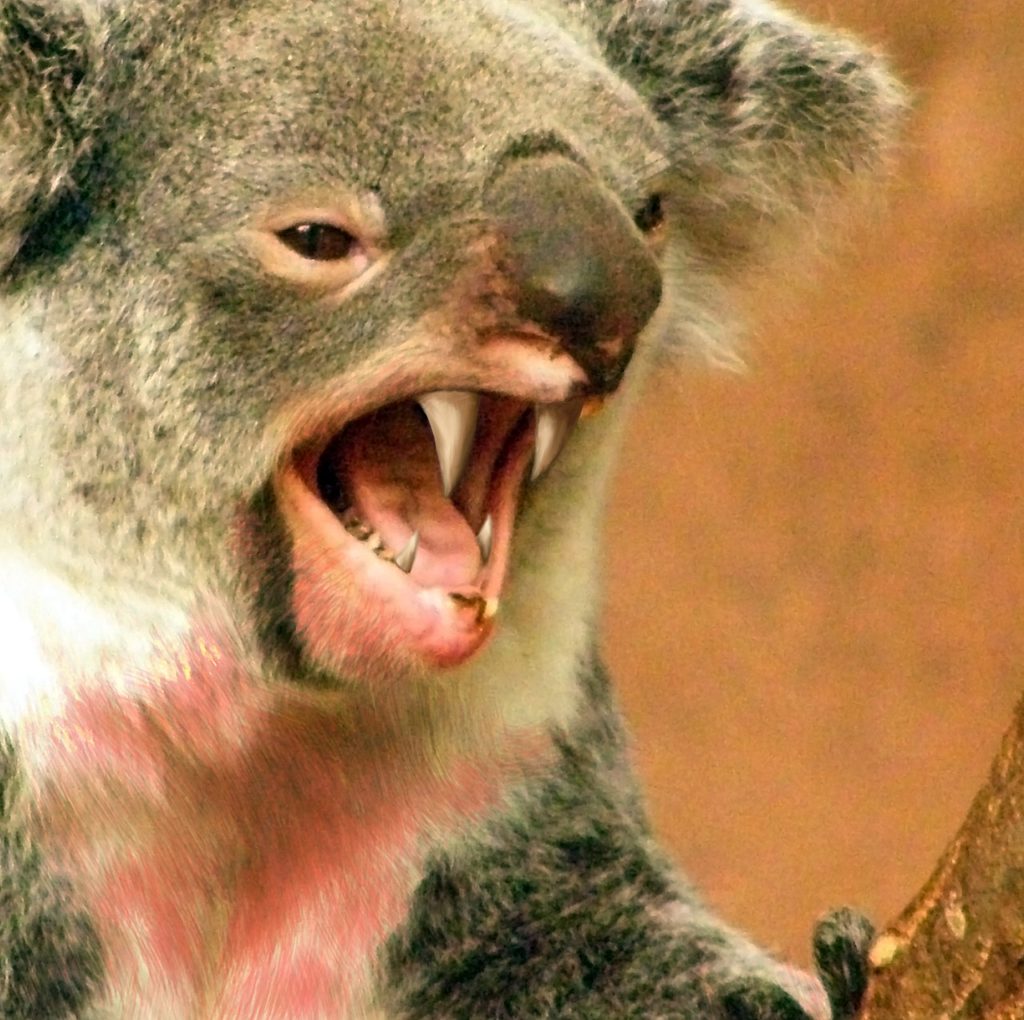
The simplest description, as Kat offers in the interview: a very vicious koala that launches itself from eucalyptus trees onto unsuspecting tourists. The paper identifies two distinct varieties circulating in oral tradition — the common drop bear, which attacks and mauls its prey, and the vampiric drop bear, which feeds primarily on blood rather than flesh. The researchers suggest (tongue still firmly in cheek) that the vampiric variety may represent an adaptation to Australia’s frequent droughts: liquid meals are easier to digest and reduce the risk of dehydration in a harsh environment.
Real koalas, it should be noted, are not actually the gentle cuddle-machines of tourist-brochure fame. Kat recounts witnessing a male koala launch an aggressive attack at a zoo handling session after detecting the scent of a rival male. Long claws, sharp teeth, and strong territorial instincts make them more than capable of inflicting serious injury — which is, one suspects, where the legend found its raw material.
📖 Urban Legend, Myth, or Folk Tale?
The paper draws on a well-established typology from anthropologist William Bascom (1960s) to locate the drop bear in the landscape of narrative tradition:
– Myth: held as fact by its originating culture; set in the remote past; sacred; non-human principal characters.
– Legend: retold as fact; set in a more recent past; human characters; secular or sacred.
– Folk tale: understood as fiction; any setting; human or non-human characters.
– Urban legend: a contemporary variant of the legend form; secular; often functions as a cautionary tale — like the hook-handed killer or the vanishing hitchhiker.
The drop bear sits squarely in that last category. Its cautionary function is real, if oblique: even when Australians shrug off deadly snakes and spiders (“oh, it’s just a snake”), the spectre of a murderous vampiric koala can instil a useful wariness about wandering off into unfamiliar bush, overheating, or becoming disoriented and dehydrated. Rhian recounts a story of scout leaders pointing out scratch marks on trees during a bushwalk — “that’s from drop bears, you’d better stay on the trail.”
🌐 Information Literacy and the Art of the Straight-Faced Joke
One of the paper’s more pointed arguments is that the drop bear makes an excellent teaching tool for information literacy. Rhian uses a drop-bear article from Australian Geographic — and a mock-scientific piece from the Australian Museum framing drop bear tracking via satellite telemetry as legitimate research — to confront students with a source that passes every surface-level credibility check. Every semester, some students simply accept it. The lesson: even when all signs point to “yes, this is a legitimate source,” critical engagement with the actual content remains essential.
Blake draws a parallel to a common MonsterTalk theme: a paranormal claim gets a mention in a respectable publication, the original context is lost over decades, and what remains is a vague sense that “this was researched somewhere credible.” Poe’s Law gets a nod — satire delivered with sufficient earnestness becomes indistinguishable from sincere belief, especially once the publication date of the April Fool’s issue is forgotten.
🦁 Prehistoric Roots and the Marsupial Lion
Where did the legend come from? No clear origin point exists, but the researchers and colleagues at Flinders University have speculated that the marsupial lion (Thylacoleo carnifex) — a powerful predatory marsupial that went extinct roughly 30,000 years ago — may underlie the earliest versions of the tale. Its body shape and predation methods are suggestive. The researchers note that a deeper archival investigation of recorded Indigenous oral traditions would be needed to trace the thread further back. A folkloric militarised variant also circulates: folklorist Ian Coates collected oral histories from former servicemen describing a “mammoth drop bear” standing five metres tall, and claims that the Australian SAS trained in drop bear habitats specifically to become familiar with avoiding them.
🧄 Protective Measures (Field Guide)
For the benefit of any listeners planning to visit Australia, the paper documents several folk remedies said to deter drop bear attacks:
– Spit upward when standing beneath a eucalyptus tree (you’ll spot the drop bear before it lands — or at least know the spit is coming back).
– Smear Vegemite on exposed skin: Australians raised on Vegemite may excrete protective compounds through their sweat, rendering them effectively immune from infancy.
– Wear cutlery in your hair or on your hat (comparable to the magpie-deterrence strategy well-known to Australian cyclists).
– Speak in an Australian accent.
– Sing “Waltzing Matilda.”
The Vegemite hypothesis prompts Blake to note that pre-Vegemite mortality statistics would make for a compelling (if fictional) dataset. Vegemite, for the uninitiated, is a savagely salty yeast extract — a byproduct of beer brewing — that polarises non-Australians but is, apparently, a rose in every Australian cheek.
🐍 Comparative Cryptids: Hoop Snakes and Tree Alligators
The conversation takes a brief but enjoyable detour into comparative folklore. The hoop snake — a creature that allegedly grabs its own tail and rolls — exists in both Australian and American Southern tradition (Blake’s grandmother told him about them in Georgia). The Australian version is reportedly more aggressive: it doesn’t just roll away from you, it chases you. Karen recalls arriving in California and being warned about “tree alligators” by hikers, a local tall tale clearly operating on the same “terrify the newcomer” logic as the drop bear.
📚 Further Reading
– “Man-Eating Teddy Bears of the Scrub: Exploring the Australian Drop Bear Urban Legend” by Catherine Livingston, Felice Goldfinch, and Rhian Morgan (e-Tropic journal, open access)
– The Folklore Podcast: Bunyips (recommended by the hosts as essential listening on the bunyip legend)
🔗 Related Links
– Drop Bear – Wikipedia
– Drop Bear – Australian Museum (the straight-faced mock-scientific profile used in Rhian’s information literacy classes)
– Thylacoleo carnifex (Marsupial Lion) – Wikipedia
– Bunyip – Wikipedia
– Yowie – Wikipedia
– Hoop Snake – Wikipedia
– Vegemite – Wikipedia
– Poe’s Law – Wikipedia
Note: ads inserted into the distributed audio alter the timestamps in unpredictable ways, so timing references in these notes are approximate.
Australia is home to monsters both real and legendary. In a country where a tiny octopus is toxic enough to kill 20 adults, where huge spiders can catch birds and eat them, where people are so tough that they voluntarily eat Vegemite, what kind of creature could be the apex monster? Not the bunyip. Not the yowie. Keep looking up in the trees; it’s time to face the dropbears!
Items of Interest
- Blake being interviewed at Beyond The Darkness
- The Folklore Podcast: Bunyips
- “Man-Eating Teddy Bears of The Scrub: Exploring The Australian Drop Bear Urban Legend” by Catherine Livingston, Felise Goldfinch, and Rhian Morgan
Music
- Monstertalk Theme: Monster by Peach Stealing Monkeys
MTArchivist
0