Regular Episode
#131 – NAMING MONSTERS
🔬 How Species Are Actually Discovered
Ben dispels the glamorous notion of dramatic field discoveries: for ichthyologists, new species often turn up by comparing dead fish in museum drawers and noticing that one specimen looks subtly different from the others. Some finds are genuinely serendipitous — an ornithologist dissecting a seagull stumbles onto a new genus of parasitic amphipod — but the workhorse of taxonomy is careful comparison of existing collections. Ben notes that roughly 400 new fish species are formally described every year, tracked in the Catalog of Fishes maintained by researchers at the California Academy of Sciences. The richest frontiers for new fish discoveries are South American freshwaters, African freshwaters, and Southeast Asian freshwaters — places where, as Ben puts it, “you can’t sneeze in a neotropical collection without uncovering a new species.”
📜 The Rules: Linnaeus, the ICZN, and Binomial Nomenclature
The naming of life forms has its roots in the Age of Enlightenment, when naturalists began systematizing the chaotic riot of Latin descriptive phrases that passed for species names. Carl Linnaeus formalized the two-part naming system — genus plus species epithet — in his landmark work Systema Naturae, and the hierarchical classification scheme (Kingdom, Phylum, Class, Order, Family, Genus, Species) that high schoolers still memorize.
Today the rules governing animal names are codified in the International Code of Zoological Nomenclature (ICZN), with a parallel International Code of Nomenclature for algae, fungi, and plants governing botany. To formally describe a new species, a researcher must: write a detailed formal description; provide an illustration or photograph; designate type specimens — a primary holotype and supporting paratypes — deposited at publicly accessible institutions; and propose and etymologically explain a name. The one thing you are explicitly forbidden to do under the ICZN: name the new species after yourself. Other people, however, may name things after you.
🐟 What’s in a (Scientific) Name?
Ben walks through the logic of how species epithets are constructed. Honorific names latinize a person’s surname with gendered endings: -i for a man, -ae for a woman. Geographic names take the suffix -ensis. Descriptive names draw on Latin or Greek roots — Ben’s own first described species, a lizardfish, received the epithet macrostigmus (“big spot”) for its most diagnostic character.
Then there are the delightful outliers Ben rattles off in the episode’s post-credits stinger:
– Centropyge narcosis, a deep-reef pygmy angelfish named by diver Richard Pyle after he surfaced from a 300-foot dive so nitrogen-narked that he thought he hadn’t caught the fish — only to find it in his collecting bucket.
– Picoltia greedoi, named because its face resembles Greedo from Star Wars.
– The goby genus Zappa, named in honor of Frank Zappa.
– The cichlid genus Nosferatu, for its rodent-like front teeth.
– Vampyroteuthis infernalis, the vampire squid — not actually a squid, and smaller than most people picture it.
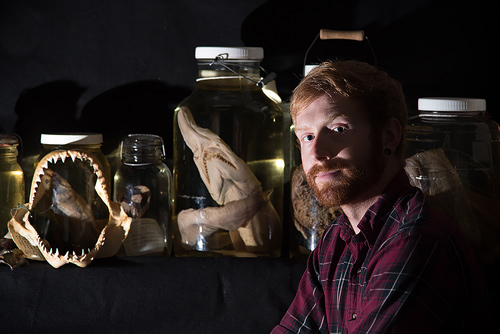
– The goblin shark (Mitsukurina owstoni), whose Japanese name Tengu-zame means “demon shark,” and which can reach 14 feet — considerably larger than the juvenile specimen on display at Scripps.
🦕 Living Fossils, Coelacanths, and Cryptozoology’s Poster Child
Ben brings up the coelacanth as one of the greatest zoological discoveries of the 20th century. The African species, Latimeria chalumnae, was described by ichthyologist J.L.B. Smith in 1939 after museum curator Marjorie Courtenay-Latimer recognized it as extraordinary among a trawler’s catch near the mouth of the Chalumna River in South Africa. The genus name honors her; the species epithet honors the river. A second species, Latimeria menadoensis, was described from Indonesia. Blake raises a mild objection to the coelacanth’s pride of place in cryptozoology literature: no one was really predicting it was still alive, so it lacks the “mystery animal that people claim to see” quality that arguably defines a true cryptid. The okapi, they agree, is a better example.
The broader discussion of living fossils touches on lungfish (which possess some of the largest genomes of any animal, the result of repeated genome duplications over hundreds of millions of years), nautiluses, scorpions, and Ginkgo biloba. The key point: morphological stasis doesn’t mean molecular stasis — these animals may look like their ancient relatives without having stopped evolving at the molecular level.
🔀 Lumpers, Splitters, and the Species Concept
Ben explains the perennial tension in taxonomy between lumpers (who consolidate similar-looking organisms into fewer species) and splitters (who carve out new species on finer distinctions). The rise of cheap molecular sequencing has given splitters a considerable advantage, since genetic divergence can be documented even between populations that look nearly identical to the naked eye. However, Ben notes that the standard barcode gene — cytochrome oxidase 1 (CO1) — and its oft-cited 2% divergence cutoff for species boundaries is not universally accepted and can produce misleading results depending on the lineage.
The underlying problem, as both Ben and Blake acknowledge, is that “species” is itself a human construct mapped onto a continuous, branching process. The biological species concept (organisms that cannot interbreed, or whose hybrids are sterile) is what most people learn in school, but it breaks down badly for plants, bacteria, and many other groups. Ben mentions several alternatives: the phylogenetic species concept, the ecological species concept, and — tongue somewhat in cheek — the authoritarian species concept: “I am an expert in this group. I say it’s a new species, therefore it’s a new species.” He admits that in practice, expert authority plays a larger role than the formal definitions might suggest.
📸 Describing Species from Photographs — and the Cadborosaurus Problem
A lively tangent explores a proposal, advanced primarily by ornithologists reluctant to collect endangered birds, to allow very high-resolution photographs to serve as the type material for new species or subspecies descriptions. Ben notes this idea generated significant backlash — and that it had a direct cryptozoological precedent: at least three cryptids have had formal (if not formally accepted) species descriptions published from images rather than physical specimens. The most prominent example is Cadborosaurus willsi, the purported Pacific sea serpent, which prompted discussion in mainstream scientific literature at the time of its description. Ben’s verdict, echoed at the episode’s close: a description without proper type material, by researchers without appropriate taxonomic expertise, is not a valid description regardless of what rules it nominally follows.
🦕 Brontosaurus: A Taxonomy Tale
Prompted by a question about Mokele-mbembe — Ben’s favorite cryptid, loved precisely because the Congo basin is dense enough that a large animal could plausibly remain hidden — the conversation pivots to the saga of Brontosaurus. The name had been sunk into synonymy with Apatosaurus when a student’s paper (published around 2014–2015) reexamined the type material and argued the femur was distinctive enough to resurrect the genus. A rebuttal appeared in short order. Ben’s assessment at the time of recording: the name Brontosaurus is technically valid on the books, but the matter isn’t fully settled — and someone is probably working on a paper to sink it again.
📚 Further Reading
– 📚 Species Concepts and Phylogenetic Theory: A Debate 💵 (mentioned by Ben as essential — and genuinely difficult — background reading on the species problem)
🔗 Related Links
– International Code of Zoological Nomenclature (ICZN)
– International Code of Nomenclature for algae, fungi, and plants
– Catalog of Fishes — California Academy of Sciences
– Coelacanth (Wikipedia)
– Marjorie Courtenay-Latimer (Wikipedia)
– Cadborosaurus willsi (Wikipedia)
– Goblin shark (Wikipedia)
– Vampire squid (Wikipedia)
– Cookiecutter shark (Wikipedia) — Ben’s suggested homework for listeners who have never encountered this deeply unsettling animal
– Mokele-mbembe (Wikipedia)
– Brontosaurus (Wikipedia)
– Biological species concept (Wikipedia)
– Binomial nomenclature (Wikipedia)
– Nitrogen narcosis (Wikipedia) — the phenomenon behind the name Centropyge narcosis
Note: ads inserted into the distributed audio alter the timestamps in unpredictable ways, so timing references in these notes are approximate.
What’s in a name? More than you might imagine, if you’re a scientist trying to officially name a new species. In this episode of MonsterTalk, we talk to Ichthyologist Ben Frable about the process (and many challenges) of scientifically identifying and naming new species.
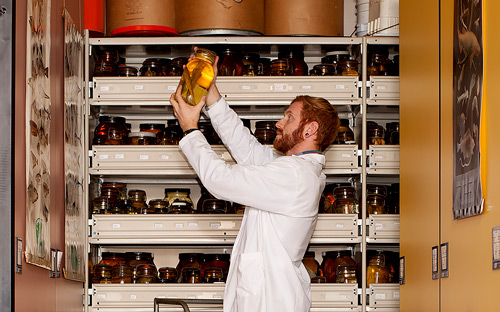
Benjamin Frable is an Ichthyologist and is the Collection Manager of the Marine Vertebrate Collection at Scripps Institution of Oceanography at UC San Diego.
Frable was on a featured panel of scientists at Comic Con San Diego 2017 discussing the influence of science on sci-fi and vice versa.
Of Interest
- Frable’s scholarly articles
- International Code of Nomenclature (Fungi/Plants)
- International Code of Zoological Nomenclature (Animals)
Music
- Monstertalk Theme: Monster by Peach Stealing Monkeys
MTArchivist
0