Regular Episode
#130 – ENGLAND’S MOST HAUNTED VILLAGE
Pluckley is a genuinely tiny settlement — more hamlet than village — tucked into the Wealden countryside of southeast England. Its well-preserved, almost timeless appearance made it the filming location for the beloved television series The Darling Buds of May, and that same unchanged quality lends it an atmosphere that, as Hayley puts it, looks a bit like a Hammer film still.
👻 The Ghosts of Pluckley: A Crayola Box of Apparitions
The village claims anywhere from 12 to 16-plus ghosts — a roster that, the hosts note, keeps growing. Most of the classic hauntings trace back to one aristocratic family: the Dering family, who were rewarded with Dering Manor by King Charles II for their loyalty during the Civil War.
The most discussed apparitions include:
– The White Lady Dering, said to haunt St. Nicholas Church, where she was buried in a series of nested airtight coffins — her grieving husband reportedly could not bear the thought of her body decomposing. She is seen walking the churchyard with a rose at her chest.
– A second White Lady said to roam Dering Manor itself, famously shot at by a U.S. Embassy employee during a Christmas Eve vigil; the bullet allegedly passed clean through her.
– The Red Lady Dering, searching the church grounds for a lost baby, accompanied by reports of knocking sounds and strange light flashing through the stained-glass windows.
– A highwayman named Robert DuBois, said to have hidden behind a hollow oak at Fright Corner before being killed, now a shadowy cloaked figure seen at crossroads.
– A phantom coach and horses, witnessed by a couple who reportedly gave way to it on a bridge one evening before it passed and vanished.
– The Watercress Woman, a Romany traveller who sold watercress and, depending on the source, either drowned or fell asleep smoking her pipe.
– The Screaming Woods (Dering Wood), named for unexplained sounds heard within and a popular destination for overnight ghost-hunting events.
The hosts observe that the color-coded tradition for female ghosts — white, red, grey, brown, green — is pervasive across Britain, and Hayley references the book 📚 The Haunted: A Social History of Ghosts 💵 by Owen Davies, which notes that white lady sightings often overlap with fairy folklore, frequently appearing near water as ethereal figures.
📺 Ghost TV in Pluckley
Several paranormal television productions have descended on Pluckley over the years, with mixed (to put it charitably) results:
– 📺 Strange But True ran an episode on Pluckley’s ghosts that Hayley found on YouTube while researching. It features an interview with the then-current vicar, Michael Higgs, a declared skeptic who noted the ghost stories really took off after World War II and suspected the tourist trade played a role — before signing off with “The only ghost in this church is the Holy Ghost.”
– Most Haunted visited Pluckley as part of a sub-series titled Most Haunted: Midsommer Murders. Medium David Wells picked up on the highwayman’s spirit in the woods; a subsequent Ouija session at the Black Horse Inn produced the words “demon” and “Lucifer,” and at least one team member declared he wanted to kill everyone and had to be walked outside.
– Haunted Finders (Series 3, Episode 1) attempted a stakeout in the Screaming Woods but found it too crowded with other ghost tourists to conduct their investigation — a detail the hosts find quietly devastating.
Blake notes that Paranormal State (the A&E series originating from a Pennsylvania State University ghost-hunting club) has been credibly accused of faking or heavily manipulating its content — sweetened audio, deceptive editing — and links to takedowns from people who were present on set will be in the show notes.
🔁 Folklore, Feedback Loops, and the Echo Chamber
One of the episode’s most substantive threads is Hayley’s observation that modern ghost hunting has become a closed feedback loop: ghost hunters now largely investigate what other ghost hunters have experienced, rather than what independent eyewitnesses have reported. The original folklore is the seed, but the subsequent crop has little connection to fresh testimony.
Hayley and Blake also discuss the legend-tripping dimension of Pluckley’s ghost traditions — the way many legends come with a specific ritual attached (dance around Devil’s Bush thirteen times, stand at the crossroads at midnight) that invites ostension and draws visitors. Karen notes this gives the stories a kind of built-in verisimilitude: you can always test it yourself, and if nothing happens, you simply weren’t open-minded enough.
The group also touches on how ghost stereotypes have shifted. Classic British apparitions were largely passive — a white lady gliding past, a coach vanishing over a bridge. Contemporary ghosts, shaped by shows like Ghost Adventures and Paranormal Lockdown, tend to scratch, push, and threaten. The role of the ghost has changed from a folkloric warning or justice-seeker to an almost purely malevolent entity, and Hayley worries this shift — amplified by ghost hunting event companies charging £50 a head for a night in the Screaming Woods — is genuinely distressing to people who have unusual experiences.
⚔️ Post-War Belief and the Pendle Connection
The conversation takes a thoughtful turn when Karen asks why the ghost stories seem to have intensified after World War II. Hayley draws a parallel with the post-WWI surge in Spiritualism, suggesting that mass bereavement creates fertile ground for belief in an afterlife. She also sketches a longer arc: in earlier centuries, in communities near places like Pendle Hill — where the Pendle Witches were tried and executed in 1612 — spirits were something to be feared and suppressed, not embraced. The gradual secularization of British life meant that by the mid-twentieth century, those same spirits could be reframed as sources of comfort and community identity.
📖 The Guinness Record That (Probably) Wasn’t
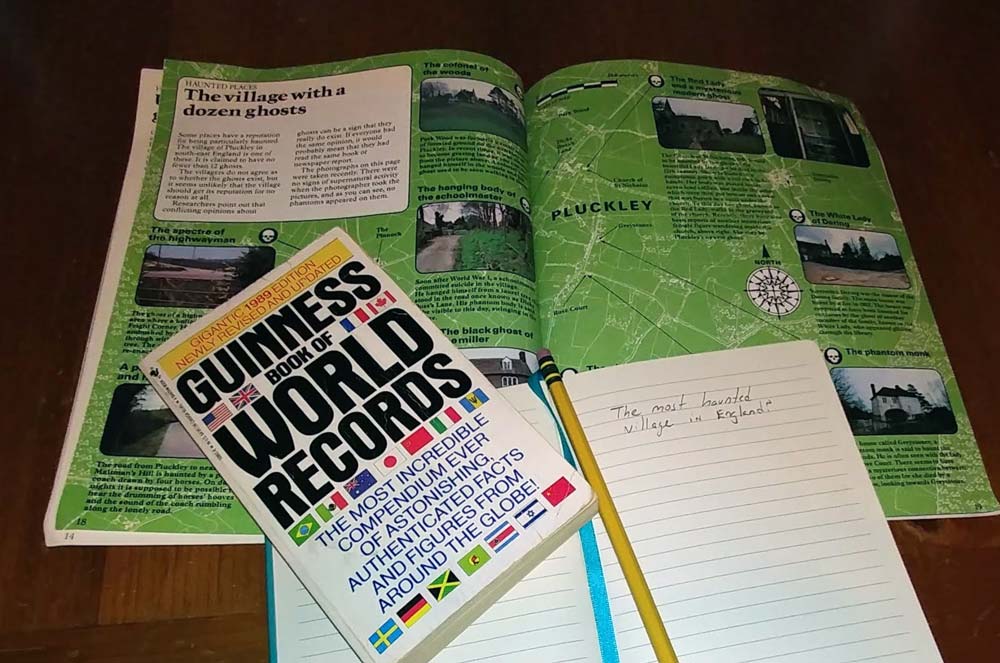
The episode closes with a fascinating piece of live fact-checking by Blake. The claim that Pluckley was certified as Britain’s most haunted village by the Guinness Book of World Records — widely repeated, including on Wikipedia, usually with the 1989 edition cited — turns out to be deeply questionable.
Blake searched multiple digital and physical copies of the 1989 edition and found no such entry. Guinness itself, when contacted, confirmed the category has been “rested” for years, explaining that a haunting cannot be meaningfully standardized or verified. Their full criteria require a record to be measurable by a single superlative, verifiable, standardizable, breakable, and to involve an element of skill.
Blake did eventually locate an actual Guinness entry — a PDF of which is linked in the original show notes — but its text reads more like a charming summary of village folklore than a rigorously adjudicated world record. His conclusion: he is “extremely skeptical” that a formal, verified entry ever appeared in any edition of the book. He updates his assessment on air, models the correction openly, and notes that admitting you’re wrong and moving on is “absolutely imperative for the advancement of science — or of science shows about monsters.”
Also mentioned: the Cock Lane Ghost (London, 1762) as an early example of paranormal tourism, complete with opportunistic landlords and pickpockets working the crowds; Prestbury near Cheltenham and its infamous Black Monk as a rival claimant to the most-haunted title; and York, which was awarded the title of most haunted city in Europe by the (not entirely unbiased) Ghost Research Foundation International.
📚 Further Reading
– 📚 The Haunted: A Social History of Ghosts 💵 by Owen Davies
– 📚 The Ghost Hunter’s Almanac 💵 by Peter Underwood (one of several Underwood titles consulted during research)
🔗 Related Links
– Pluckley – Wikipedia
– Dering Family – Wikipedia
– The Cock Lane Ghost – Wikipedia
– The Pendle Witches – Wikipedia
– Spiritualism – Wikipedia
– Legend Tripping – Wikipedia
– The Darling Buds of May (TV series) – Wikipedia
– The Difference Between the UK, Great Britain, and England Explained
– 1989 Guinness Entry on Pluckley (PDF) — see show notes at monstertalk.org for the verified scan
– Carrie Poppy’s TEDx Talk on Ghosts & Hauntings (link at monstertalk.org)
Note: ads inserted into the distributed audio alter the timestamps in unpredictable ways, so timing references in these notes are approximate.
Is the little village of Pluckley truly the most haunted village in England? We interview skeptical ghost hunter Hayley Stevens (The Spooktater) about the curious little town more famous for its dead than its living.
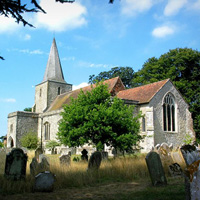
Pictured above is one of the many haunted buildings in Pluckley — St. Nicholas Church — said to be haunted by two ghosts of the same woman who died in the 1100s (or at least the ghosts appear to be the same person) who have come to be known as the “White Lady Dering” and the “Red Lady Dering.” (photo by Stephen Nunney [CC BY-SA 2.0], via Wikimedia Commons)

Of Interest
- TEDx talk on Ghosts & Hauntings
- Strange But True episode on Pluckley Ghosts.
- England’s Most Haunted Village — A Day and Night Investigation of Pluckley, Kent (by Haunted Earth TV on Vimeo)
- The Pendle Witches
- Ghosts of Pluckley Haunted Finders S03E01
- Paranormal State allegedly faking its content
- The Difference Between the United Kingdom, Great Britain and England Explained
- The Cock Lane Ghost
- Hayley Stevens also appeared in MonsterTalk Episode # 37: Lake Monster Mysteries
- 1989 Guinness entry on Pluckley (PDF)
Music
- Monstertalk Theme: Monster by Peach Stealing Monkeys
MTArchivist
0