Regular Episode
#107 – THE EPISODE THEY DON’T WANT YOU TO KNOW ABOUT
The conversation ranges from the anatomy of a classic conspiracy theory to the real-world harms of anti-vaccine and climate-denial movements, with detours through the Illuminati, hip-hop, and why a lone gunman just doesn’t feel like a satisfying explanation for a world-historical event.
🔍 What Even Is a Conspiracy Theory?
Rob opens by noting that defining “conspiracy theory” is harder than it looks — and that researchers have often skipped that step entirely. Everyone has an intuitive sense of the term, but the line between a conspiracy (Al-Qaeda planned 9/11 in secret) and a conspiracy theory (the U.S. government planned 9/11 in secret) is not always obvious from the surface structure of the claim alone.
He identifies several recurring features of the prototypical conspiracy theory:
– Unusually evil conspirators — real-world plotters tend to be petty and self-interested; conspiracy theories propose grand schemes for world domination or total control.
– Unusually competent conspirators — nobody spills the beans, plans are executed flawlessly, and secrecy holds indefinitely — a standard real conspiracies almost never meet.
– Inherently unproven — the conspiracy is always framed as ongoing and not yet fully exposed, rather than settled.
– Unfalsifiable — any evidence against the theory can be reinterpreted as deliberate misinformation planted by the conspirators themselves.
That last property is the one that makes these theories so sticky: a good conspiracy theory can absorb any conceivable counter-evidence.
🧠 The Cultic Milieu and Contradictory Beliefs
Rob references sociologist Colin Campbell‘s concept of the cultic milieu — an intellectual underground where conspiratorial, paranormal, and New Age beliefs tend to cluster together. The link isn’t always logical (there’s no obvious reason a believer in psychic phenomena should also distrust vaccines), but surveys consistently show these unorthodox beliefs traveling in packs.
He describes a study by colleague Mike Wood examining belief in mutually contradictory conspiracy theories about Osama bin Laden — some held he had been dead for years before the 2011 raid, others that he was still alive afterward. People who endorsed one version were more likely to endorse the contradictory version. The unifying factor was a higher-order belief that the Obama administration was hiding something — that generic suspicion made both specific theories feel plausible at once, even when they couldn’t both be true.
⚠️ When Conspiracy Thinking Has Real Consequences
Most people who suspect a JFK conspiracy don’t change their daily lives because of it. But Rob walks through two domains where conspiratorial belief causes measurable harm beyond the individual believer:
– Anti-vaccination: The modern wave traces to Andrew Wakefield‘s retracted 1998 paper linking the MMR vaccine to autism. UK vaccination rates fell, and a large measles outbreak in Wales followed roughly a decade later — timed almost precisely to when unvaccinated children entered school together. Blake adds the perspective of someone old enough to have known adults disabled by polio, and both hosts cite Paul Offit‘s observation that polio was the last disease visible enough — iron lungs, withered limbs — to generate near-universal public support for vaccination.
– Climate change denial: Rob cites research by colleague Dan Jolly showing that simply exposing people to pro-conspiracy-theory framing about climate change reduced their subsequent willingness to take pro-environmental action — a small individual effect that scales badly across a population.
👤 Who Is the Conspiracy Theorist?
Rob pushes back against two common stereotypes. First, that conspiracy believers are cognitively simple or less intelligent — studies find no reliable correlation with intelligence or need for cognitive complexity, and many conspiracy theories are more elaborate than the official account (flat-Earth cosmology, for instance, requires extensive contortions to accommodate modern physics). Second, that they are a tiny paranoid fringe: polling consistently finds that roughly a quarter to a third of Americans endorse quite specific 9/11 conspiracy claims, and “paranoia” in this context means everyday, subclinical suspicion (wondering if co-workers are talking about you) rather than clinical delusion.
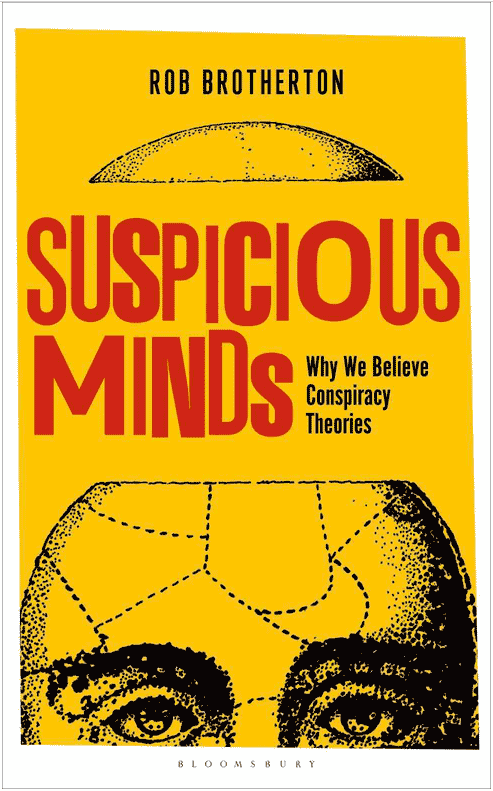
The subtitle of Suspicious Minds — “Why We Believe Conspiracy Theories” — is the thesis: our brains evolved to be receptive to these narratives. The difference between a believer and a skeptic is one of degree, not of kind.
⚖️ Cognitive Biases Behind the Curtain
Rob names two specific biases that feed conspiratorial thinking:
– Intentionality bias: when something ambiguous happens, the brain defaults to assuming someone planned it. The disappearance of Malaysia Airlines Flight MH370 generated an explosion of conspiracy theories precisely because, for months, no causal explanation existed — the ambiguity activated the brain’s tendency to infer intent.
– Proportionality bias: we expect causes to be proportional to their effects. It feels wrong that Lee Harvey Oswald — a nobody — could topple a presidency. A sprawling conspiracy is a “bigger” cause and therefore feels more commensurate with the outcome. Rob contrasts this with the attempted assassination of Ronald Reagan: because Reagan survived, the event felt smaller, and almost no conspiracy theories attached to it.
Rob also discusses the backfire effect — the finding that presenting strong believers with direct counter-evidence can paradoxically deepen their conviction — and uses the birther movement as a case study: even the release of Obama’s long-form birth certificate was immediately reinterpreted as evidence of forgery (the doctor’s signature, rotated, “looks like a smiley face” — proof the forgers were mocking us).
🔮 The Illuminati: From Real Secret Society to Pop-Culture Monster
[This section contains the episode’s “favorite monster” segment — head to the audio for Rob’s full answer.]
Blake notes the Illuminati: New World Order collectible card game from Steve Jackson Games, and the conversation touches on the role of 1990s hip-hop — including the rapper Canibus and his song “Channel Zero,” which names Carl Sagan as a co-conspirator in the alien cover-up — in reviving and repackaging Illuminati mythology for a new generation. The KLF and Robert Anton Wilson‘s Illuminatus! trilogy also get a mention as earlier cultural carriers of the mythology.
📚 Further Reading
– 📚 Suspicious Minds: Why We Believe Conspiracy Theories 💵 by Rob Brotherton
🔗 Related Links
– Anomalistic Psychology Research Unit, Goldsmiths
– Colin Campbell and the Cultic Milieu
– Confirmation Bias
– Backfire Effect
– Kahneman and Tversky — cognitive bias research
– Andrew Wakefield and the MMR controversy
– Illuminati (historical)
– Obama Birther Conspiracy Theories
– Malaysia Airlines Flight MH370
– Canibus (rapper)
– What’s the Harm? (Tim Farley’s resource on the real-world costs of paranormal belief)
Note: ads inserted into the distributed audio alter the timestamps in unpredictable ways, so timing references in these notes are approximate.
Rob Brotherton is the author of Suspicious Minds: Why We Believe Conspiracy Theories. Rob has a doctorate in the psychology of conspiracy theories, and taught classes at the Anomalistic Psychology Research Unit at Goldsmiths. He joins us in this episode to discuss the psychology of conspiracies.
Music
- Monstertalk Theme: Monster by Peach Stealing Monkeys
MTArchivist
0