Regular Episode
#098 – DOCTOR ATLANTIS
Kenny arrives with a fitting nickname — “Dr. Atlantis” — earned through years of being the go-to skeptical talking head for every TV production company, Japanese documentary crew included, that wants someone to confirm the lost continent is real. (They stop calling back once he clarifies his position.) He also arrives with a confession involving bedsheets, guitars, and a certain 1969 college campus. More on that shortly.
🎵 The Donovan Problem
Kenny traces the popular Atlantis narrative — a precociously advanced utopian civilization seeding all of humanity’s ancient cultures before sinking in a single catastrophic day and night — not to any scholarly source, but to the spoken-word introduction of Donovan’s 1968 song “Atlantis.” Kenny’s first “public commentary” on Atlantis was, apparently, parading around his college campus in 1969 wrapped in a bedsheet and strumming that very song’s chorus. He reports it did not have the intended social effect.
The song’s origin story — Atlantis as mother civilization of Egypt, Mesopotamia, China, the Maya, the Inca, and the mound builders — maps almost perfectly onto Ignatius Donnelly‘s 1882 book 📚 Atlantis: The Antediluvian World 💵, which Kenny identifies as the true origin of the modern Atlantis mania. Before Donnelly, the story was philosophy. After Donnelly — and after the Theosophists got hold of it — it became a cottage industry.
📜 What Plato Actually Wrote
The sole original source for Atlantis is Plato, writing around 360 BCE in two dialogues: Timaeus and Critias. Kenny’s core argument is one of reading comprehension: almost nothing in the popular Atlantis story actually appears in those dialogues.
Key points from the actual text:
– The “perfect utopian society” in Plato is not Atlantis — it’s a mythical ancient Athens, invented to embody the ideals Socrates described in The Republic seven years earlier. Atlantis is the villain: a powerful, corrupt, militarily aggressive empire.
– Plato writes in the dialogue form, putting words in characters’ mouths. It is Critias (a character) who vouches for the story’s truth — not Plato himself. Kenny draws the parallel: Archie Bunker’s bigotry wasn’t Norman Lear’s opinion either.
– Critias explicitly traces the story through a multi-generational chain: himself ← his grandfather ← Dropides ← Solon ← Egyptian priests. Plato could hardly have been more theatrical about distancing himself from the tale’s reliability.
– Critias adds that his grandfather first told the story at a festival whose whole point was to reward the best made-up story — the ancient Greek equivalent of an April Fool’s competition.
– After the dialogues circulated, no Greek historian commented on Atlantis as history — not even to refute it. Kenny’s explanation: they recognized fiction and didn’t feel compelled to debunk Star Wars.
🌋 The Santorini Hypothesis (and Why It Doesn’t Hold)
The most respectable version of Atlantis-as-history points to the Minoan civilization of Crete and the catastrophic volcanic eruption of Santorini (~1600 BCE) as a garbled kernel of truth behind the legend. Kenny took that hypothesis seriously enough to do the homework: he read through Critias and Timaeus alongside actual archaeological site reports for Santorini and Minoan Crete, identifying 53 specific, materially testable claims in the dialogue.
Result: exactly one detail matches — the palace and temple were large and impressive. Every other specific (location in the Atlantic beyond the Pillars of Hercules, the continent’s size, the presence of elephants, the mysterious metal orichalcum lining the city walls, the dimensions of the central plain) has no archaeological support in Minoan Crete or Santorini. As Kenny puts it, you don’t get to cherry-pick one vague match out of 53 and declare a hit. L. Sprague de Camp made the same point in his book 📚 Lost Continents 💵: when you have to change virtually every detail of a legend to make it fit a real event, what exactly are you preserving?
🏛️ The “They Laughed at Schliemann” Argument
Atlantis believers frequently invoke Heinrich Schliemann‘s excavation of Troy as proof that legendary places can be real. Kenny (citing Carl Sagan‘s formulation of the “they laughed at Columbus” fallacy) points out that each archaeological claim must stand on its own evidence. That Schliemann may have found something doesn’t license every subsequent fringe claim — a point Kenny’s colleague neatly summarized: “They also laughed at Laurel and Hardy.” (Kenny also notes, with characteristic bluntness, that which layer of Hisarlik actually constitutes “Troy” remains genuinely contested among archaeologists.)
🗺️ The Geography of Wishful Thinking
Kenny surveys the global smorgasbord of proposed Atlantis locations — the Bimini Road off the Bahamas, sites in Spain, South America, and the seafloor off Japan — and names his personal favorite: Antarctica. The appeal, he explains, is purely rhetorical: burying your lost civilization under a mile of ice is the ultimate “covering your ass” move. You can’t disprove what you can’t excavate. Donnelly himself, writing in the 1880s, predicted that by around 1990 the world’s museums would be filled with Atlantean artifacts and its libraries stocked with Atlantean books. Kenny’s verdict: that prediction aged about as well as everything else in the lost-continent genre.
⛏️ What Real Archaeology Offers Instead
Kenny is working on what he calls his “50 sites bucket list” — a forthcoming book highlighting 50 real, publicly accessible archaeological sites across the United States, from cliff dwellings to effigy mounds to painted cave walls. His motivating insight: students won’t remember the half-life of radiocarbon, but they might remember that Montezuma Castle exists and is worth stopping for on I-17. Real archaeological wonders — the ancestral Puebloan cliff dwellings, the effigy mounds of the Midwest — don’t need a lost continent to be awe-inspiring.
Kenny is also co-hosting a podcast with archaeologist Sarah Head called Archaeology Fantasies, which tackles fringe archaeological claims with the same rigor (and similar vocabulary) he brings to MonsterTalk.
📚 Further Reading
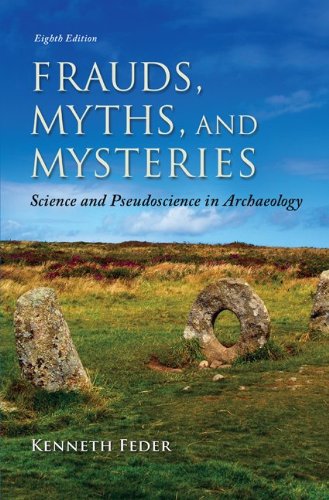
– 📚 Frauds, Myths, and Mysteries: Science and Pseudoscience in Archaeology 💵 by Kenneth Feder
– 📚 The Past in Perspective: An Introduction to Human Prehistory 💵 by Kenneth Feder
– 📚 Linking to the Past: A Brief Introduction to Archaeology 💵 by Kenneth Feder
– 📚 Atlantis: The Antediluvian World 💵 by Ignatius Donnelly
– 📚 Lost Continents 💵 by L. Sprague de Camp
🔗 Related Links
– Critias (Plato’s dialogue) — Wikipedia
– Timaeus (Plato’s dialogue) — Wikipedia
– Donovan’s “Atlantis” — Wikipedia
– Minoan eruption of Santorini — Wikipedia
– Orichalcum — Wikipedia
– Archaeology Fantasies Podcast
Note: ads inserted into the distributed audio alter the timestamps in unpredictable ways, so timing references in these notes are approximate.
IS THERE A LOST CITY somewhere that formed the basis of the legend of Atlantis? Dr. Kenny Feder returns, not to praise Atlantis, but to bury it.
Kenny Feder: Selected Works
Related Links
Music
- Monstertalk Theme: Monster by Peach Stealing Monkeys
MTArchivist
0