Regular Episode
#095 – EL D20ABLO — THE SATANIC PANIC & ROLE-PLAYING GAMES
Blake, a lifelong gamer himself, notes there are two reasons this topic belongs on MonsterTalk: the rich menagerie of mythological and invented creatures that populate games like Dungeons & Dragons, and the sociologically fascinating monster conjured around those games — an imaginary satanic underground that sent real people to prison and shaped law enforcement training for decades.
🎲 A Brief History of Role-Playing Games
Joe traces the lineage of tabletop role-playing games from Prussian military Kriegsspiel war-game simulations — credited with helping a Prussian militia defeat a professional French army during the Napoleonic era — through civilian adaptations like Gettysburg from Avalon Hill, and finally to the introduction of fantastic elements and individually focused characters in the 1960s and 70s. He recommends John Peterson‘s 📚 Playing at the World 💵 for a comprehensive history. The key innovation of games like D&D was the shift from a zero-sum, winner-takes-all format to an open-ended collaborative narrative played purely for pleasure — a structure Joe argues has deep sociological significance because the model of the world inside the game shapes how players think about the real one.
🕵️ The Dallas Egbert Case and the Birth of a Legend
The first major flashpoint linking D&D to public danger was the 1979 disappearance of Dallas Egbert III, a sixteen-year-old prodigy at Michigan State University. Private detective William Dear was hired to find him and quickly constructed a narrative — amplified at a press conference — that Egbert had lost his grip on reality due to D&D and was living out a fantasy in the campus steam tunnels.
The reality was considerably more mundane and considerably more tragic. Egbert, who was gay and not out at a time when that carried severe social stigma, had taken quaaludes in a failed suicide attempt in the tunnels, then fled to Louisiana and lived with acquaintances from the gay community for a month before calling his parents. Dear had little to do with finding him. A year later, Egbert died by suicide — and Joe notes that the newspaper coverage, which outed him publicly, may have been a contributing factor.
The case was fictionalized in the novel 📚 Mazes and Monsters 💵 by Rona Jaffe — who, notably, played quite a lot of D&D herself for her research and was not hostile to gaming — and then adapted into the 🎬 Mazes and Monsters 💵 TV movie starring a young Tom Hanks. The steam-tunnel legend seeded by Dear’s press conference became one of the most persistent urban myths in gaming culture.
😱 Moral Entrepreneurs and the Folk Devil
Joe draws on sociologist Stanley Cohen‘s framework of moral panics to explain how D&D became a cultural lightning rod. A moral panic requires a folk devil — a perceived threat to society that is typically new, misunderstood, and too weak to fight back — and moral entrepreneurs who lead the charge. In the case of D&D, the ideal folk devil was a population of adolescents with no public platform to rebut the claims being made about them.
The most consequential moral entrepreneur was Patricia Pulling, whose son — an honors student who had been allowed to play D&D as a classroom reward — died by suicide. Pulling reframed her son’s death as martyrdom: she believed he had been given a hypnotic command in the game to murder his family, and killed himself to prevent it. She subsequently founded Bothered About Dungeons and Dragons (BADD) and cultivated what she called a “trophy list” of violent incidents allegedly linked to the game. Joe notes that mathematicians pointed out the list actually implied D&D prevents suicide when compared against national rates — but that statistical reasoning rarely features in a panic.
Pulling also demonstrated a savvy ability to tailor her message: before secular audiences she adopted the persona of a psychologist warning about brainwashing and desensitization to violence; before religious audiences she described demons literally escaping from the game pieces. She died of cancer in 1992, and Joe argues that her personal energy had been holding much of BADD together.
✝️ Jack Chick, John Todd, and the Rival Fantasy
Many of the most extreme claims traced back to a single publisher: Chick Publications, founded by the famously reclusive Jack Chick. Chick was inspired by Mao’s use of comics to spread ideology and applied the same model to evangelical Christianity, producing the ubiquitous Dark Dungeons tract depicting D&D as a literal gateway to witchcraft.
Joe identifies a remarkable cluster of deeply troubled figures who all ended up publishing with Chick:
– John Todd, who claimed membership in a family of witches secretly controlling the world on behalf of the Rothschilds, alleged that C.S. Lewis and Tolkien were Satanists, and eventually went to prison for rape before dying in a mental institution.
– Eric Schnobelein, who claimed to have sustained himself on human blood as a literal vampire due to his involvement in Satanism.
– Rebecca Brown (pen name), a physician whose medical license was revoked after she gave patients drugs justified by her demonological beliefs.
Joe’s pointed observation: the moral entrepreneurs had, in their own minds, constructed exactly the kind of richly imagined alternative world they accused gamers of inhabiting — except they believed theirs was real. He calls D&D and the conspiracy theories rival fantasies, both drawing on the same cultural well of horror films (he name-checks 🎬 The Wicker Man 💵), sword-and-sorcery imagery, and 1970s dread. The difference, as Joe puts it, is that one admitted it was a fantasy and the other did not.
📐 Frame Theory, Paracosms, and Why It Matters
Joe applies sociologist Gregory Bateson‘s frame theory — and the later work of Gary Alan Fine, who first used it to analyze role-playing games — to explain what was really at stake in the panic. Players move fluidly between three frames: the physical reality of sitting around a table, the mechanical rules of the game, and the narrative fiction of the story. Most players manage this transition effortlessly. The moral entrepreneurs, Joe argues, were attempting to collapse that distinction by insisting that the magic and monsters in the game were real — dragging them out of what psychologists call a paracosm and into literal reality.
The irony is acute. Joe notes that D&D’s creators — including Gary Gygax, who was at one point a Jehovah’s Witness — were devout Christians who viewed the game’s magic as pure fiction. Gygax reportedly quipped that if he actually knew magic, he wouldn’t be making games — he’d be ruling the world. And one spell in the rulebooks calls for legumes as a material component. Hardly diabolical.
Meanwhile, the FBI eventually concluded in its own review that when panic advocates said “occult,” they effectively meant any religion other than their own — a police training manual of the era listed the Star of David, the Islamic crescent, the yin-yang, and the ankh as occult symbols of dangerous cults.
🎭 Therapeutic Play and the Question of Real Harm
Asked directly whether role-playing games cause real-world harm, Joe is unequivocal: the evidence runs the other way. He cites published case studies of D&D being used therapeutically — including a teenager who had attempted suicide and, through playing an evil character, worked through family trauma in a way his therapist found clinically valuable. The therapist wrote a paper on it. Joe draws a parallel to the Church of Satan‘s use of psychodrama: a structured fictional frame for processing things that can’t easily be expressed otherwise — which is, as he notes, what all art does.
He also addresses the correlation question directly: yes, there is overlap between fantasy gaming communities and people who practice Wicca or modern paganism — but anecdotal evidence suggests interest in magic typically preceded gaming, not the other way around. The Deities & Demigods sourcebook (later retitled Legends & Lore) drew particular fire for including game statistics for Odin, Zeus, and figures from world mythology. One claims-maker alleged it contained stats for Jesus — something Joe confirms is entirely false, and which he suggests reveals more about the accuser’s own suppressed anxieties than about the book’s contents.
📚 Further Reading
– 📚 Dangerous Games 💵 by Joseph Laycock
– 📚 Playing at the World 💵 by Jon Peterson
– 📚 Mazes and Monsters 💵 by Rona Jaffe
– 📚 The Dungeon Master 💵 by William Dear
– 📚 Evil Incarnate 💵 by David Frankfurter
– 📚 Religion of Fear 💵 by Jason Bivins
🔗 Related Links
– Dungeons & Dragons (Wikipedia)
– Satanic Panic (Wikipedia)
– Bothered About Dungeons and Dragons / Patricia Pulling (Wikipedia)
– Dallas Egbert III (Wikipedia)
– Chick Publications / Jack Chick (Wikipedia)
– Moral Panic — Stanley Cohen (Wikipedia)
– Paracosm (Wikipedia)
– Skeptoid Podcast (Blake’s contributions mentioned in the episode)
– Dead Alewives D&D Comedy Sketch (see show notes at monstertalk.org)
– Jack Chick’s Dark Dungeons tract (primary source)
Note: ads inserted into the distributed audio alter the timestamps in unpredictable ways, so timing references in these notes are approximate.
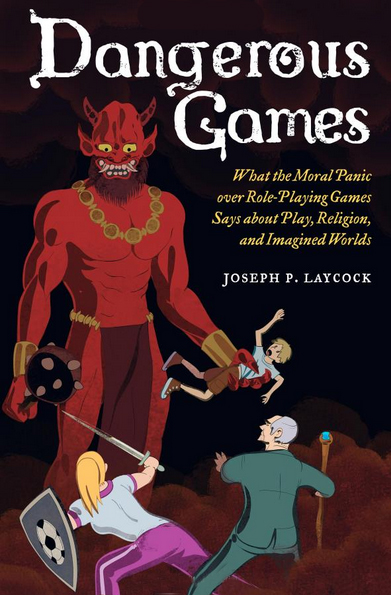
THE LATE 1970s AND 1980s saw the rise of a new kind of game. Dungeons & Dragons and its many competitors captivated many high-school and college students, but many parents and authority figures feared that these new games were a gateway to Satanic ritual and perhaps even murder. Author Joseph Laycock returns to discuss his new book: Dangerous Games.
Related Links
- Dangerous Games by Joe Laycock
- Joe’s previous episode on Slenderman & Tulpas
- Dead Alewives D&D Skit
- Jack Chick’s Dark Dungeons
Music
- Monstertalk Theme: Monster by Peach Stealing Monkeys
MTArchivist
0