Regular Episode
#094 – A FEAR OF SPIDERS
Fair warning: the episode gets into spider reproduction — including pre-copulatory sperm webs and post-mating cannibalism — so maybe queue this one up after the kids are in bed.
🕷️ From Arachnophobia to Appreciation
Lynne’s arachnophobia wasn’t a mild distaste — it was interfering with her daily life, producing waking hallucinations of spiders on her bed (consistent with sleep paralysis hypnopompic imagery) and making walks in the Australian bush genuinely distressing. Her self-prescribed cure: knowledge. She started by watching small spiders on the outside of her windows, keeping safely indoors while she gave them names — Itsy, Tiny — and got to know them as individuals.
Her core argument is that irrational fear shrinks when you replace the unknown with the observable. The unpredictability of spiders is a huge driver of fear; once their behaviour becomes predictable, the threat response fades. She still gets the initial jolt — the fast, automatic threat response — but has trained herself to override it almost instantly.
🦘 Australia’s Spider Reputation vs. Reality
Living in Castlemaine, Victoria — self-described as the redback capital of the world — Lynne is well placed to reality-check Australia’s fearsome reputation. Key points from the discussion:
– The Sydney funnel-web spider has caused only 23 recorded deaths in all of recorded history, and none in roughly the past 40 years.
– The redback spider (closely related to the North American black widow) hasn’t killed anyone in about 50 years; anti-venom is no longer routinely administered for bites in healthy adults.
– Australia’s most deadly animal by annual fatalities? The introduced British honeybee, whose stings trigger fatal allergic reactions more often than any native spider or shark.
– Karen notes, as a transplanted Australian living in Denver, that she has had more close encounters with venomous spiders (black widows) in Colorado than she ever did with redbacks back home.
Blake cites his own participation in research by Dr. Rick Vetter of UC Riverside, whose work systematically documents the over-reporting of brown recluse bites — particularly the widespread myth that the species is common in California, where arachnologists say it is essentially absent.
🕸️ Spider Myths, Venom, and the Daddy Longlegs Problem
Lynne systematically dismantles the greatest hits of spider folklore:
– Swallowing spiders in your sleep: originated as a deliberate online hoax to demonstrate how readily people believe things they read on the internet. Spiders avoid warm, moist environments like open mouths.
– Spiders burrowing under skin to lay eggs: biologically impossible — far too warm and moist for them.
– Cactus full of spiders: spiders don’t nest in plants; egg sacs are silk-bound and placed in secure, stable locations.
– Necrotic lesions from the white-tailed spider (Lampona spp.): a persistent Australian urban legend with no clinical evidence behind it.
– Daddy longlegs are the world’s most venomous spider: the myth likely arose because cellar spiders (the true “daddy longlegs” spiders, as opposed to the unrelated harvestmen) prey on redbacks and black widows — leading to the faulty syllogism that they must therefore be more dangerous to humans. Their venom has never been properly tested, and they are extremely docile.
Lynne also clarifies that technically all spiders are venomous (they use venom to liquefy prey), with the sole exception of the family Uloboridae — but vanishingly few species pose any meaningful danger to healthy humans.
🧬 Silk, Spider Goats, and the Engineering Problem
Spider silk is a recurring source of wonder in the conversation. An orb weaver uses up to six distinct types of silk in a single web — sticky capture spiral, non-sticky structural radii, the initial bridge thread, and more — all produced at room temperature, all with material properties that human engineering still cannot replicate at scale.
The word “cobweb” itself comes from the Middle English coppe, meaning spider — so a cobweb is literally a spider-web.
On the biotechnology front, researchers have inserted spider silk protein genes into goats, allowing silk proteins to be extracted from goats’ milk — but practical harvesting remains a challenge because spiders produce silk in short, discontinuous bursts rather than the single long filament a silkworm lays down. A notable exception: a textile piece at the American Museum of Natural History in New York, woven from golden orb-weaver (Nephila) silk, required roughly a million spiders to produce. Indigenous communities in Australia and New Guinea have long used collected orb-weaver silk for fishing lines and as a wound dressing for burns.
💀 Reproduction, Cannibalism, and the Boxing-Glove Trick
Sexual cannibalism in spiders is real — but far less universal than popular culture suggests. The best-known case is the black widow (and its close relative the Australian redback), where the much smaller male sometimes somersaults into the female’s fangs at the end of mating — a behaviour thought to maximise his reproductive success by keeping the female occupied. Similar dynamics occur in some large orb weavers including Nephila and Argiope species.
Before any of that drama, male spiders face the challenge of approaching a carnivore who may mistake them for prey. The solution: males spin a small “sperm web,” deposit sperm onto it, then collect it into their pedipalps — the small appendages at the front of the body that swell into distinctive “boxing gloves” once charged. A male with boxing-glove palps is on a mission and has no interest in anything else.
🔬 Jumping Spiders, Trapdoors, and Individual Personalities
The episode’s most enthusiastic digression concerns jumping spiders (family Salticidae), which Lynne calls “the intellectual giants.” Unlike most spiders, which rely primarily on touch via web vibrations and sensitive hairs, jumping spiders use acute forward-facing vision to hunt. The genus Portia — a tiny Australian species that mimics debris in a web — has been shown in controlled experiments to plan detour routes to prey that go out of its line of sight, and to learn novel web-jiggling signals over several days to lure target spiders. Phidippus audax, a common North American jumping spider, gets a particular shout-out for its apparent curiosity and willingness to interact with observers.
On lifespan: most modern spiders live one to two years, but primitive spiders (tarantulas, trapdoor spiders, funnel-webs) can live dramatically longer. A trapdoor spider in a Western Australian collection was, at the time of recording, 32 years old. Spider classification is still very much a work in progress — roughly 40,000 species described, with estimates suggesting around 30% of Australian species remain unnamed. Classification relies heavily on genital morphology, which is, as one arachnologist at the Western Australian Museum put it, his entire professional life.
📚 Further Reading
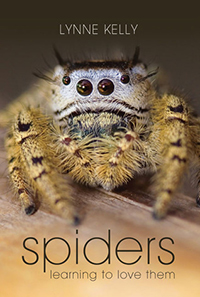
– 📚 Spiders: Learning to Love Them 💵 by Lynne Kelly
– 📚 Spider Woman 💵 by Lynne Kelly
– 📚 The Skeptic’s Guide to the Paranormal 💵 by Lynne Kelly
– 📚 Language, Myths, Mysteries and Magic 💵 by Karen Stollznow
🔗 Related Links
– Brown Recluse Spider Myths — Dr. Rick Vetter, UC Riverside
– Arachnophobia (Wikipedia)
– Uloboridae — the non-venomous spider family
– Spider Silk (Wikipedia)
– Portia jumping spiders — cognitive research overview
– Sleep paralysis and hypnopompic hallucinations
Note: ads inserted into the distributed audio alter the timestamps in unpredictable ways, so timing references in these notes are approximate.
ONE OF THE MOST COMMON FEARS in the world is the fear of spiders. But what does a rationalist do when gripped by an irrational fear? MonsterTalk interviews author Lynne Kelly about her transition from arachnophobia to spider enthusiast. Note: This episode deals with spider sexual reproduction which includes masturbation and cannibalism.
Further Reading
- Spiders: Learning to Love Them
- The Skeptics Guide to the Paranormal
- Spider Goats
- Silk Milk
- Brown Recluse Spider Myths (Dr. Rick Vetter)
- Karen Stollznow’s Language Myths, Mysteries and Magic
Music
- Monstertalk Theme: Monster by Peach Stealing Monkeys
- Intro music: The Itsy Bitsy Spider (public domain)
- Outro excerpt: Spider by They Might Be Giants
MTArchivist
0