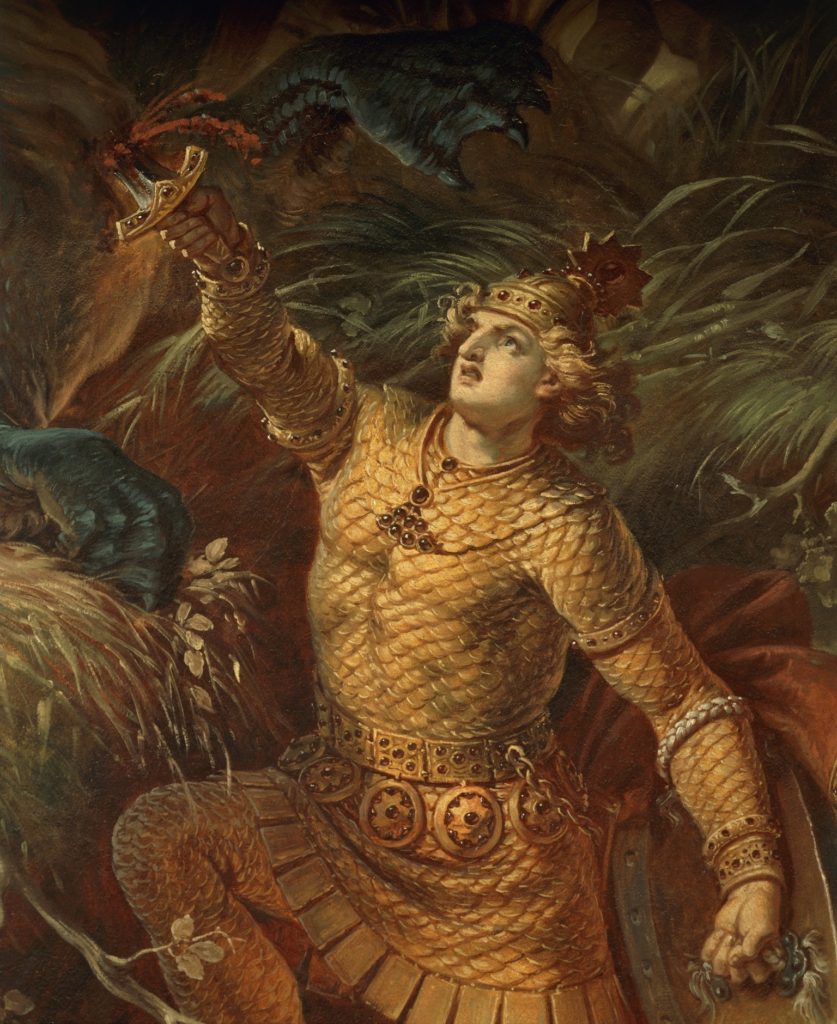
059 – YEC AND BEOWULF: It’s verse than you think
Eve’s analysis of this claim was slated to appear in Skeptical Inquirer. It is, as Blake puts it, verse than you think.
📜 What Is Beowulf, Anyway?
Beowulf is the earliest surviving Germanic epic, composed in Old English and set entirely in Scandinavia. Its date of composition is genuinely contested among scholars — somewhere between the mid-8th century and the early 11th century — and we have exactly one surviving manuscript. The poem follows the hero Beowulf through three monster battles: against Grendel, against Grendel’s mother, and finally against a treasure-hoarding dragon.
Eve notes that the poem blends Christian and pagan Germanic elements in ways that are deeply integrated — not superficial additions. Grendel is associated with the race of Cain, and the poem references the biblical flood, but these aren’t considered late interpolations by mainstream scholarship. Only one character in the poem, Beowulf’s king Hygelac, is corroborated by an outside historical source (Gregory of Tours), and even then only barely. The poem also makes rich use of kennings — compressed poetic metaphors like hronrād (“whale-road”) for the sea — that signal its roots in an oral-poetic tradition.
🦕 The Young Earth Creationist Interpretation
The primary architect of the Beowulf-as-dinosaur-history argument is Bill Cooper, author of 📚 After the Flood: The Early Post-Flood History of Europe Traced Back to Noah 💵. Cooper’s argument runs roughly as follows:
– Dragons in literature = dinosaurs.
– Dinosaurs coexisting with humans = Young Earth.
– Beowulf has a dragon, therefore Beowulf is evidence of a Young Earth.
– (Profit.)
Cooper goes further, claiming Beowulf is a true historical account, that Beowulf himself was born around 495 AD, and that the poem predates the conversion of the English to Christianity — making its references to Cain and the flood independent corroboration of the Bible. Eve dismantles this last point by noting that references to Noah appear very late in the relevant genealogies, most compiled during the reign of Alfred the Great, and that the Norse genealogies largely borrowed from the English ones anyway — hardly independent sources.
Cooper also claims Beowulf predates the written language it’s actually written in, which is a significant problem.
🔬 The Mistranslation Problem
Eve, who actually reads Old English, identifies clear patterns of selective misreading in Cooper’s analysis:
– Grendel and his mother are repeatedly described in the poem as human-shaped — in the shape of a man and in the shape of a woman. Cooper quotes a translation that drops the word other from the line “larger than any other man,” quietly transforming a large humanoid into an unspecified biped that could, conceivably, be a Tyrannosaurus rex.
– Beowulf tears off Grendel’s arm in the poem through a feat of combined, desperate strength — both combatants straining against each other. Cooper reframes this as evidence that Grendel had small, weak arms. Like a T-Rex. QED.
– The dragon is called a “far flyer” — a poetic term chosen for alliteration. Cooper takes this as a specific zoological designation and identifies the creature as a pteranodon rather than a pterodactyl, on the grounds that pteranodons could fly farther.
Cooper gives the impression of Old English fluency — quoting the original, offering his own translations — without actually knowing the language. Eve notes his BA from Kingston University covered an English literature module that would not have included Old English. His source citations are also difficult to follow and he leans on a verse translation of the poem, which takes the kind of poetic license that is entirely appropriate for literary purposes but catastrophic if you’re trying to extract literal zoological data from it.
🌍 The Biogeography Problem (and Other Inconveniences)
Even setting aside the literary analysis, the dinosaur identifications don’t survive basic scrutiny:
– T. rex has not been found in Europe. Kent Hovind‘s version of the argument swaps in megalosaurus, which was found in England — but he doesn’t cite Cooper despite clearly drawing on his work.
– Pteranodons are exclusively North American. A fire-breathing pteranodon in Scandinavia is a long way from home on multiple levels.
– The Beowulf dragon hoards treasure and guards it for 300 years before being disturbed by a stolen cup — classic behavior for Germanic dragons, less so for Cretaceous fauna. As Eve observes, if dragons were real dinosaurs sitting on Viking treasure hoards, we’d expect to find dinosaur bones alongside the Anglo-Saxon grave goods. Strangely, this has not happened.
The book 📚 Claws, Jaws, and Dinosaurs 💵 by Hovind and William J. Gibson also repeats and expands on these claims, adding Bigfoot meeting Leif Erikson and a chapter on dodos — whose connection to Young Earth creationism the hosts find genuinely difficult to reconstruct.
📻 Filtering Down to Children
These ideas haven’t stayed in obscure quasi-academic paperbacks. Eve describes a radio drama series called Jonathan Park, aimed at homeschooled children, that includes an episode called “The Hunt for Beowulf” in which a creationist response team races to recover the stolen Beowulf manuscript — because it contains proof that dinosaurs and humans coexisted. Eve notes, drily, that the poem itself still exists regardless of the manuscript’s whereabouts, so the urgency is a little hard to follow.
Cooper’s argument also appears in various homeschool curriculum materials, reflecting a broader pattern: cryptids, dragons, and ancient texts all get drafted into service as evidence against evolutionary biology. Blake notes similar dynamics in Bigfoot literature (the “race of giants” Biblical connection) and in the case of a chupacabra specimen purchased by a creationist museum. The logic, such as it is: if science can be shown wrong about anything, maybe it’s wrong about evolution too.
📚 Further Reading
– 📚 After the Flood: The Early Post-Flood History of Europe Traced Back to Noah 💵 by Bill Cooper (the primary creationist text discussed)
– 📚 Claws, Jaws, and Dinosaurs 💵 by Kent Hovind and William J. Gibson
– 📖 Beowulf (multiple translations available via Project Gutenberg)
🔗 Related Links
– Beowulf (Wikipedia)
– Young Earth Creationism
– Kenning (Old English poetic device)
– Kent Hovind
– National Center for Science Education (NCSE)
– Skeptical Humanities (Eve Siebert’s website)
Note: ads inserted into the distributed audio alter the timestamps in unpredictable ways, so timing references in these notes are approximate.
THERE ARE THOSE WHO BELIEVE the Earth is only about 6000 years old. They believe that the evidence for this is all in the Bible, but as we’ve discussed on MonsterTalk before, they still seek confirmatory evidence from other works. So it was only a matter of time before someone suggested that the epic poem Beowulf helps prove that (a) the earth is indeed very, very young and (b) that the monsters in the poem Beowulf were dinosaurs. Hard to believe? Tune in as we talk to skeptic and Humanities researcher Eve Siebert about the most surprising interpretation of this classic story you’re likely to hear.
Eve Siebert has a Ph.D. in English literature, specializing in Old and Middle English with secondary concentrations in Old Norse and Shakespeare. She is a frequent contributor to www.skepticalhumanities.com and her article about Beowulf and Creationists will appear in Skeptical Inquirer.
Also, check out Blake Smith’s pro fiction debut: Weird Tales #360, featuring a short story by MonsterTalk host Blake Smith.
Music
- Monstertalk Theme: Monster by Peach Stealing Monkeys