Regular Episode
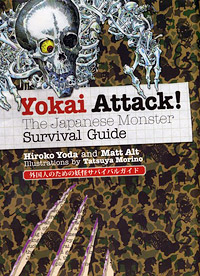
058 – YOKAI ATTACK!
🏮 What Is a Yokai, Exactly?
Matt draws a sharp distinction between kaiju — the city-stomping giants of film and television — and yokai, which emerge from Japanese oral tradition and folklore. Where Godzilla is a product of the modern imagination, yokai are “superstitions with personalities”: pre-scientific explanations for the uncanny things that happen in the natural world, given bodies, faces, and backstories.
A key ingredient is animism — the belief, deeply embedded in Japanese culture, that any object, not just living things, can possess a soul or spirit. This is why so many yokai take anthropomorphic form, and why some are animated everyday objects: old sandals, umbrellas, discarded tools. Hiroko points out that this impulse isn’t uniquely Japanese — Westerners name their cars, sailors call ships “she,” WWII pilots painted faces on their aircraft. Yokai just take that tendency to its logical extreme. The hosts also note that while yokai aren’t a direct part of Shinto tradition, there’s significant conceptual overlap: Shinto’s reverence for deified trees, waterfalls, and places shares the same animistic root.
📜 The History of Yokai Studies
Matt credits the first serious documentation of yokai lore not to a Japanese scholar but to Lafcadio Hearn, a Greek-Irish writer who settled in Japan in the late 19th century, married a Japanese woman, and began collecting ghost and monster stories that Japanese people had never thought to write down — because everyone already knew them. His book 📖 In Ghostly Japan was eventually translated back into Japanese, where it ironically ignited the country’s own folklore studies movement.
That movement found one of its most fascinating figures in Dr. Enryo Inoue, a philosopher who dedicated himself to debunking superstition across Japan — a project Matt compares to the work of James Randi. The irony is that Inoue’s meticulous catalogs of the very beliefs he sought to disprove became some of the strongest surviving records of what ordinary Japanese people once believed. He even transplanted a famously haunted willow tree into a public park in Nakano to demonstrate there was nothing to fear — a gesture that says more about his obvious fascination with the subject than his detachment from it.
The visual vocabulary of yokai owes much to the artist Toriyama Sekien, who in the mid-1770s (around the time of George Washington’s election) produced the world’s first yokai encyclopedia — originally as a parody of the encyclopedic texts fashionable in Japan at the time. His illustrations remain the canonical visual reference for how these creatures are imagined today.
😷 The Kuchisake-Onna: A Modern Yokai in Real Time
One of the episode’s most compelling segments covers the Kuchisake-onna (Slit-Mouth Woman), which Hiroko and Matt call Japan’s most recent yokai. In the 1970s, with no internet to spread the story, a rumor tore through Japanese elementary schools: a woman in a surgical mask was stalking children’s routes to school. When she asked “Am I pretty?” and a child answered yes, she peeled off the mask to reveal a mouth slashed from ear to ear — and asked again. There was no right answer. Schools canceled classes. Principals issued rules about walking home in groups. Police received hysterical calls and actually escorted children home.
The legend has all the hallmarks of classic urban legend structure — friend-of-a-friend sourcing, no firsthand witnesses, and elaborate “survival rules” (say the word pomade three times; she’ll flee, traumatized by its association with dentists). Ben notes the parallel with the folkloric concept of ostension, and Blake draws a comparison to the La Llorona legend of Mexico and the American Southwest — a beautiful woman who turns monstrous when confronted. The Kuchisake-onna is a rare example of being able to watch, almost in real time, how a yokai gets made.
👺 On Oni, Demons, and Bad Translations
A substantial portion of the conversation addresses the problem of translating yokai concepts into English. The word oni is routinely rendered as “demon,” but Matt argues this is misleading: oni don’t map onto the Judeo-Christian devil-and-demons framework that Western missionaries imposed when they first encountered Japanese folklore in the 16th and 17th centuries. Oni are better understood as personifications of overwhelming, inhuman power — forces beyond human comprehension or control. Hiroko cites the Japanese idiom oni ni naru (“make your heart an oni”) meaning to steel yourself to make a hard but necessary decision. Strength, not evil.
Similarly, the film title Princess Mononoke loses something in translation: mononoke is not “ghost” but closer to “yokai” — a spirit of place or nature, a something rather than a someone. Matt suggests Spirited Away actually captures the ambiguity better: its spirits function as minor natural deities, which is far closer to the original concept. My Neighbor Totoro‘s title character is explicitly called a god in the film, but his treatment is, as Matt puts it, “extremely yokai-like.”
🥒 Kappa, Onibaba, and the Yokai Ecology
The conversation ranges across several specific creatures. The Kappa — a river-dwelling yokai familiar even to casual students of Japanese folklore — turns out to have three anuses (the plural being, as the hosts cheerfully establish, ani) and a legendarily toxic flatulence, referenced in the Japanese idiom kappa no he (“a kappa’s fart”) meaning “easy as pie.” The Onibaba (Demon Hag) is introduced not as a simple villain but as a tragic figure: ordered by nobles to harvest organs from unborn fetuses as a cure for a princess’s illness, she eventually discovers that the pregnant woman she killed was her own long-lost daughter. Hiroko’s point is characteristic of the episode’s broader argument — most yokai, however monstrous on the surface, have a sad backstory that demands empathy rather than simple fear.
Blake also asks whether yokai interact with one another, the way gods do in Norse or Greek mythology. The short answer is mostly no — yokai lore is cobbled together from regional and local sources without a unifying mythology. The major exception is the Hyakki Yagyo (Night Parade of a Hundred Demons), a supposedly historical event in which an army of yokai marched along the edge of Kyoto over a thousand years ago — less an invasion than an ominous show of force.
🎮 Yokai and the DNA of Japanese Pop Culture
Matt and Hiroko argue that yokai aren’t just historical curiosities — they are the direct ancestors of modern Japanese character culture. Every Pokémon, every Studio Ghibli spirit, every mascot on a Japanese product carries what Matt calls “yokai DNA.” Japan’s remarkable global dominance in character creation — from Hello Kitty to Godzilla — has deep roots in a centuries-old tradition of giving supernatural forces distinct personalities, faces, and bodies. Blake notes that the book’s format (creature stats, threat levels, survival tips) reads like a field guide or a Dungeons & Dragons monster manual — which turns out to be entirely intentional, and a very effective on-ramp for Western readers.
📚 Further Reading
– 📚 Yokai Attack! The Japanese Monster Survival Guide 💵 by Matt Alt and Hiroko Yoda
– 📚 Yurei Attack! The Japanese Ghost Survival Guide 💵 by Matt Alt and Hiroko Yoda
– 📖 In Ghostly Japan by Lafcadio Hearn
🔗 Related Links
– Yokai (Wikipedia overview)
– Lafcadio Hearn
– Enryo Inoue — the “Japanese James Randi” of yokai debunking
– Toriyama Sekien — artist and author of the first yokai encyclopedia
– Kuchisake-onna (Slit-Mouth Woman)
– Kappa
– Oni
– Hyakki Yagyo — The Night Parade of a Hundred Demons
– Princess Mononoke (Studio Ghibli, 1997)
– Spirited Away (Studio Ghibli, 2001)
– La Llorona — the Mexican weeping-woman legend discussed as a cross-cultural parallel
– Parsec Award — science fiction podcasting award presented annually at Dragon*Con
Note: ads inserted into the distributed audio alter the timestamps in unpredictable ways, so timing references in these notes are approximate.
THIS WEEK ON MONSTERTALK, we interview Matt Alt and Hiroko Yoda, authors of Yokai Attack! The Japanese Monster Survival Guide, a book which details many folkloric monsters of Japan. From the slash-mouthed woman to a giant disgusting foot—these creatures have inspired fear and wonder in Japan and influenced books, movies and video-games.
2012 Parsec Award Winner!
Best “Fact Behind the Fiction” Podcast
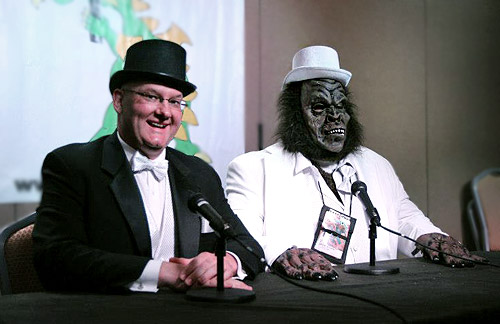
Ben Radford (left) and Blake Smith conduct a live MonsterTalk at Dragon*Con 2012.
(Photo courtesy Susan Gerbic)

The Parsec is an award given to support excellence in podcasting. It has been a regular feature of Dragon*Con since 2006. 2012 marked MonsterTalk’s third nomination and first win in the “Fact Behind the Fiction” category. MonsterTalk is honored to have been nominated and delighted to have won.
Music
- Intro Music: Greetings to Casino versus Japan by irokez
- Monstertalk Theme: Monster by Peach Stealing Monkeys
MTArchivist
0