Regular Episode
042 – Bad Wolf
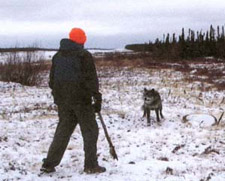
Carnegie’s remains were found that evening, torn apart by an animal. The question of which animal sparked a surprisingly bitter scientific and legal dispute, with one camp insisting it was a bear and another — ultimately prevailing — concluding it was wolves. Geist was one of three scientists retained by the Carnegie family to investigate independently, and his findings go well beyond a single tragedy: they challenge the widely held North American belief that wolves simply do not prey on people.
🐺 The Case for Wolves
The bear hypothesis rested largely on the interpretation of large holes in the snow photographed near the scene — which Paul Paquet, the scientist who championed the bear theory, read as bear-sized prints. Geist dismantles this reading methodically: lake ice buckles and traps lenses of water beneath the snow, so anyone or anything crossing it will periodically punch through, leaving an oversized impression. Elementary North Country tracking, as Geist puts it. Every other examiner — two local RCMP-affiliated trackers with lifelong bush experience, two provincial game wardens, four Alaskan scientists consulted by Mark McNay, two Finnish colleagues, and Geist himself — found only wolf tracks (and one fox track) at the scene. No bear track, which would have been, as Geist dryly notes, utterly unmistakable. The coroner’s inquest ultimately sided with the wolf conclusion.
⚠️ The Seven Steps of Habituation
Geist’s broader research — sparked by wolves colonizing his own acreage on Vancouver Island in 1999 and systematically eliminating roughly 120 local deer within three months — led him to identify a predictable escalation sequence when wolves run short of prey and begin targeting humans. He presented this framework at a meeting of the Wildlife Society, and later discovered that two California scientists had independently described the identical steps for coyotes targeting children in urban parks six years earlier.
The sequence unfolds as follows: wolves first begin observing humans intently — sitting and watching, closing distances gradually. They are observational learners, and this surveillance is itself a warning sign. Then come exploratory (“preliminary”) attacks. Critically, four days before Carnegie’s death, two wolves had already charged two men from the same camp — a pilot and a physicist — who fended them off by swinging small trees and, apparently, thought nothing more of it. Those preliminary attacks, Geist argues, were entirely predictable and should have triggered an evacuation.
🌍 Why North America Had No History — Until It Did
A recurring objection from the “wolves don’t attack humans” camp was the supposed absence of any such history in North America. Geist offers a pointed explanation. From roughly the 1920s through the 1960s, Canadian wolf populations were subjected to what he calls “one of the most murderous [control] machines that has ever existed”: tens of thousands of licensed trappers (5,000 in Alberta alone) who despised wolves for destroying game and raiding trap lines; government bounty systems generous enough that trappers preferred wolf scalps to wolf pelts; predator-control officers working livestock zones; wardens conducting post-season poisoning campaigns; an open season with no restrictions; and, in the early 1950s, aerial strychnine poisoning of horse meat dropped onto lakes across the north in response to a rabies outbreak — terminated only in 1961.
The result was that every researcher who studied North American wolves in that era — including, by his own admission, Geist himself — encountered only wolves at artificially suppressed densities, far from human settlements, extremely shy. That behavior was mistaken for the natural state of the species. It wasn’t. It was an artifact of extreme persecution. Meanwhile, in France, Russia, India, Italy, Germany, Japan, Korea, Turkey, and Finland, the historical record of wolf predation on humans was never in serious doubt — France alone, according to a historian Geist cites, recorded over 3,000 deaths.
🔬 After Carnegie: Further Cases
Blake notes that since the 2005 Carnegie attack, at least two additional probable cases of wolf predation on humans have occurred. In 2010 in Alaska, Candace Berner, a special-education teacher, was killed while jogging near Chignik Lake — a case later confirmed by state wildlife investigators as a wolf attack. Geist’s framing is deliberately unsensational: wolves, like all large predators, perceive humans as prey animals. We are, as Blake puts it, “made of meat” — unprotected by intelligence, undone by soft bodies and lack of natural defenses.
📚 Further Reading
– “When Do Wolves Become Dangerous to Humans?” by Valerius Geist (circulated report; linked from original show notes)
– Kenton Carnegie wolf attack — Wikipedia overview of the case and inquest
🔗 Related Links
– Kenton Carnegie — Wikipedia
– Candace Berner wolf attack (2010) — Wikipedia
– Wolf attacks on humans — Wikipedia
– Ethology — Wikipedia
– Taphonomy — Wikipedia (relevant to misreading of physical evidence at death scenes)
– The Wildlife Society
Note: ads inserted into the distributed audio alter the timestamps in unpredictable ways, so timing references in these notes are approximate.
ON NOVEMBER 8, 2005 Canadian geological engineering student Kenton Carnegie went for a walk. He told people that he’d be back by 5 pm. When he hadn’t returned by 7 pm, a search party went out and discovered his remains in the woods. In this episode of Monstertalk (a follow-up to last week’s), we interview professor Valerius Geist about the true cause of Kenton Carnegie’s death. Some people thought he was killed by a bear, but more likely he was killed by a myth.
Further Reading
- When do wolves become dangerous
to humans? (by Valerius Geist) - The Kenton Carnegie Wolf Attack
on Wikipedia
Music
- Our Breath Shall Intermix by Symbion Project (used with permission)
- Le Fétichisme Dans L’amour by Symbion Project (used with permission)
- Monstertalk Theme: Monster by Peach Stealing Monkeys
MTArchivist
0